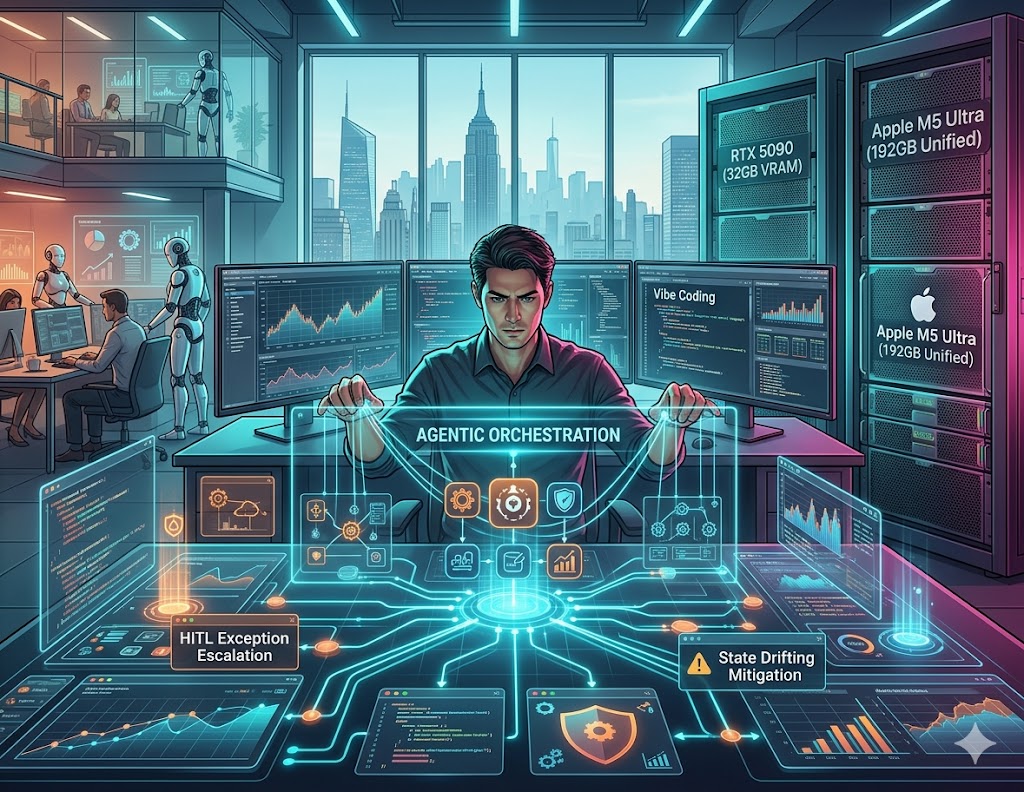
The United States labor market is currently navigating a structural transformation of unprecedented scale and velocity, propelled by the rapid commercialization and deployment of advanced artificial intelligence technologies. By the year 2027, the conceptual boundary separating digital technology tools from human co-workers will dissolve entirely, creating a hybrid organizational architecture comprising both human employees and silicon-based autonomous agents.
According to comprehensive global workforce projections, 60% of all workers will require substantial reskilling by 2027 to remain viable. Furthermore, while 92 million jobs may be displaced globally by 2030, an estimated 170 million new roles will be created, resulting in a net positive labor expansion. If you are still relying on basic prompt engineering, your skill set is evaporating. This guide breaks down the three definitive AI skills required for the new economy: Agent Orchestration, Governance, and Vibe Coding—and covers the exact local VRAM hardware required to power these workflows.
- The Prompt Engineer is Dead: Modern LLMs infer intent autonomously. The focus is now on orchestration.
- Skill 1: AI Agent Orchestration: Building multi-agent workflows (using LangGraph/CrewAI) to solve complex pipelines autonomously.
- Skill 2: Governance & HITL: Engineering "Human-in-the-Loop" exceptions so AI doesn't execute catastrophic actions unchecked.
- Skill 3: Vibe Coding: Non-developers utilizing natural language to build production-grade software architecture.
- Hardware Requirement: VRAM is king. RTX 5090 (32GB) for fast compute, or Apple M5 Ultra (192GB) for massive multi-agent memory.
The Macroeconomic Context: The Shift to the Agentic Enterprise
To accurately forecast the skill requirements of 2027, you must understand the technological architecture redefining the enterprise. The initial wave of AI—the Retrieval-Augmented Generation (RAG) era—was primarily assistive. You provided a prompt, and the AI generated an answer in a reactive loop. You were the orchestrator; the AI was a passive tool.
Moving firmly into 2026, the paradigm shifted aggressively toward Agentic Artificial Intelligence. Agentic AI refers to systems engineered to act as digital agents capable of understanding high-level objectives, decomposing goals into sub-tasks, selecting APIs, and acting without manual human triggers.
Despite the profound enthusiasm, Gartner predicts that over 40% of agentic AI projects will fail by the end of 2027. This high failure rate is not attributed to a lack of underlying model intelligence, but rather to legacy system incompatibilities, poorly architected workflows, and a severe market deficit of skilled human orchestrators. Organizations frequently attempt to automate broken, legacy processes instead of reimagining their workflows for an agent-native environment, resulting in "workslop"—poorly architected agent applications that actually increase operational friction.
| Macroeconomic Labor Metric | 2024/2025 Baseline | 2027/2030 Projection | Strategic Workforce Implication |
|---|---|---|---|
| Global Reskilling Requirement | ~40% | 60% by 2027 | Continuous, self-directed learning is an absolute occupational baseline. |
| Enterprise Agentic Adoption | 15% (Pilots) | 50% by 2027 | Transition from experimental generative AI to core operational infrastructure. |
| Core Skill Disruption Rate | 35% | 44% by 2027 | Legacy software competencies and rigid operational skills face rapid obsolescence. |
| AI Job Postings | ~1 Million | ~7 Million+ | Demonstrated fluency with autonomous systems is the primary hiring differentiator. |
Essential Skill 1: AI Agent Orchestration and Workflow Design
An Artificial Intelligence Orchestrator is a professional responsible for transforming scattered AI capabilities into structured, reliable workflows. They do not simply "chat" with AI; they build intricate pipelines using advanced orchestration frameworks to connect large language models (LLMs) to enterprise databases and autonomous decision engines.
The Mechanics of Multi-Agent Orchestration
Orchestration requires a profound understanding of the Observe-Plan-Act cycle. By 2027, industry analysts project that one-third of all agentic implementations will involve multi-agent systems.
In a multi-agent ecosystem, highly specialized agents collaborate. For example, a "research agent" gathers data, passes it to an "analysis agent," which hands insights to a "QA agent" before execution. The orchestrator's value lies in designing communication protocols, state management, and memory limits between these autonomous entities.
| Orchestration Framework | Primary Enterprise Architecture Focus | 2027 Market Positioning |
|---|---|---|
| LangGraph | Deep customization and cyclic graphs. | Best for technical teams requiring full control over complex agent topologies. |
| CrewAI | Speed, modularity, role-based deployment. | Popular for rapid prototyping and deploying specialized teams of agents. |
| Salesforce Agentforce | Customer-facing ops, CRM embedding. | Ideal for businesses already entrenched in the Salesforce infrastructure. |
| SimplAI | Strict deployment and air-gapped setups. | Built explicitly for regulated environments like banking and healthcare. |
As of 2026, AI workflow orchestration specialists and hyperautomation architects command base salaries ranging from $115,000 to well over $200,000 annually, driven by the massive ROI they deliver to automation pipelines. Data indicates that organizations employing dedicated orchestration specialists achieve full agent productivity 65% faster than their competitors, while also recording three times higher employee satisfaction.
Essential Skill 2: Critical Thinking, Governance, and Risk Fluency
As enterprises grant AI agents the agency to execute real-world actions—such as negotiating supplier contracts or authorizing refunds—institutional liability scales exponentially. Blind trust in an automated system is unacceptable.
Human-in-the-Loop (HITL) Architecture
The modern governance skill set involves engineering sophisticated Human-in-the-Loop frameworks where human intelligence provides strategic value without creating manual bottlenecks. Governance professionals deploy four core patterns:
- Exception Escalation: Agents process routine volume autonomously. Humans are only alerted when triggers occur (e.g., confidence scores drop below a mathematical threshold or a high-value transaction occurs).
- Guidance Over Approval: When an agent reaches a strategic impasse, it pauses, presents multiple calculated tradeoffs, and requests directional intent from a human, keeping the human in a leadership role.
- Continuous Learning: Human overrides are logged as structured feedback artifacts, transforming a one-off manual correction into a permanent, systemic training mechanism.
- Accountability Transfer: The agent prepares the complex decision with a full cryptographic audit trail. The human authorizes it, absorbing the legal and ethical liability that machines are prohibited from holding.
The labor market disproportionately rewards this regulatory fluency. Baseline AI governance roles average $141,000 annually, with senior executives earning up to $220,000. Professionals possessing "dual-expertise"—such as traditional data privacy combined with AI governance—earn a 56% wage premium over peers who lack AI capabilities.
Essential Skill 3: Domain-Integrated "Vibe Coding"
In previous decades, bridging a business problem with a tech solution required dedicated software engineers. By 2026, the proliferation of context-aware coding agents—like Claude Code, Cursor, and Qwen 2.5 Coder—introduced "vibe coding."
Vibe coding is the iterative, AI-assisted approach where users leverage natural language interfaces to generate, modify, design, and debug entire software architectures without manually writing the underlying syntax. By early 2026, industry data revealed that 41% of all global software code was generated by artificial intelligence, representing over 256 billion lines of code. Astoundingly, 63% of professionals utilizing vibe coding are strictly non-developers.
The Rise of the T-Shaped Professional
In 2027, the most valuable workers are "T-shaped" domain experts. They possess deep knowledge in a specific field and possess the interface design skills to guide agents in building custom software solutions for that exact domain. While productivity gains are profound—development teams report creating UI components 51% faster and boilerplate configuration 81% faster—they are highly unequal. Senior developers and experienced domain experts see an 81% productivity gain, while junior employees often show negligible output improvement because they lack the architectural knowledge to validate the AI's output.
Because agents eliminate the friction of syntax, the cognitive burden shifts entirely to product vision, logical planning, and debugging failures. Individuals who simply "prompt and pray" will see their generated applications collapse under logical inconsistencies.
In the manufacturing sector, domain experts are utilizing these skills to deploy specialized agents that monitor supply chain data to dynamically reconfigure assembly lines. In marketing, directors orchestrate agents to simulate promotion performance across synthetic consumer cohorts. The common thread is the human ability to interface strategic intent with autonomous machine execution.
Implementation: Start Your First Orchestrated Agent
To move from theory to execution, you must understand the basic syntax of orchestration. Here is how a modern professional might initialize a dual-agent workflow using CrewAI, proving the shift from chat-prompts to programmed roles.
# Basic CrewAI Multi-Agent Workflow Example (Python)
from crewai import Agent, Task, Crew

# 1. Define the Specialized Agents
researcher = Agent(
  role='Senior Financial Analyst',
  goal='Identify macro-economic trends in the 2026 local AI hardware market',
  backstory='You are an elite analyst known for uncovering hidden supply chain bottlenecks.',
  verbose=True,
  allow_delegation=False
)

writer = Agent(
  role='Technical Risk Architect',
  goal='Compile the research into a governed, enterprise-safe risk report',
  backstory='You ensure all AI-generated claims pass strict enterprise compliance.',
  verbose=True,
  allow_delegation=True
)

# 2. Define the Tasks
task1 = Task(description='Analyze Q3 RTX 5090 inventory data', agent=researcher)
task2 = Task(description='Draft the final risk assessment for the CTO', agent=writer)

# 3. Orchestrate the Crew
hardware_crew = Crew(
  agents=[researcher, writer],
  tasks=[task1, task2],
  verbose=2
)

result = hardware_crew.kickoff()
The Foundational Substrate: Hardware Literacy & VRAM
None of these skills can be securely executed without foundational infrastructure literacy. Because cloud APIs carry data privacy risks and severe latency delays, enterprises are migrating to running AI models locally.
When evaluating hardware for local agent orchestration, CPU clock speed is secondary. The absolute governing metric for AI inference performance is Video Random Access Memory (VRAM). Multi-agent systems require massive VRAM to keep several models loaded in memory simultaneously; otherwise, severe "cold start" bottlenecks and CPU-offloading will crash token generation speeds.
For continuous, agentic workflows, memory requirements scale aggressively. A highly capable 70-billion parameter model requires approximately 40GB to 48GB of VRAM even with advanced quantization. Running a comprehensive multi-agent swarm can easily demand 80GB of VRAM or more.
2026/2027 Hardware Ecosystem: NVIDIA vs Apple

NVIDIA RTX 5090
The Compute Powerhouse
- Memory: 32GB GDDR7 VRAM
- Bandwidth: 1.79 Terabytes/sec
- Architecture: Blackwell (Native FP4 Quantization)
- Best For: High-speed coding agents, rapid token generation, custom LoRA fine-tuning.
~$1,999

Apple M5 Ultra
The Unified Memory Behemoth
- Memory: Up to 192GB Unified RAM
- Bandwidth: 800 Gigabytes/sec
- Architecture: UltraFusion interconnect
- Best For: Running massive 70B+ multi-agent swarms concurrently without out-of-memory errors.
~$3,999+
Troubleshooting Common Agentic Failure Modes
Orchestrators are highly compensated specifically to diagnose and resolve systemic failures. When deploying multi-agent swarms, be prepared to mitigate these specific architecture errors:
What happens: An agent forgets its primary objective halfway through a complex workflow due to context window limitations.
Fix: Implement explicit memory management constraints. Use summary agents to compress conversational history before passing state forward to the next step.
What happens: Circular delegation causes two agents to pass tasks back and forth endlessly without resolving the terminal state.
Fix: Hardcode `allow_delegation=False` for terminal task execution agents, and enforce strict "max_iter" timeouts within your framework graph.
What happens: Loading excessive schemas and irrelevant tool descriptions degrades the AI's reasoning capabilities over time.
Fix: Dynamically load only the tools required for the immediate step. Do not inject the entire enterprise database schema into the system prompt.
Decision Tree: Which Skill Path Should You Pick?
Are you wondering where to pivot your career first? Follow this logic:
- 👉 Are you currently a Software Engineer? Pivot directly to Agent Orchestration. Use your syntax knowledge to build scalable Python/Go infrastructure (LangGraph) that manages LLMs.
- 👉 Are you in Compliance, Legal, or Management? Pivot to AI Governance & Risk Fluency. Focus on designing HITL systems and mitigating hallucination liability.
- 👉 Are you a subject-matter expert (Finance, Marketing, Logistics)? Pivot to Vibe Coding. Use Claude Code and Cursor to turn your domain knowledge into internal enterprise tools.
Frequently Asked Questions
- The Era of the "Orchestrator" has Begun: The economic value of writing static prompts is depreciating. Future value is generated by professionals who can architect multi-step autonomous workflows.
- Trust and Accountability are the Ultimate Currencies: Professionals who master AI governance, risk scoring, and Human-in-the-Loop protocols will become the most critical assets within the modern enterprise.
- Domain Expertise is Amplified by Interface Design: The technical barrier to building software has been lowered. The future belongs to "T-shaped" professionals who build custom agentic solutions using natural language.
- Infrastructure Fluency Drives Profitability: Understanding VRAM constraints, quantization, and local hardware architectures separates successful deployments from costly, latency-ridden failures.
To survive the volatile labor market of 2027, human capital must pivot away from attempting to compete with the machine on execution speed. Focus on mastering system design, ethical judgment, and complex orchestration. Those who adapt to guide the silicon-based workforce will not be replaced by technology; they will be elevated by it.
Sources: Data aggregated from McKinsey Workforce Research (2025), Salesforce Agentic Reports (2026), Deloitte Silicon Workforce Insights, and World Economic Forum 2027 projections. Hardware specifications sourced from NVIDIA and Apple product releases (May 2026).