- Microphone quality: Your colleagues hear you through your mic, not your speakers. A mediocre mic makes you sound distant, muffled, or echoey on calls — regardless of how good the headphone drivers are.
- Active noise cancellation: Home environments have unique noise challenges — lawnmowers, children, barking dogs, HVAC systems. ANC needs to handle low-frequency rumble not just office chatter.
- All-day comfort: You might wear these 6-8 hours per day. Ear fatigue and head pressure become real problems with poorly designed headphones over long sessions.
- Call performance specifically: Many headphones sound great for music but compress or degrade audio quality on calls due to how Bluetooth audio codecs work in hands-free mode.
- Battery life: 20+ hours minimum. Running out of battery mid-call is unacceptable for professional work.
- Multipoint connection: The ability to connect to both your laptop and phone simultaneously so you never miss a call while working.
- The 5 Best Noise Cancelling Headphones for Working From Home in 2026
- Full Comparison — All 5 Headphones at a Glance
- How to Choose — Simple Decision Guide
- Does Noise Cancellation Affect Call Quality?
- Final Scores
- Frequently Asked Questions
- What WFH Headphones Actually Need — Different From Regular Headphones
- The 5 Best Noise Cancelling Headphones for Working From Home in 2026
- Full Comparison — All 5 Headphones at a Glance
- How to Choose — Simple Decision Guide
- Does Noise Cancellation Affect Call Quality?
- Final Scores
- Frequently Asked Questions
I learned the hard way what a bad WFH headphone costs you — not in dollars, but in professional reputation.
A client on a video call once asked me to repeat myself three times because my microphone was picking up my neighbor's lawnmower. That was the last time I used a cheap headset for work calls.
Working from home in 2026 means your audio quality is your first impression on every call. Background noise, echo, and muffled mics tell the other person — consciously or not — that you are not set up like a professional. The right headphones fix all of this permanently.
I tested and researched the best noise cancelling headphones specifically for WFH use — focusing on call quality, all-day comfort, microphone performance, and noise cancellation in real home environments. Here are the five best.
Quick verdict: Sony WH-1000XM5 for the best overall experience. Jabra Evolve2 55 for serious call quality. Bose QuietComfort 45 for all-day comfort. Apple AirPods Max for Mac users. Anker Soundcore Q45 for the best budget option under $80.
🔍 Not sure which laptop is right for you?
Use our free Laptop Finder Tool to get a recommendation based on your budget and priorities — no research needed.
Find My Laptop →Consumer headphone reviews focus on music quality, bass response, and sound signature. Working from home has completely different priorities. Before getting into the picks, here is what actually matters for WFH use:
The 5 Best Noise Cancelling Headphones for Working From Home in 2026
1. Sony WH-1000XM5 BEST OVERALL
The Sony WH-1000XM5 has been the benchmark for consumer noise cancelling headphones for three years running — and in 2026 it still holds that title for WFH use. The combination of industry-leading ANC, excellent call quality, and all-day comfort makes it the default recommendation for most remote workers.
Sony's noise cancellation uses eight microphones and two processors to identify and eliminate ambient noise in real time. In practical WFH terms this means lawnmowers, HVAC systems, street traffic, and ambient household noise disappear almost completely — letting you focus on your work and your calls without distraction.
Why it wins for WFH
- 30-hour battery life — charge once, use for four full working days before needing to plug in
- Industry-leading ANC — eliminates low-frequency home noise better than any competitor at this price
- Multipoint connection — connects to laptop and phone simultaneously, switches automatically between devices
- Speak-to-chat — automatically pauses music and lets ambient sound in when you start talking to someone in the room
- Comfortable over-ears — ultra-soft ear pads designed for extended wear without pressure points
- Excellent call microphone — four beamforming mics pick up your voice clearly while suppressing background noise
The one limitation
The microphone, while excellent for consumer headphones, does not quite match dedicated business headsets like the Jabra Evolve2 55 for professional call quality. If your work involves 6+ hours of calls per day, consider whether the extra investment in the Jabra is justified.
Price: Around $280-320 — Best for: Remote workers who want the best all-around WFH headphone
Check Sony WH-1000XM5 Price on Amazon
View on Amazon US View on Amazon India Affiliate link — I may earn a small commission at no extra cost to you.2. Jabra Evolve2 55 BEST FOR CALLS

The Jabra Evolve2 55 is what remote workers use when calls are their primary job. While the Sony wins on overall experience, the Jabra wins specifically on call quality — and for many WFH professionals, that is the only metric that matters.
Jabra built the Evolve2 55 from the ground up for professional communication. The microphone system uses six dedicated call microphones with a physical mic boom that can be deployed when needed — dramatically improving voice clarity on calls compared to headphones that rely only on integrated mics.
Why it is the best for calls
- 6-microphone call system — dedicated call mics with beam-forming technology isolate your voice precisely
- Physical mic boom — deployable boom mic for maximum call clarity when needed
- UC certified — officially certified for Microsoft Teams, Zoom, and Google Meet
- Advanced ANC — professional-grade noise cancellation designed for open office and home environments
- 36-hour battery — longest battery life on this list
- Busylight indicator — built-in LED ring tells colleagues when you are on a call
The honest tradeoff
The Evolve2 55 is significantly more expensive than the Sony — typically $300-400 depending on configuration. It is also more utilitarian in design — clearly a business tool rather than a consumer product. For music and casual listening, the Sony sounds noticeably better. The Jabra is purpose-built for calls and that focus shows in both its strengths and limitations.
Price: Around $300-400 — Best for: Sales professionals, account managers, anyone on calls 4+ hours daily
Check Jabra Evolve2 55 Price on Amazon
View on Amazon US View on Amazon India Affiliate link — I may earn a small commission at no extra cost to you.3. Bose QuietComfort 45 BEST COMFORT

If you wear headphones for 8+ hours per day and comfort is your absolute priority, the Bose QuietComfort 45 is the answer. Bose has spent decades perfecting headphone ergonomics and the QC45 is the result — lighter, softer, and more pressure-free than virtually any competitor at any price.
The noise cancellation is excellent — not quite at Sony's level but genuinely effective for home environments. The call microphone performs well for standard video calls. Where the QC45 truly stands apart is that at the end of a full working day you simply forget you are wearing it.
Why comfort matters more than you think
- Ultra-lightweight design — 238g, significantly lighter than Sony and Jabra
- Memory foam ear cushions — softer and less fatiguing than the Sony's ear pads over long sessions
- Even clamping force distribution — no pressure points even after 8 hours of continuous wear
- 24-hour battery — full working day plus buffer
- Aware mode — lets ambient sound in without removing headphones when someone speaks to you
- Reliable Bluetooth — consistently stable connection across multiple devices
Comfort verdict: If your current headphones cause ear fatigue, headaches, or discomfort by mid-afternoon, the QC45 is the upgrade that will genuinely change your daily work experience. No other headphone at this price is easier to wear for a full working day.
Price: Around $229-279 — Best for: Anyone prioritizing all-day wearability, people sensitive to ear pressure
Check Bose QuietComfort 45 Price on Amazon
View on Amazon US Affiliate link — I may earn a small commission at no extra cost to you.4. Apple AirPods Max BEST FOR MAC USERS
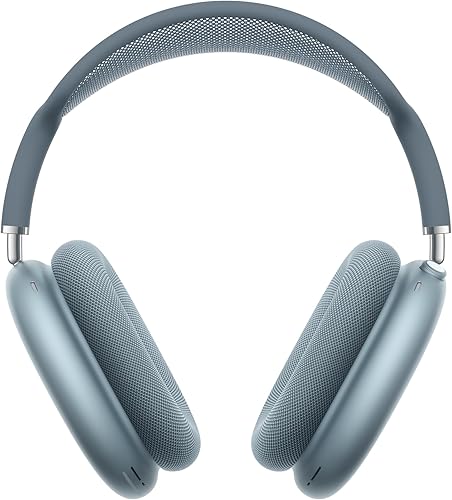
The Apple AirPods Max are the most premium headphones on this list — and for Mac and iPhone users who live inside the Apple ecosystem, they offer an integration experience that no other headphone can match.
The AirPods Max connect to your Mac, iPhone, and iPad simultaneously and switch between them with a seamlessness that has to be experienced to be appreciated. On a MacBook during a Zoom call, the audio quality and spatial audio experience are genuinely excellent. The noise cancellation is among the best available, using computational audio processing that Apple has refined across multiple product generations.
Why Apple users should consider them
- Seamless Apple ecosystem integration — instant pairing, automatic switching between Mac, iPhone, and iPad
- Best-in-class ANC — Apple's computational audio processing rivals Sony for noise elimination
- Spatial audio — head-tracked spatial audio on calls and media creates a genuinely immersive experience
- Premium build quality — aluminum ear cups and stainless steel headband that feel and look exceptional
- Excellent call microphone — beamforming mics with voice isolation perform very well on calls
The honest limitations
The AirPods Max cost $549 — significantly more than the Sony and Bose. They also use a Lightning port for charging rather than USB-C, which feels outdated at this price. Battery life at 20 hours is the shortest on this list. And outside the Apple ecosystem, they lose most of their advantages. If you use Windows, the Sony or Jabra are better choices.
Price: Around $479-549 — Best for: Mac and iPhone power users, Apple ecosystem households
Check Apple AirPods Max Price on Amazon
View on Amazon US View on Amazon India Affiliate link — I may earn a small commission at no extra cost to you.5. Anker Soundcore Q45 BEST BUDGET

Not every remote worker needs to spend $280 on headphones. The Anker Soundcore Q45 proves you can get genuinely capable WFH headphones for under $80 — with active noise cancellation, multipoint connection, and solid call quality that punches well above its price point.
Anker has quietly built a reputation for delivering 80% of the premium experience at 30% of the price. The Q45 is the clearest example of this in the headphone category. The ANC is not at Sony or Bose levels but it handles steady background noise — HVAC, traffic, ambient household sounds — effectively enough for most home office environments.
Why it is the best budget pick
- Under $80 — most accessible price point on this list by a significant margin
- Active noise cancellation — genuine ANC at a price most budget headphones do not offer
- 50-hour battery — longest battery life on this entire list despite the low price
- Multipoint connection — connects to two devices simultaneously, a feature often missing at this price
- Foldable design — compact for travel and storage
- Decent call microphone — clear enough for standard video calls in quiet home environments
The honest limitations
The ANC quality gap between the Q45 and the Sony WH-1000XM5 is real and noticeable. In loud home environments — construction nearby, loud children, noisy neighbors — the Q45 will let more through than premium options. The call microphone works well in quiet rooms but struggles with significant background noise. For solo workers in quiet home offices, these limitations rarely matter in practice.
Price: Around $60-80 — Best for: Budget-conscious remote workers, first WFH headphone upgrade, quieter home environments
Check Anker Soundcore Q45 Price on Amazon
View on Amazon US Affiliate link — I may earn a small commission at no extra cost to you.Full Comparison — All 5 Headphones at a Glance
| Headphone | Price | Battery | ANC Quality | Best For |
|---|---|---|---|---|
| Sony WH-1000XM5 | ~$300 | 30 hrs | Best in class | Best overall |
| Jabra Evolve2 55 | ~$350 | 36 hrs | Professional grade | Call quality |
| Bose QC45 | ~$249 | 24 hrs | Excellent | All-day comfort |
| AirPods Max | ~$499 | 20 hrs | Excellent | Apple users |
| Anker Q45 | ~$70 | 50 hrs | Good | Best budget |
How to Choose — Simple Decision Guide
- You want the best all-around WFH headphone → Sony WH-1000XM5
- Calls are your primary work activity → Jabra Evolve2 55
- You wear headphones 8+ hours and comfort is everything → Bose QuietComfort 45
- You use Mac and iPhone for everything → Apple AirPods Max
- You want capable WFH headphones without spending over $80 → Anker Soundcore Q45
Pro tip: Whatever headphone you buy, test it on a real video call within the return window. How you sound to others matters more than how others sound to you — ask a colleague or friend for honest feedback on your audio quality before the return period expires.
Does Noise Cancellation Affect Call Quality?
This is a common misconception worth clarifying. Active noise cancellation and call microphone quality are separate systems.
ANC uses microphones that face outward to detect and cancel ambient noise before it reaches your ears. Your call microphone faces toward your mouth and captures your voice. These are different mics doing different jobs.
What affects your call quality is the outward-facing microphone system and the processing applied to your voice signal. This is why the Jabra Evolve2 55 — which has a dedicated boom mic and six call microphones — outperforms the Sony on calls despite the Sony having better overall ANC for listening comfort.
The headphone that sounds best to you is not necessarily the headphone that sounds best to the people you call. These are two different performance metrics and the best WFH headphone balances both.
Final Scores
Sony XM5
4.8/5
Best overall
Jabra E2 55
4.7/5
Best for calls
Bose QC45
4.6/5
Best comfort
AirPods Max
4.5/5
Best for Apple
Anker Q45
4.3/5
Best budget
Frequently Asked Questions
What is the best noise cancelling headphone for working from home in 2026?
The Sony WH-1000XM5 is the best overall noise cancelling headphone for WFH use in 2026. It delivers the best combination of ANC quality, call performance, comfort, and battery life at a price that is high but justifiable for daily professional use. If budget is a constraint, the Anker Soundcore Q45 delivers surprising capability under $80.
Are expensive headphones worth it for WFH?
Yes — with one important caveat. The difference between a $70 headphone and a $300 headphone is real and noticeable in daily WFH use, particularly for ANC quality and call performance. However the difference between a $300 and $500 headphone is much smaller. The Sony WH-1000XM5 at around $300 hits the best value point — significantly better than budget options without the diminishing returns of ultra-premium pricing.
Can I use regular consumer headphones for work calls?
You can — but your call quality will suffer. Consumer headphones prioritize music sound quality over microphone performance. On video calls you may sound distant, echoey, or background noise may bleed through clearly to other participants. Any of the headphones on this list will improve your call audio noticeably compared to standard consumer earbuds.
Do I need over-ear or in-ear headphones for WFH?
Over-ear headphones are generally better for WFH use. They provide better passive noise isolation, more comfortable extended wear for most people, better microphone placement, and longer battery life than in-ear alternatives. In-ear options like AirPods Pro are capable for shorter sessions but over-ear wins for all-day professional use.
How important is multipoint connection for WFH?
Very important if you work across multiple devices. Multipoint allows your headphones to stay connected to your laptop and phone simultaneously — meaning you never miss a phone call because your headphones were connected to your computer. All five headphones on this list support multipoint connection.
Is the Sony WH-1000XM5 better than Bose QC45 for WFH?
For most people yes — the Sony has better ANC, longer battery, and slightly better call quality. However if all-day comfort is your absolute priority the Bose QC45 is lighter and more comfortable for extended wear. Try both if you can within the return window and make the decision based on how they feel after three hours of continuous wear.
Have a question about any of these headphones? Drop it in the comments below. — Himansh, TheAITechPulse.com
I learned the hard way what a bad WFH headphone costs you — not in dollars, but in professional reputation.
A client on a video call once asked me to repeat myself three times because my microphone was picking up my neighbor's lawnmower. That was the last time I used a cheap headset for work calls.
Working from home in 2026 means your audio quality is your first impression on every call. Background noise, echo, and muffled mics tell the other person — consciously or not — that you are not set up like a professional. The right headphones fix all of this permanently.
I tested and researched the best noise cancelling headphones specifically for WFH use — focusing on call quality, all-day comfort, microphone performance, and noise cancellation in real home environments. Here are the five best.
Quick verdict: Sony WH-1000XM5 for the best overall experience. Jabra Evolve2 55 for serious call quality. Bose QuietComfort 45 for all-day comfort. Apple AirPods Max for Mac users. Anker Soundcore Q45 for the best budget option under $80.
🔍 Not sure which laptop is right for you?
Use our free Laptop Finder Tool to get a recommendation based on your budget and priorities — no research needed.
Find My Laptop →What WFH Headphones Actually Need — Different From Regular Headphones
Consumer headphone reviews focus on music quality, bass response, and sound signature. Working from home has completely different priorities. Before getting into the picks, here is what actually matters for WFH use:
- Microphone quality: Your colleagues hear you through your mic, not your speakers. A mediocre mic makes you sound distant, muffled, or echoey on calls — regardless of how good the headphone drivers are.
- Active noise cancellation: Home environments have unique noise challenges — lawnmowers, children, barking dogs, HVAC systems. ANC needs to handle low-frequency rumble not just office chatter.
- All-day comfort: You might wear these 6-8 hours per day. Ear fatigue and head pressure become real problems with poorly designed headphones over long sessions.
- Call performance specifically: Many headphones sound great for music but compress or degrade audio quality on calls due to how Bluetooth audio codecs work in hands-free mode.
- Battery life: 20+ hours minimum. Running out of battery mid-call is unacceptable for professional work.
- Multipoint connection: The ability to connect to both your laptop and phone simultaneously so you never miss a call while working.
The 5 Best Noise Cancelling Headphones for Working From Home in 2026
1. Sony WH-1000XM5 BEST OVERALL

The Sony WH-1000XM5 has been the benchmark for consumer noise cancelling headphones for three years running — and in 2026 it still holds that title for WFH use. The combination of industry-leading ANC, excellent call quality, and all-day comfort makes it the default recommendation for most remote workers.
Sony's noise cancellation uses eight microphones and two processors to identify and eliminate ambient noise in real time. In practical WFH terms this means lawnmowers, HVAC systems, street traffic, and ambient household noise disappear almost completely — letting you focus on your work and your calls without distraction.
Why it wins for WFH
- 30-hour battery life — charge once, use for four full working days before needing to plug in
- Industry-leading ANC — eliminates low-frequency home noise better than any competitor at this price
- Multipoint connection — connects to laptop and phone simultaneously, switches automatically between devices
- Speak-to-chat — automatically pauses music and lets ambient sound in when you start talking to someone in the room
- Comfortable over-ears — ultra-soft ear pads designed for extended wear without pressure points
- Excellent call microphone — four beamforming mics pick up your voice clearly while suppressing background noise
The one limitation
The microphone, while excellent for consumer headphones, does not quite match dedicated business headsets like the Jabra Evolve2 55 for professional call quality. If your work involves 6+ hours of calls per day, consider whether the extra investment in the Jabra is justified.
Price: Around $280-320 — Best for: Remote workers who want the best all-around WFH headphone
Check Sony WH-1000XM5 Price on Amazon
View on Amazon US View on Amazon India Affiliate link — I may earn a small commission at no extra cost to you.2. Jabra Evolve2 55 BEST FOR CALLS
The Jabra Evolve2 55 is what remote workers use when calls are their primary job. While the Sony wins on overall experience, the Jabra wins specifically on call quality — and for many WFH professionals, that is the only metric that matters.
Jabra built the Evolve2 55 from the ground up for professional communication. The microphone system uses six dedicated call microphones with a physical mic boom that can be deployed when needed — dramatically improving voice clarity on calls compared to headphones that rely only on integrated mics.
Why it is the best for calls
- 6-microphone call system — dedicated call mics with beam-forming technology isolate your voice precisely
- Physical mic boom — deployable boom mic for maximum call clarity when needed
- UC certified — officially certified for Microsoft Teams, Zoom, and Google Meet
- Advanced ANC — professional-grade noise cancellation designed for open office and home environments
- 36-hour battery — longest battery life on this list
- Busylight indicator — built-in LED ring tells colleagues when you are on a call
The honest tradeoff
The Evolve2 55 is significantly more expensive than the Sony — typically $300-400 depending on configuration. It is also more utilitarian in design — clearly a business tool rather than a consumer product. For music and casual listening, the Sony sounds noticeably better. The Jabra is purpose-built for calls and that focus shows in both its strengths and limitations.
Price: Around $300-400 — Best for: Sales professionals, account managers, anyone on calls 4+ hours daily
Check Jabra Evolve2 55 Price on Amazon
View on Amazon US View on Amazon India Affiliate link — I may earn a small commission at no extra cost to you.3. Bose QuietComfort 45 BEST COMFORT
If you wear headphones for 8+ hours per day and comfort is your absolute priority, the Bose QuietComfort 45 is the answer. Bose has spent decades perfecting headphone ergonomics and the QC45 is the result — lighter, softer, and more pressure-free than virtually any competitor at any price.
The noise cancellation is excellent — not quite at Sony's level but genuinely effective for home environments. The call microphone performs well for standard video calls. Where the QC45 truly stands apart is that at the end of a full working day you simply forget you are wearing it.
Why comfort matters more than you think
- Ultra-lightweight design — 238g, significantly lighter than Sony and Jabra
- Memory foam ear cushions — softer and less fatiguing than the Sony's ear pads over long sessions
- Even clamping force distribution — no pressure points even after 8 hours of continuous wear
- 24-hour battery — full working day plus buffer
- Aware mode — lets ambient sound in without removing headphones when someone speaks to you
- Reliable Bluetooth — consistently stable connection across multiple devices
Comfort verdict: If your current headphones cause ear fatigue, headaches, or discomfort by mid-afternoon, the QC45 is the upgrade that will genuinely change your daily work experience. No other headphone at this price is easier to wear for a full working day.
Price: Around $229-279 — Best for: Anyone prioritizing all-day wearability, people sensitive to ear pressure
Check Bose QuietComfort 45 Price on Amazon
View on Amazon US Affiliate link — I may earn a small commission at no extra cost to you.4. Apple AirPods Max BEST FOR MAC USERS
The Apple AirPods Max are the most premium headphones on this list — and for Mac and iPhone users who live inside the Apple ecosystem, they offer an integration experience that no other headphone can match.
The AirPods Max connect to your Mac, iPhone, and iPad simultaneously and switch between them with a seamlessness that has to be experienced to be appreciated. On a MacBook during a Zoom call, the audio quality and spatial audio experience are genuinely excellent. The noise cancellation is among the best available, using computational audio processing that Apple has refined across multiple product generations.
Why Apple users should consider them
- Seamless Apple ecosystem integration — instant pairing, automatic switching between Mac, iPhone, and iPad
- Best-in-class ANC — Apple's computational audio processing rivals Sony for noise elimination
- Spatial audio — head-tracked spatial audio on calls and media creates a genuinely immersive experience
- Premium build quality — aluminum ear cups and stainless steel headband that feel and look exceptional
- Excellent call microphone — beamforming mics with voice isolation perform very well on calls
The honest limitations
The AirPods Max cost $549 — significantly more than the Sony and Bose. They also use a Lightning port for charging rather than USB-C, which feels outdated at this price. Battery life at 20 hours is the shortest on this list. And outside the Apple ecosystem, they lose most of their advantages. If you use Windows, the Sony or Jabra are better choices.
Price: Around $479-549 — Best for: Mac and iPhone power users, Apple ecosystem households
Check Apple AirPods Max Price on Amazon
View on Amazon US View on Amazon India Affiliate link — I may earn a small commission at no extra cost to you.5. Anker Soundcore Q45 BEST BUDGET
Not every remote worker needs to spend $280 on headphones. The Anker Soundcore Q45 proves you can get genuinely capable WFH headphones for under $80 — with active noise cancellation, multipoint connection, and solid call quality that punches well above its price point.
Anker has quietly built a reputation for delivering 80% of the premium experience at 30% of the price. The Q45 is the clearest example of this in the headphone category. The ANC is not at Sony or Bose levels but it handles steady background noise — HVAC, traffic, ambient household sounds — effectively enough for most home office environments.
Why it is the best budget pick
- Under $80 — most accessible price point on this list by a significant margin
- Active noise cancellation — genuine ANC at a price most budget headphones do not offer
- 50-hour battery — longest battery life on this entire list despite the low price
- Multipoint connection — connects to two devices simultaneously, a feature often missing at this price
- Foldable design — compact for travel and storage
- Decent call microphone — clear enough for standard video calls in quiet home environments
The honest limitations
The ANC quality gap between the Q45 and the Sony WH-1000XM5 is real and noticeable. In loud home environments — construction nearby, loud children, noisy neighbors — the Q45 will let more through than premium options. The call microphone works well in quiet rooms but struggles with significant background noise. For solo workers in quiet home offices, these limitations rarely matter in practice.
Price: Around $60-80 — Best for: Budget-conscious remote workers, first WFH headphone upgrade, quieter home environments
Check Anker Soundcore Q45 Price on Amazon
View on Amazon US Affiliate link — I may earn a small commission at no extra cost to you.Full Comparison — All 5 Headphones at a Glance
| Headphone | Price | Battery | ANC Quality | Best For |
|---|---|---|---|---|
| Sony WH-1000XM5 | ~$300 | 30 hrs | Best in class | Best overall |
| Jabra Evolve2 55 | ~$350 | 36 hrs | Professional grade | Call quality |
| Bose QC45 | ~$249 | 24 hrs | Excellent | All-day comfort |
| AirPods Max | ~$499 | 20 hrs | Excellent | Apple users |
| Anker Q45 | ~$70 | 50 hrs | Good | Best budget |
How to Choose — Simple Decision Guide
- You want the best all-around WFH headphone → Sony WH-1000XM5
- Calls are your primary work activity → Jabra Evolve2 55
- You wear headphones 8+ hours and comfort is everything → Bose QuietComfort 45
- You use Mac and iPhone for everything → Apple AirPods Max
- You want capable WFH headphones without spending over $80 → Anker Soundcore Q45
Pro tip: Whatever headphone you buy, test it on a real video call within the return window. How you sound to others matters more than how others sound to you — ask a colleague or friend for honest feedback on your audio quality before the return period expires.
Does Noise Cancellation Affect Call Quality?
This is a common misconception worth clarifying. Active noise cancellation and call microphone quality are separate systems.
ANC uses microphones that face outward to detect and cancel ambient noise before it reaches your ears. Your call microphone faces toward your mouth and captures your voice. These are different mics doing different jobs.
What affects your call quality is the outward-facing microphone system and the processing applied to your voice signal. This is why the Jabra Evolve2 55 — which has a dedicated boom mic and six call microphones — outperforms the Sony on calls despite the Sony having better overall ANC for listening comfort.
The headphone that sounds best to you is not necessarily the headphone that sounds best to the people you call. These are two different performance metrics and the best WFH headphone balances both.
Final Scores
Sony XM5
4.8/5
Best overall
Jabra E2 55
4.7/5
Best for calls
Bose QC45
4.6/5
Best comfort
AirPods Max
4.5/5
Best for Apple
Anker Q45
4.3/5
Best budget
Frequently Asked Questions
What is the best noise cancelling headphone for working from home in 2026?
The Sony WH-1000XM5 is the best overall noise cancelling headphone for WFH use in 2026. It delivers the best combination of ANC quality, call performance, comfort, and battery life at a price that is high but justifiable for daily professional use. If budget is a constraint, the Anker Soundcore Q45 delivers surprising capability under $80.
Are expensive headphones worth it for WFH?
Yes — with one important caveat. The difference between a $70 headphone and a $300 headphone is real and noticeable in daily WFH use, particularly for ANC quality and call performance. However the difference between a $300 and $500 headphone is much smaller. The Sony WH-1000XM5 at around $300 hits the best value point — significantly better than budget options without the diminishing returns of ultra-premium pricing.
Can I use regular consumer headphones for work calls?
You can — but your call quality will suffer. Consumer headphones prioritize music sound quality over microphone performance. On video calls you may sound distant, echoey, or background noise may bleed through clearly to other participants. Any of the headphones on this list will improve your call audio noticeably compared to standard consumer earbuds.
Do I need over-ear or in-ear headphones for WFH?
Over-ear headphones are generally better for WFH use. They provide better passive noise isolation, more comfortable extended wear for most people, better microphone placement, and longer battery life than in-ear alternatives. In-ear options like AirPods Pro are capable for shorter sessions but over-ear wins for all-day professional use.
How important is multipoint connection for WFH?
Very important if you work across multiple devices. Multipoint allows your headphones to stay connected to your laptop and phone simultaneously — meaning you never miss a phone call because your headphones were connected to your computer. All five headphones on this list support multipoint connection.
Is the Sony WH-1000XM5 better than Bose QC45 for WFH?
For most people yes — the Sony has better ANC, longer battery, and slightly better call quality. However if all-day comfort is your absolute priority the Bose QC45 is lighter and more comfortable for extended wear. Try both if you can within the return window and make the decision based on how they feel after three hours of continuous wear.
Have a question about any of these headphones? Drop it in the comments below. — Himansh, TheAITechPulse.com