
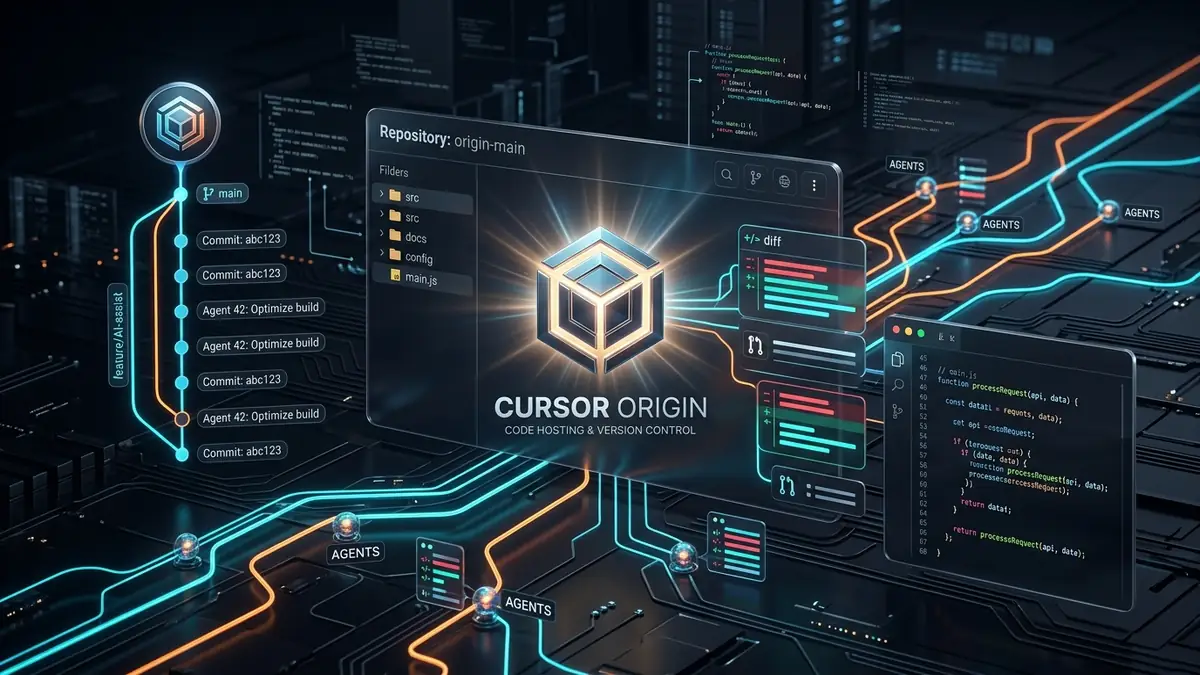
Cursor Origin is a proprietary code hosting platform and Git forge engineered for autonomous AI development workflows. Built by Anysphere (SpaceXAI), it processes rapid multi-agent commits, tracks prompt provenance, and resolves semantic merge collisions directly inside the IDE interface.
While Cursor Origin is locked behind paid subscription tiers starting at $20 monthly for Pro users, engineers and students can legally secure zero-cost or heavily subsidized access through accredited academic verification, power-user referral credits, and open-source infrastructure grants.
Quick summary: How to access Cursor Origin
Access requires an authenticated account tier with active cloud agent permissions:
- Verified Students: 100% free Pro tier for 12 months via SheerID academic credentials ($240 annual value).
- Non-Student Developers: 50% discount on the first billing cycle via verified power-user referral codes.
- Open-Source Maintainers: Partner ecosystem grants providing up to $200 monthly compute credits.
- Hobby & BYOK Users: Free Hobby plan and Bring Your Own Key mode do not grant Origin repository hosting.
- High-Frequency Throughput: Demonstrated handling 22.6 commits per second across parallel autonomous agents.
- Semantic Merge Intelligence: Replaces raw text diffs with structural AST incompatibility analysis.
- GitHub Mirror Strategy: Functions as a frictionless read-mostly overlay without disturbing production compliance.
- Model Foundation: Powered by Composer 2.5 with targeted trajectory feedback and Colossus 2 cluster backing.
- Security Advisory: Unofficial Solana crypto tokens using the Origin name are fraudulent honeypot contracts.
Source: Telemetry benchmarks, Cursor Compile technical presentations, and SheerID verification documentation (August 2026).
Architectural shift: When autonomous agents generate over a third of an organization's merged pull requests, code review ceases to be a human conversation. It becomes an asynchronous, machine-speed verification problem that legacy Git forges were never designed to solve.
- 1. The Infrastructure Crisis Behind Cursor Origin
- 2. Architectural Design: Engineering for Machine Throughput
- 3. Subscription Tiers and the Definition of Free Access
- 4. Strategies for Zero-Cost and Subsidized Access
- 5. The Read-Mostly Mirror Strategy and GitHub Outage
- 6. Composer 2.5 Training and Agent Performance
- 7. Security Alert: The Unofficial Crypto Token
- 8. Enterprise Governance and Data Telemetry
- Frequently Asked Questions
1. The Infrastructure Crisis Behind Cursor Origin
Software development workflows have shifted from isolated human typing sessions to continuous multi-agent execution loops. Developers increasingly operate as system architects and code directors, delegating hours of refactoring, test writing, and bug isolation to background agents. Industry reporting indicates that in automated setups, autonomous cloud agents generate roughly 35% of all successfully merged pull requests.
This surge in automated output created severe friction within traditional Git platforms. Systems like GitHub and GitLab were conceived around the assumption of deliberate human authors engaging in conversational review. When dozens of machine-generated pull requests land concurrently, manual review queues clog rapidly, turning into a scheduling bottleneck of unparsed diffs.
The Delivery Stability Paradox
Data from the 2025 Google DevOps Research and Assessment (DORA) report showed that while artificial intelligence adoption increased deployment frequency, delivery stability showed negative correlations across high-volume pipelines. Faster generation amplified underlying review debt. Simultaneously, Stack Overflow surveys showed developer confidence in AI accuracy dropped from 43% to 33% year-over-year. Without semantic understanding in the version control layer, reviewing machine-generated code placed an unsustainable cognitive burden on engineering teams.
The SpaceXAI Capitalization Milestone
Anysphere, founded in 2022 by MIT researchers, grew from an initial $8 million seed investment from the OpenAI Startup Fund to over $3 billion in annualized revenue by early 2026. This trajectory culminated in a $60 billion all-stock acquisition by SpaceX, establishing the SpaceXAI corporate division. This consolidation provides Cursor with compute resources from dedicated superclusters, enabling the operational scale required to host millions of active agentic repositories.
2. Architectural Design: Engineering for Machine Throughput
Cursor Origin re-engineers the traditional code hosting pipeline around continuous agent interaction. Rather than treating code as static line-based files, Origin structures code modifications around structured Abstract Syntax Tree (AST) representations and stacked differentials.
Commit Velocity and Stacked Diffs
At the Compile technical event, demonstrations utilizing technology from acquired code-review startup Graphite showed parallel agent fleets pushing continuous updates at a sustained 22.6 commits per second on a single active repository. Origin structures these submissions into dependent stacks, allowing agents to chain sequential feature branches without waiting for human blockers to merge each foundational branch manually.
Semantic Conflict Resolution
Standard Git engines flag conflicting text lines with primitive merge markers, requiring a human to infer the intended logic. Origin analyzes branch divergence at the semantic layer. For example, if Branch A converts a database query from synchronous to an asynchronous Promise, while Branch B adds a downstream function call expecting synchronous data, Origin communicates the structural type collision directly to the agent. The agent resolves the discrepancy based on program intent rather than text collisions.
Contextual Generation Metadata
Every pull request created inside Origin attaches the complete generative envelope: the initial user prompts, the indexed codebase state inspected within the context window, alternative implementations evaluated and rejected, and the exact model checkpoint utilized. When human reviewers inspect a pull request, they review the algorithmic rationale rather than just line changes.
3. Subscription Tiers and the Definition of Free Access
Because running background cloud agents and hosting active Git infrastructure requires substantial compute overhead, Cursor Origin is not included in the baseline free editor tier. Developers must understand the distinct tier boundaries to choose the right access path.
| Subscription Tier | Monthly Cost | Origin Forge Access | Agent & AI Allowances | Ideal User Profile |
|---|---|---|---|---|
| Hobby Plan | $0 (Free) | No Access | ~50 slow premium requests/mo, capped Tab completions | Local evaluation and basic code editing |
| Pro Plan | $20 | Early Beta Access | 500 fast requests/mo, unlimited Tab, cloud agents | Professional software engineers & researchers |
| Pro+ Plan | $60 | Early Beta Access | 1,500 fast requests/mo (3x Pro limit) | Independent contractors & heavy agent users |
| Ultra Plan | $200 | Early Beta Access | 10,000 fast requests/mo (20x Pro limit) | Full-time agentic pipeline developers |
| Enterprise | Custom | Early Beta Access | Shared team pools, SOC2 compliance, SSO/SCIM | Commercial engineering organizations |
4. Strategies for Zero-Cost and Subsidized Access
Because Origin requires an authenticated Pro level subscription or higher, using the platform at zero cost relies on verified academic credentials, affiliate discount credits, or open-source community subsidies.
1. The SheerID Academic Verification (100% Free Pro Tier)
The primary legitimate route to free Origin access is the official Cursor Student program. Verified university students receive a 100% discount on Cursor Pro for 12 continuous months ($240 annual value). This tier provides identical features to commercial Pro accounts, including unlimited Tab completions, 500 fast requests per month, frontier model access, and Origin repository hosting.
To ensure verification approval through SheerID without automated fraud flags:
- Email Alignment: Log into Cursor using your university-issued (.edu or international academic equivalent) email address. Mismatches between personal login accounts and submitted academic emails cause immediate rejections.
- Document Verification: If your university is not auto-approved, submit a current-term tuition invoice, class schedule, or dated student identity card.
- Network Settings: Turn off VPNs and proxy services during the SheerID submission process to avoid fraud detection flags.
- Automatic Refund: If you are currently paying $20 monthly on a personal card and get approved as a student, the billing system automatically refunds the active cycle's balance and applies the free 12-month extension.
2. Power-User Referral Discounts (50% Off First Month)
For graduated developers who do not qualify for academic verification, community referral codes allow an immediate 50% discount on the first month across any paid tier (reducing Pro to $10 or Ultra to $100). This provides an affordable evaluation period to test the Origin environment before committing long-term operational budget.
3. Open-Source Maintainer Grants
Triage and moderation overhead from automated pull requests has led ecosystem partners to sponsor maintainer compute. Platforms such as Ona provide up to $200 per month in background agent credits to recognized maintainers of active open-source projects. Maintainers can offload continuous CI and PR evaluation to subsidized agent pipelines while preserving local resources.
Recommended Hardware for Multi-Agent AI Development
Running high-throughput multi-agent workflows, continuous local indexing, and IDE-based background tasks requires reliable mobile hardware with ample unified memory or dedicated VRAM. Below are our top vetted workstation laptops for software engineers and students in 2026:
5. The Read-Mostly Mirror Strategy and GitHub Outage
Replacing an enterprise version control system involves severe administrative resistance and compliance overhead. To streamline adoption, Cursor built Origin around a parallel "wedge strategy" rather than requiring teams to disconnect from GitHub.
The Read-Mostly Architecture
Origin operates directly within the "Codebase" tab of the Cursor IDE. Users authenticate through their GitHub organization, importing repositories with existing read/write permission models intact. Pushes continue to propagate to GitHub as the central authority, while review comments, pull request states, and agent task threads synchronize bidirectionally within seconds. This allows teams to evaluate the platform without disrupting SOC2 audits or existing CI/CD triggers.
| Integration Partner | Role in Origin Workflow | Operational Benefit |
|---|---|---|
| Vercel | Edge deployment & preview environments | Automated branch previews generated on agent PRs |
| Depot | Accelerated container & CI builds | Up to 10x faster continuous integration pipelines |
| Buildkite | Enterprise hybrid build automation | Executes agent testing suites on internal infrastructure |
The August 17th Outage and Platform Resilience
The operational rationale for secondary Git infrastructure was underscored during Origin's initial beta deployment on August 17, 2026. Approximately three hours after rollout, GitHub suffered a widespread global degradation lasting 6 hours and 42 minutes. The incident saw error rates reach 20% on pull request APIs and 50% on raw archive downloads, while enterprise SSO systems and GitHub Copilot went completely offline.
The outage demonstrated the utility of local-first, synchronized forge layers. Teams utilizing Origin's mirrored workspace maintained continuous code review, local branching, and edge deployments through Vercel while upstream hosting resolved infrastructure failures.
6. Composer 2.5 Training and Agent Performance
The utility of agentic version control depends directly on the reasoning capabilities of the models driving code generation. Cursor introduced Composer 2.5, built on the open-source Kimi K2.5 checkpoint with extensive custom reinforcement learning.
Targeted Trajectory Feedback
Traditional reinforcement learning on long multi-file tasks suffers from credit assignment issues, where the model cannot identify which specific tool call or logic step led to a broken build after hundreds of iterations. Cursor trained Composer 2.5 using targeted textual feedback injected directly at error points during rollout execution. Combined with Sharded Muon and dual mesh Fully Sharded Data Parallel (FSDP) optimization, this approach substantially improved multi-step instruction following.
- alphaXiv: Developed by Stanford student Rehaan Ahmad using Cursor to serve research paper discussions to hundreds of thousands of users.
- SaveMate: High-performance price-tracking desktop application handling cross-language Rust and TypeScript IPC interfaces.
- AI-CMS: Cloud-native project management system configured to spin up complete containerized dev environments in under five minutes.
7. Security Alert: The Unofficial Crypto Token
Following the public announcement of Cursor Origin and the SpaceXAI corporate restructuring, malicious actors created an unauthorized token on the Solana blockchain under the ticker "ORIGIN" (Cursor Origin).
| Scam Identifier | Token Details | Security Assessment |
|---|---|---|
| Token Name / Ticker | Cursor Origin / ORIGIN | Unauthorized brand impersonation |
| Network | Solana | Micro-cap token targeting search traffic |
| Contract Analysis | Honeypot / Modifiable Metadata | Critical: Sell functions disabled, total capital loss risk |
8. Enterprise Governance and Data Telemetry
Adopting an agent-first hosting layer requires clear legal and governance frameworks. During early beta releases, Origin was enabled by default across paid accounts before complete data retention and fine-tuning opt-out terms were formally published.
For organizations bound by strict IP compliance and SOC2 requirements, enterprise administrators must verify whether mirrored source code is excluded from future foundational model training sets. Furthermore, the acquisition of open-source projects like Continue emphasizes the ongoing market consolidation toward centralized AI developer ecosystems, making transparent data sovereignty policies vital for enterprise engineering leads.
Frequently Asked Questions
Sources: Cursor Compile 2026 Technical Briefings, SheerID Academic Verification Portal, Google DORA 2025 Engineering Report, and GitHub Status Incident Records (August 2026). — Himansh, TheAITechPulse
