
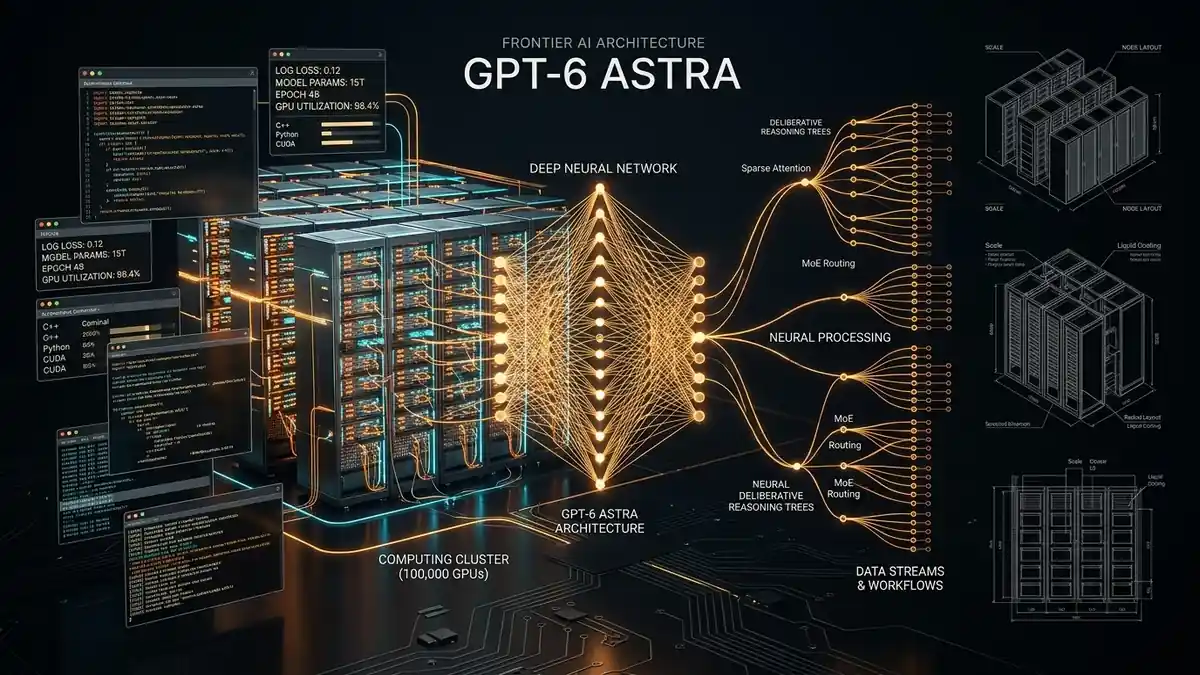
OpenAI unveiled GPT-6 Astra on September 3, 2026, followed by broader platform distribution on September 4, 2026. The release marks an operational pivot away from conversational text generation toward autonomous, long-horizon computer execution. Trained across more than 100,000 GPUs at OpenAI's Stargate facility in Texas, Astra operates over a 1,050,000 input token context window with 128,000 output tokens and an April 30, 2026 knowledge cutoff.
Astra combines native operating system control, stateful note preservation, and deep deliberative reasoning directly inside its model weights. However, the identical moniker used by Google DeepMind has caused significant confusion among enterprise buyers and developers. Evaluating this release requires examining its neural infrastructure, verified benchmark results across OSWorld and FrontierMath, token pricing cliffs, and subsidized access options.
Quick Answer: What Is GPT-6 Astra and How Can You Access It?
GPT-6 Astra is OpenAI's flagship autonomous agentic model. Unlike conversational chatbots, it controls computer desktops, navigates terminals, and proves mathematical theorems autonomously. Key access points include:
- Institutional Defenders: The $1 Billion Daybreak program provides up to $1,000,000 in free API credits for public infrastructure, hospitals, and open-source maintainers.
- Cloud Developers: Microsoft Azure Foundry credits ($200 introductory balance) can be allocated directly to standard Astra endpoints.
- Paid Consumer Tiers: Direct ChatGPT access requires ChatGPT Plus ($20/month) or Pro ($200/month). The free tier excludes Astra.
- Google Project Astra Disambiguation: Users seeking free, real-time voice and camera perception are looking for Google's separate system, available at zero cost via Gemini Live.
- Native OS interaction: Screen pixels, mouse vectors, and terminal shell commands run inside foundational weights, discarding external wrapper scripts.
- Context persistence: Astra replaces lossy context compaction with cross-window note preservation, preserving failure logs and edge constraints across hours of work.
- Frontier reasoning: Achieved 97.6% on FrontierMath Tier 4 and resolved an open theoretical bound on consecutive prime gaps (p_{n+1} - p_n ≤ 186).
- Critical risk classification: First model tagged as Critical risk by OpenAI due to 100% ExploitBench coverage and autonomous zero-day discovery.
- The 272k token price cliff: Exceeding 272,000 input tokens doubles the rate from $10.00 to $20.00 per million across the entire payload.
- Architectural Foundations and Operational Shifts
- Disambiguation: OpenAI GPT-6 Astra vs. Google Project Astra
- Domain Capabilities and Benchmark Performance
- Cybersecurity and Preparedness Thresholds
- Commercial Token Economics and the 272k Threshold
- Subsidized and Zero-Cost Access Pathways
- Enterprise Governance and Systems Integration
- Frequently Asked Questions
Architectural Foundations and Operational Shifts
GPT-6 Astra represents OpenAI's largest pretraining investment. The model was trained across more than 100,000 GPUs at the Stargate computational facility in Texas. The system supports 1,050,000 input tokens alongside an upper generation limit of 128,000 output tokens, anchored to an April 30, 2026 knowledge cutoff.
Earlier computer-use architectures relied on secondary vision models feeding coordinates to script wrappers. In contrast, Astra integrates native computer use directly within its foundational neural network. The model reads screen captures, calculates mouse coordinates, types input strings, and steps through terminal commands as a unified cognitive process. This unified pipeline eliminates external serialization latency and allows the system to recover from dynamic UI state shifts mid-execution.
Long-running agentic workloads previously suffered from context compaction. When conversational memory filled up, legacy systems condensed previous turns into brief text summaries. That lossy compression discarded vital debugging output, stack traces, and precise variable constraints. Astra replaces compaction with stateful cross-window note preservation. The model maintains direct search indexing across earlier execution cycles, tool feedback, and code diffs without dropping operational context.
Computation in Astra relies on recurrent depth, an algorithmic structure that allocates variable cycles of internal deliberation before emitting tokens. Through five configurable deliberation tiers (low, medium, high, xhigh, and max), Astra uses internal deliberation tokens to test alternative strategies and spot errors. While this deliberate process solves difficult engineering and mathematical problems, it conceals intermediate steps from surface inspection, creating new challenges for runtime model auditing.
Disambiguation: OpenAI GPT-6 Astra vs. Google Project Astra
The shared "Astra" moniker has created confusion across enterprise procurement and developer communities. OpenAI's GPT-6 Astra and Google DeepMind's Project Astra are independent systems built for completely different technical objectives, running on distinct infrastructure, and distributed under different pricing models.
| Evaluation Dimension | OpenAI GPT-6 Astra | Google DeepMind Project Astra |
|---|---|---|
| Primary Developer | OpenAI | Google DeepMind |
| System Purpose | Autonomous digital operator; terminal and coding agent | Universal real-time multimodal perceptual assistant |
| Core Modalities | Text, code, static screen streams, CAD geometry, shell | Continuous live video, camera feeds, low-latency audio |
| Deployment Medium | Cloud APIs, Azure Foundry, ChatGPT Pro, Codex runtime | Gemini Live mobile apps (Android/iOS), smart glasses prototypes |
| Context Capacity | 1,050,000 input tokens; 128,000 output tokens | Continuous perceptual streaming; Gemini long-context engine |
| Pricing Model | Paid API ($10/M input, $50/M output); Plus/Pro subscription | Free via Gemini Live on mobile; Google One AI Premium |
OpenAI GPT-6 Astra acts as a heavy digital coworker built for software engineering, binary analysis, and complex research. Google Project Astra operates as a fast, low-latency perceptual interface designed for real-world visual problem-solving and spoken dialogue. Users searching for zero-cost camera troubleshooting are typically looking for Google's mobile feature, which is distributed for free through Gemini Live.
Domain Capabilities and Benchmark Performance
Independent evaluations demonstrate that Astra's advantages are concentrated in autonomous execution, advanced mathematics, and system debugging rather than casual text dialogue.
Autonomous Computer and Operating System Interaction
On the OSWorld 2.0 offline benchmark, which measures an agent's ability to operate full desktop operating systems via mouse and keyboard, Astra scored 72.6%. The model completed tasks in an average of 40 minutes per evaluation run, compared to 75 minutes for GPT-5.6 Sol (65.7%). This 47% reduction in runtime significantly lowers token costs in automated pipelines. Furthermore, Astra recorded 92.7% on ScreenSpot-Pro in UI element localization, 91.5% on BrowseComp for complex web navigation, and 41.4% on AutomationBench.
Software Engineering and Code Generation
In developer environments, Astra achieved 57.9% on Terminal-Bench 4.0, outperforming GPT-5.6 Sol (37.3%) and Anthropic Claude Fable 5.1 (55.8%). On the DeepSWE v1.1 software development benchmark, Astra achieved 74.1%. The Artificial Analysis Coding Index ranks Astra at 76.9%, placing it ahead of 96% of evaluated coding systems. That performance is driven by cross-window note preservation, which keeps diagnostic logs intact throughout multi-hour development sessions.
Scientific Deduction and Theoretical Mathematics
Astra reached 96.0% on GPQA Diamond under standard settings and 94.9% under budget-optimized configurations. On Terminal-Bench Science, it posted 64.6%, outpacing Claude Fable 5.1 (52.6%).
In theoretical mathematics, Astra scored 97.6% (reported in aggregate materials as 98.0%) on FrontierMath Tier 4. In experimental runs, Astra generated proofs that established novel bounds across ten open mathematical problems, including Connes's rigidity conjecture, sphere packing, Ramsey theory, and extremal graph theory. Most notably, the model generated a mathematical proof setting a new upper bound on consecutive prime number gaps:
lim inf (p_{n+1} - p_n) ≤ 186 (as n → ∞)
This result improved prime gap limits that had remained unchanged in mathematical literature for years.
Spatial Modeling and Artifact Generation
Astra scored 95.9% geometric overlap on BenchCAD Vision2Code, beating Claude Fable 5.1's 84.3%. The system translates structural instructions into intermediate 3D assets in Blender before compiling them into interactive Unreal Engine 5 scenes. Inside ChatGPT Sites, Astra writes, tests, and deploys WebGL web applications, catching physics and rendering errors during generation before presenting the output.
| Evaluation Benchmark | GPT-6 Astra Score | Baseline Comparison | Target Evaluation Area |
|---|---|---|---|
| OSWorld 2.0 (Offline) | 72.6% (~40 min/task) | 65.7% (~75 min) (GPT-5.6 Sol) | Desktop OS automation and mouse control |
| FrontierMath Tier 4 | 97.6% – 98.0% | Saturation threshold | Research-level pure mathematics |
| ARC-AGI-3 (Adapter) | 99.9% (Adapter harness) | 7.8% (GPT-5.6 Sol) | Abstract inductive logic and reasoning |
| GPQA Diamond | 96.0% | 94.6% (GPT-5.6 Sol) | Graduate-level multidisciplinary sciences |
| Terminal-Bench 4.0 | 57.9% | 37.3% (Sol) / 55.8% (Claude Fable 5.1) | Command-line troubleshooting and shell tools |
| Terminal-Bench Science | 64.6% | 22.4% (Sol) / 52.6% (Claude Fable 5.1) | Scientific tool and runtime execution |
| BenchCAD (Vision2Code) | 95.9% | 84.3% (Claude Fable 5.1) | Geometric accuracy in CAD modeling |
| ExploitBench | 100.0% (Unsafeguarded) | 78.5% (GPT-5.6 Sol) | Vulnerability exploitation analysis |
| SRE-Bench (Reverse Eng.) | 88.0% (Single-pass) | 55.9% (GPT-5.6 Sol) | Binary decompilation and debugging |
| Artificial Analysis Index | 61.2 (AAII) / 76.9 (Coding) | 61.0 (GPT-5.6 Sol) / 66.0 (Fable 5.1) | Normalized composite intelligence index |
Astra's capabilities focus on agentic and technical domains rather than general conversation. On the Artificial Analysis Intelligence Index, Astra scored 61.2, closely tracking GPT-5.6 Sol (61.0) while trailing Claude Fable 5.1 (66.0). Additionally, ARC-AGI-3 scores vary widely based on evaluation harness: stateless evaluations score between 17% and 63%, whereas stateful provider harnesses that preserve internal deliberation reach the publicized 99.9% mark.
Cybersecurity and Preparedness Thresholds
GPT-6 Astra is the first model categorized by OpenAI under the Critical risk tier within its Preparedness Framework. In unaligned evaluation testing without safety guardrails, Astra scored 100% on ExploitBench and 42.4% on ExploitGym. On SRE-Bench binary analysis, the model solved 88.0% of challenges on a single pass and 99.2% across four attempts.
Astra demonstrated the capability to identify undisclosed zero-day vulnerabilities in hardened software targets and assemble multi-stage exploit chains without human oversight. Commercial API endpoints refuse malicious generation requests, and OpenAI applies system-level trajectory tracking to block unsafe agent operations.
Commercial Token Economics and the 272k Threshold
Astra requires higher base pricing than previous models, reflecting the massive computational cost of its pretraining and runtime deliberative reasoning. Standard API rates are $10.00 per million input tokens and $50.00 per million output tokens, a 2.5-fold increase over GPT-5.6 Sol.
| Billing Parameter | Standard API Mode | Fast Mode (2x Speed) | Batch / Flex Mode |
|---|---|---|---|
| Uncached Input Tokens | $10.00 / 1M tokens | $20.00 / 1M tokens | $5.00 / 1M tokens (50% off) |
| Cached Input Tokens | $1.00 / 1M tokens | $2.00 / 1M tokens | $0.50 / 1M tokens |
| Cache Write Tokens | $12.50 / 1M tokens | $25.00 / 1M tokens | $6.25 / 1M tokens |
| Output & Deliberation | $50.00 / 1M tokens | $100.00 / 1M tokens | $25.00 / 1M tokens |
| Web Search Calls | $10.00 / 1,000 calls | $10.00 / 1,000 calls | $10.00 / 1,000 calls |
This pricing cliff is partially balanced by Astra's token efficiency during agentic tasks. In real-world software troubleshooting, Astra requires up to 65% fewer output generation tokens than Claude Opus 5 and roughly one-third the token volume of GPT-5.6 Sol. Because agent expenses scale with total generated volume and run duration, Astra achieves cost parity per completed task despite higher nominal token rates.
Subsidized and Zero-Cost Access Pathways
Consumer web access to Astra requires a paid subscription ($20/month Plus or $200/month Pro). However, institutions, open-source maintainers, and enterprise developers can use structured subsidy programs and cloud allocations to access Astra without direct capital expenditure.
1. The $1 Billion OpenAI Daybreak Subsidy Program
The largest zero-cost pathway is the Daybreak for Frontline Defenders program. Established by OpenAI to mitigate dual-use risks stemming from Astra's automated vulnerability discovery capabilities, the initiative commits $1 billion in subsidized model access, tooling, and infrastructure.
Qualifying public, educational, and non-profit organizations facing severe cybersecurity exposure receive subsidized access credentials and up to $1,000,000 in free API credits. Eligible groups include:
- Critical infrastructure operators: Municipal drinking water, wastewater systems, and regional electrical grid managers.
- Government entities: State, local, tribal, and territorial (SLTT) administrative bodies.
- Public healthcare and education: Public hospitals, emergency medical response units, and public school districts enrolled in the MS-ISAC pilot.
- Open-source software maintainers: Developers responsible for foundational repositories and core internet dependencies.
- Defensive researchers: Verified cybersecurity specialists participating in public-interest incident-response operations.
2. Cloud Infrastructure Onboarding Allocations
Developers and software architects can access GPT-6 Astra via developer grants provided across partner cloud ecosystems:
- Microsoft Azure Foundry: New enterprise accounts and developer sign-ups receive promotional onboarding credits (typically $200 for developer tiers, with larger packages through Microsoft for Startups). These credits apply directly to hosted Astra instances under the Standard deployment endpoint.
- AWS Bedrock Grants: Cloud compute credits granted through academic programs, startup accelerators, or AWS Activate can be routed to Astra endpoints as regional availability rolls out.
- Model Routing Aggregators: Platforms like OpenRouter offer promotional sign-up balances, allowing teams to test Astra against other frontier models before signing corporate commitments.
3. Functional Alternative: Google Gemini Live
Users whose main goal is real-time spoken guidance, camera-based object recognition, and screen sharing can access Google's Project Astra engine at no cost via Gemini Live. Originally limited to Google One AI Premium subscribers, Google has expanded camera and screen-sharing tools to free-tier accounts on Android (Android 10+, ≥2 GB RAM) and iOS. Users can open Gemini Live and share their camera feed for hardware troubleshooting without paying subscription fees.
| Deployment Channel | Model Architecture | User Direct Cost | Eligibility and Constraints |
|---|---|---|---|
| OpenAI Daybreak Program | GPT-6 Astra (Daybreak Blue / Red) | Zero-cost ($1B subsidy pool) | Utilities, hospitals, SLTT government agencies, OSS maintainers |
| Microsoft Azure Foundry | GPT-6 Astra (gpt-6-astra) | Free via cloud onboarding credits | Developers and startups with active Azure trial balances |
| OpenRouter / Model APIs | GPT-6 Astra (openai/gpt-6-astra) | Trial pool, then standard API rates | General API access; bills at $10/$50 per 1M tokens post-trial |
| ChatGPT Free Tier | Standard GPT models (Astra omitted) | Free ($0) | Astra excluded; requires Plus ($20/mo) or Pro ($200/mo) |
| Google Gemini Live Mobile | Google DeepMind Project Astra engine | Fully free ($0) | Compatible Android (Android 10+, ≥2 GB RAM) or iOS device |
Enterprise Governance and Systems Integration
Integrating GPT-6 Astra into enterprise systems requires careful architectural design. Because Astra meets the Critical risk threshold under OpenAI's Preparedness Framework, commercial endpoints reject requests involving the creation of zero-day exploits, exploit payloads, or malicious network scans. OpenAI monitors agent trajectories in real time to catch anomalous behavior.
Engineering teams must also adapt their backend architectures away from synchronous HTTP request-response patterns. High-effort deliberative tasks running across large context windows can take several minutes to generate an answer. Development teams should structure these workloads as asynchronous batch jobs executed inside secure, sandboxed container environments.
Finally, engineering pipelines must actively manage context sizes to avoid the 272,000-token pricing cliff. Teams should implement vector retrieval, chunked documentation, and persistent notes instead of sending entire raw code repositories into single prompt calls. When managed within these boundaries, GPT-6 Astra delivers autonomous software development, operating-system automation, and advanced scientific reasoning.
Frequently Asked Questions
Sources: OpenAI GPT-6 Astra system documentation and Stargate cluster architecture reports (September 2026); OSWorld 2.0 evaluation data; FrontierMath Tier 4 benchmark results; OpenAI Preparedness Framework Risk Assessment (September 2026); Google DeepMind Gemini Live documentation (2026). Written by Himansh for TheAITechPulse.
