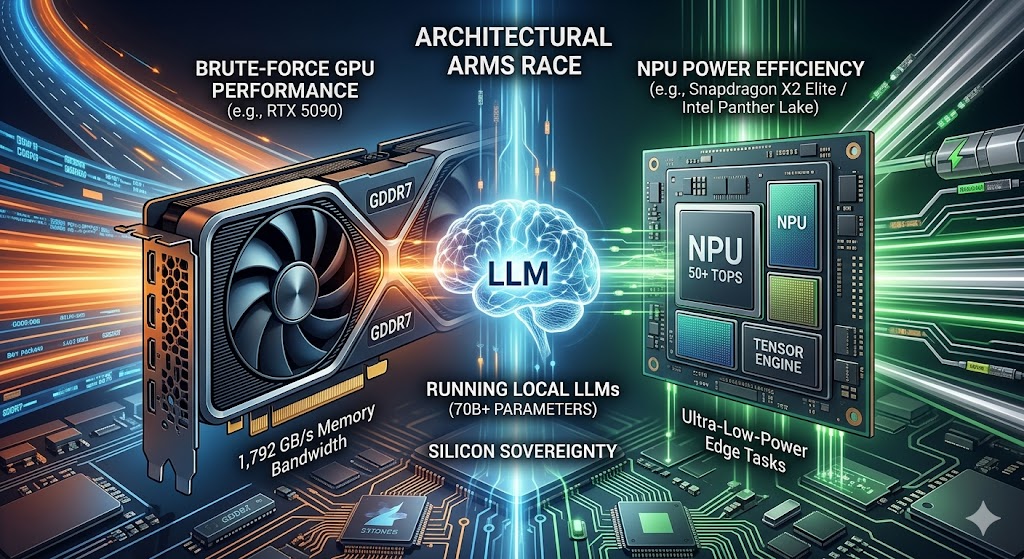
The Bottom Line: Generative LLM inference speed is strictly bound by memory bandwidth, not raw compute TOPS. Discrete GPUs (Nvidia RTX 50-series) deliver unmatched raw speed (up to 213 tokens/sec) for models up to 32B. Unified Memory (Apple M4 Max & AMD Strix Halo) is the undisputed champion for running massive 70B+ models without OOM crashes. NPUs are specialized for sub-10W background tasks and edge copilots, not large generative reasoning.
Related Picks — Live Amazon Prices
Verified specs & live Amazon prices • Click any pick to view deals
Find your match in 1 tap:
- 1. Memory vs. Compute Bounds
- 2. VRAM Formula & Quantization
- 3. Nvidia Blackwell GPU Benchmarks
- 4. NPU Revolution (Intel, AMD, Qualcomm)
- 5. Unified Memory (M4 Max / Strix Halo)
- 6. Top Laptops for Local AI (2026)
- 7. Software Stack: llama.cpp vs MLX
- 8. Buyer Configuration Archetypes
- 9. Frequently Asked Questions
1. The Physics of Generative Inference: Memory vs. Compute Bounds
To accurately evaluate the performance disparities between competing architectures, one must first deconstruct the physical and mathematical bottlenecks inherent to transformer-based large language models. The execution of an LLM is not a monolithic computational process; rather, it is strictly divided into two distinct operational phases: the prefill phase and the decode phase.
The prefill phase occurs when the model ingests the initial user prompt. During this stage, the processor maps the sequence of input tokens into internal embeddings simultaneously. Because this operation can be highly parallelized, the prefill phase is fundamentally compute-bound. Hardware performance during prefill scales directly with the raw mathematical throughput of the processor, whether measured in teraflops (TFLOPS) for GPUs or TOPS for NPUs.
Conversely, the decode phase represents the actual generation of the output response, producing text one token at a time in an autoregressive manner. The mathematical reality of the decode phase dictates that the entire parameter state of the model must be physically transferred from high-speed memory to the compute execution cores for every single token generated. Consequently, the decode phase is entirely memory-bandwidth-bound.
A processor boasting extraordinary computational power will idle uselessly if its memory bus cannot feed it weight data fast enough. This architectural truth explains why marketing metrics focusing solely on NPU TOPS are frequently misleading for LLM practitioners; a 60 TOPS chip paired with a narrow memory bus will routinely underperform a 45 TOPS chip supported by superior memory bandwidth.
2. The VRAM Capacity Formula and the Performance Cliff
The most absolute bottleneck for any localized AI deployment is memory capacity. The weights of a model must reside in the highest-speed memory available—discrete VRAM in a GPU or unified memory in a System-on-Chip (SoC)—to achieve viable inference speeds. If a model's operational size exceeds this high-speed memory threshold, the system is forced to offload the remaining layers over the PCIe bus to standard system RAM. This mechanical offloading creates a catastrophic performance cliff.
Empirical benchmarks demonstrate that while a flagship GPU might process an un-offloaded 32-billion parameter model at 45 tokens per second, spilling a larger 70-billion parameter model into system RAM plummets the generation speed to 1 to 2 tokens per second, a rate significantly slower than average human typing speed.
The base model size calculation requires multiplying the total number of billions of parameters by the precision weight size, followed by a safety multiplier of roughly 1.2 to account for the temporary memory spikes that occur during the initial model loading sequence. System overhead generally demands 2 to 4 gigabytes for OS tasks.
The Mathematics of Quantization
The absolute necessity of mitigating memory capacity limits has driven the universal adoption of quantization protocols. Quantization is the algorithmic compression of neural network weights from standard 16-bit floating-point (FP16) or Brain Floating Point (BF16) numbers down to lower-precision integer formats, drastically reducing both the static memory footprint and the dynamic bandwidth required to shuttle those weights during the decode phase.
The memory consumption multipliers based on quantization precision dictate the hardware realities of 2026:
- FP16 / BF16 (Unquantized): Consumes 2.0 bytes per parameter. A 7B model requires 14GB of VRAM, and a 70B model demands a staggering 140GB, restricting unquantized deployment entirely to professional data center hardware.
- Q8_0 (8-bit Integer): Consumes exactly 1.0 byte per parameter. This compression yields a 47% VRAM savings while incurring a negligible 1% to 2% degradation in model perplexity and response quality.
- Q5_K_M (5-bit Integer): Consumes 0.7 bytes per parameter, saving roughly 65% of the original VRAM footprint with an observable but acceptable 2% to 3% quality loss.
- Q4_K_M (4-bit Integer): Consumes 0.55 bytes per parameter. This specific quantization level has solidified itself as the industry standard "sweet spot" in 2026. It provides a massive 72% reduction in memory requirements while sacrificing only 3% to 5% of output quality. At Q4_K_M, a 70B parameter enterprise-grade model fits comfortably within 42 gigabytes of memory.
- Q2_K (2-bit Integer): Consumes 0.25 bytes per parameter. While highly efficient, the 15% to 25% degradation in reasoning capability renders it generally unsuitable for production environments or coding assistants.
Context Window Memory Scaling and KV Cache
Beyond the static weights of the model, the hardware must accommodate the Key-Value (KV) cache. The KV cache is the dynamic memory allocation that allows the transformer to remember the history of the conversation, effectively constituting the model's context window. Unlike static model weights, KV cache memory pressure scales quadratically with sequence length and can rapidly consume all available memory bandwidth during extended interactions.
For a flagship 70B parameter model, utilizing a minimal 4,000-token context window adds a trivial 0.5 gigabytes of VRAM overhead. Expanding that context to 8,000 tokens demands an additional 2 gigabytes. However, pushing the model to a 32,000-token context window adds a massive 32 gigabytes of VRAM pressure.
3. The Discrete GPU Paradigm: Nvidia's Blackwell Architecture
Within the localized computing ecosystem of 2026, the dedicated graphics processing unit remains the undisputed sovereign of raw inference throughput. Nvidia's latest consumer generation, the GeForce RTX 50-series based on the Blackwell architecture, represents the ultimate iteration of brute-force AI computing. Manufactured by TSMC on a highly customized 4N process node, the Blackwell lineage introduces hardware-accelerated fifth-generation Tensor Cores specifically tuned for deep learning inference and native FP4 operations.
The true technological leap of the RTX 50-series, however, is the integration of GDDR7 memory modules. By fundamentally elevating the memory bandwidth ceiling that constrained earlier generations, Nvidia has successfully aligned its hardware with the memory-bound physics of LLM decode execution.
Architectural Specifications of the RTX 50-Series
The product stack available to AI practitioners features distinctly tiered memory capacities and bus widths, heavily influencing purchasing decisions based on target model sizes:
| GPU Model | VRAM Capacity | Memory Interface | Memory Bandwidth | Raw AI Compute Performance |
|---|---|---|---|---|
| RTX 5090 | 32 GB GDDR7 | 512-bit | 1,792 GB/s | 1,406 AI TOPS (5th Gen Tensor) |
| RTX 5080 | 16 GB GDDR7 | 256-bit | 960 GB/s | ~600+ AI TOPS / 171 TFLOPS (RT) |
| RTX 5070 Ti | 16 GB GDDR7 | 256-bit | ~700-800 GB/s | 988 AI TOPS (5th Gen Tensor) |
| RTX 5070 | 12 GB GDDR7 | 192-bit | ~600 GB/s | ~400 AI TOPS |
Data aggregated from 2026 hardware technical specifications and industry benchmarks.
Empirical GPU Inference Benchmarks
The RTX 5090 serves as the flagship for enthusiasts and researchers targeting models exceeding 30 billion parameters. Its 32GB frame buffer allows models such as the Qwen 2.5 32B and DeepSeek R1 32B to reside entirely within maximum-bandwidth memory. Driven by an astonishing 1,792 GB/s memory bandwidth, the RTX 5090 generates tokens at velocities that vastly outpace both previous generation hardware and competing architectures.
Extensive benchmark testing of the RTX 50-series—conducted using the highly optimized llama.cpp execution engine utilizing the standard Q4_K_M quantization format—illustrates the profound impact of VRAM limits and bandwidth overhead on generation speeds:
| Model Architecture & Parameters | Quantization | RTX 5090 (32GB) | RTX 5080 (16GB) | RTX 5070 Ti (16GB) |
|---|---|---|---|---|
| Llama 3.1 8B | Q4_K_M | ~213 tok/s | ~132 tok/s | ~60 to 80 tok/s |
| Qwen 2.5 14B | Q4_K_M | ~145 tok/s | ~85 tok/s | ~80 tok/s |
| Qwen 2.5 32B | Q4_K_M | ~78 tok/s | ~20 tok/s* | ~25 to 30 tok/s* |
| DeepSeek R1 32B | Q4_K_M | ~72 tok/s | ~18 tok/s* | Data Unavailable |
| Llama 3.3 70B | Q4_K_M | ~35 tok/s | ~12 tok/s* | ~12 to 15 tok/s* |
*Asterisks indicate testing scenarios where the physical size of the model completely exceeds the GPU's onboard VRAM capacity. In these instances, the inference engine is forced to execute partial offloading to significantly slower system RAM via the PCIe interface, triggering a massive collapse in token throughput.
The benchmark data validates the core hypothesis of LLM deployment: execution is entirely memory-bandwidth-bound. When evaluating smaller 8B models that fit comfortably within the VRAM of all tested cards, the RTX 5090 proves to be approximately 60% faster than the RTX 5080 due to raw bandwidth superiority. However, upon crossing the critical 32B parameter threshold, the RTX 5090 demonstrates a 300% to 400% performance advantage purely because its massive 32GB buffer completely prevents system RAM offloading.
Cost-Effectiveness versus Cloud Dominance
While the high-end Blackwell cards carry a premium price tag, the broader economic implications of the RTX 50-series present a formidable challenge to established cloud-based AI providers. Analysis conducted in March 2026 demonstrated that an entry-to-mid-range configuration utilizing a $500 Nvidia RTX 5070 executing the open-source Qwen 3.5 Coder 32B model decisively outperformed proprietary cloud APIs.
Across a suite of 164 complex Python programming problems in the HumanEval benchmark, the local RTX 5070 configuration achieved a 92.1% pass rate at a highly responsive 40 tokens per second, entirely eliminating recurring API inference costs. In direct comparison, Anthropic's Claude Sonnet 4.6 API achieved only an 89.4% pass rate at 35 tokens per second, while incurring a cost of $3 per million tokens. This metric proves that localized inference is no longer merely a privacy-preserving alternative; it is financially and functionally superior for intensive developer workloads.

MSI Titan 18 HX RTX 5090 — Discrete Performance King
From $9,698
Discrete GPU Sovereign: Features Nvidia's Blackwell architecture with a 24GB GDDR7 frame buffer and fifth-generation Tensor Cores, delivering uncompromised tokens/sec during LLM decode cycles.
View Deal →
ASUS TUF RTX 4090 24GB — Best Performance GPU
From $3,500
Desktop GPU Sovereign: The gold standard for running complex local models. Features 24GB of ultra-fast GDDR6X memory, making it capable of running 70B models at high speeds and serving as a formidable workstation component.
View Deal →
Gigabyte RTX 4070 Ti Super 16GB — Best Mid-Range GPU
From $999
Mid-Range Sweet Spot: Equipped with a generous 16GB VRAM frame buffer and 256-bit bus, offering a highly cost-efficient gateway for developers to run 34B models locally at high precision without offloading cliffs.
View Deal →4. The NPU Revolution: Qualcomm, Intel, and AMD Edge Silicon
Neural Processing Units (NPUs) have emerged as the definitive solution to the power consumption crisis inherent to GPU-accelerated artificial intelligence. Structurally, NPUs are highly specialized Application-Specific Integrated Circuits (ASICs) architected exclusively to execute the vast arrays of matrix-vector multiplications that comprise deep neural network operations. To circumvent the massive energy toll associated with accessing external GDDR memory, NPUs traditionally leverage dense on-chip Static Random-Access Memory (SRAM), minimizing data transit latency and drastically reducing overall power draw.
Rigorous academic benchmarking validates the theoretical advantages of NPU architectures. In December 2025, independent research published by the University of Cantabria evaluated generative AI execution across diverse hardware topologies under controlled edge conditions. Evaluating specialized NPUs against flagship mobile edge GPUs like Nvidia's Jetson Orin series revealed commanding performance disparities.
For quantized models (Q4), optimized NPU architectures delivered an astonishing 110% higher raw performance measured in tokens per second, alongside a 63% improvement in pure energy efficiency, calculated in tokens per Joule. When integrating speed and energy consumption into the comprehensive Energy-Delay Product (EDP) metric, the NPU achieved a 140% improvement, underscoring its superiority for edge deployment.
Qualcomm Snapdragon X2 Elite: Pure Mobile Efficiency
Qualcomm has leveraged its decades of expertise in mobile ARM-based architecture to dominate the pure efficiency metrics of the 2026 AI PC ecosystem. The second-generation flagship processor, the Snapdragon X2 Elite Extreme, is fabricated on an ultra-efficient 3nm process node and features the highly advanced 6th-generation Hexagon NPU.
The X2 Elite Extreme pairs up to 18 Oryon CPU cores—clocking up to an unprecedented 5.0 GHz for an ARM architecture—with an NPU capable of generating 80 to 85+ TOPS. This raw output effectively doubles the minimum 40 TOPS baseline established by Microsoft for Copilot+ certification. To mitigate memory constraints, the X2 Elite utilizes an on-package design integrating up to 48GB of LPDDR5X memory across a 192-bit bus, delivering a sustained bandwidth ranging from 135 GB/s to 152 GB/s depending on the specific SKU configuration.
The generative capabilities of the Hexagon NPU are profound when utilized within optimized workflows. For diffusion-based computer vision tasks, the X2 Elite can synthesize a Stable Diffusion image in a staggering 7.25 seconds while sipping a mere 41.23 Joules of energy. This represents a paradigm shift in battery longevity, enabling professionals to run persistent agentic workflows for 15 to 20+ continuous hours on a single charge—a feat physically impossible on traditional x86 GPU workstations. When successfully executing LLMs such as Llama 3.2 3B or 7B weights, the processor can sustain generative speeds of 16 to 30 tokens per second entirely locally.

ASUS Zenbook A14 — Best Battery NPU
From $799
Qualcomm ARM Efficiency: Incorporates Snapdragon's high-efficiency Oryon cores and an NPU that delivers sustained background embeddings while yielding up to 33 hours of battery life.
View Deal →Intel Panther Lake: x86 Maturation and OpenVINO Dominance
Intel's approach to the localized AI revolution prioritizes deep integration with the developer ecosystem, native x86 architectural compatibility, and uncompromising optimization of the software stack. The flagship 2026 mobile processor lineup, the Core Ultra Series 3 (codenamed Panther Lake), represents a watershed moment for Intel's manufacturing division, representing the first commercial silicon built on the advanced Intel 18A process node.
The 18A process integrates RibbonFET gate-all-around transistors alongside PowerVia backside power delivery, drastically improving voltage regulation and thermal efficiency. Panther Lake leverages a modular, tile-based configuration, allowing Intel to mix-and-match components, ultimately combining "Cougar Cove" performance cores, low-voltage "Darkmont" efficiency cores, the next-generation Xe3 graphics architecture, and NPU 5, which delivers a dedicated 50 TOPS. Crucially, the platform operates across a highly scalable thermal envelope, with SKUs like the Core Ultra X9 388H functioning efficiently from a 15W minimum threshold up to an 80W peak turbo state.
Intel architectures excel specifically in latency-critical metrics. Benchmarking data submitted to the MLPerf Client v0.6 standards body revealed that Intel's NPU arrays achieved the fastest response times in the industry. The architecture recorded a Time to First Token (TTFT) of a mere 1.09 seconds, guaranteeing that AI chat assistants begin responding almost instantaneously upon prompt ingestion, while sustaining an average throughput of 18.55 tokens per second for standard interactive queries. Additionally, the Intel NPU distinguishes itself from its ARM and AMD competitors by retaining native FP16 execution capabilities in silicon, avoiding the quantization overhead often associated with strictly INT8-optimized NPUs.
-DGGML_OPENVINO=ON) to establish a unified execution path across Intel CPUs, integrated GPUs, and NPUs. This friction-free integration firmly positions Intel as the developer-ecosystem winner for traditional x86 environments.

Dell 14 Plus — Best Business NPU
From $999
Intel Panther Lake Sweet Spot: Pairs the 47 TOPS NPU 5 with native x86 OpenVINO compilation paths for seamless developer routing in llama.cpp environments.
View Deal →AMD Ryzen AI XDNA 2: The Latent Challenger
AMD's foray into the NPU space relies on the XDNA 2 architecture embedded within the Ryzen AI 300 and 400 series processors. Delivering between 50 and 60 TOPS, the XDNA 2 module utilizes spatially arranged AI Engine tiles leveraging Very Long Instruction Word (VLIW) and Single Instruction, Multiple Data (SIMD) vector cores for intensive matrix operations.
However, the AMD NPU narrative in 2026 is one of latent potential stifled by a highly fractured software ecosystem. While hardware metrics rival Intel and Qualcomm, the official developer tools—such as the ONNX-based Ryzen AI Software or the "Lemonade SDK"—have consistently lagged behind community requirements, struggling to provide day-one support for rapidly iterating open-source models. Independent developers have noted that the official ROCm infrastructure largely ignores the NPU in favor of traditional GPU routing, and crucial XDNA 2 drivers for Linux kernels have historically sat at the bottom of priority lists.
As a direct result of these ecosystem bottlenecks, many advanced users bypass the Ryzen NPU entirely. When engaging with high-end AMD laptop hardware, the community routinely offloads inference tasks to the integrated RDNA 3.5 graphics processing unit via open-source Vulkan drivers, yielding superior speeds but drastically increasing thermal output and battery drain. AMD's hardware undeniably represents a massive leap forward, but its utility as an NPU relies heavily on ongoing community interventions, such as the third-party FastFlowLM framework, rather than native, seamless integration.
5. The Unified Memory Revolution: Obliterating the VRAM Ceiling
While discrete GPUs dominate in raw throughput, they are physically bloated and capped by the absolute cost of specialized GDDR memory. Conversely, while NPUs excel in efficiency, mobile SoCs are traditionally constrained by total package memory limits. To service professional environments demanding the localized deployment of massive models—ranging from 70 billion to over 300 billion parameters—a third architectural paradigm has conquered the 2026 enterprise landscape: The high-bandwidth Unified Memory Architecture (UMA).
UMA systems are engineered so that the central processing unit, the integrated graphics architecture, and the neural processing unit all access a single, massive pool of shared system memory. This design entirely eliminates the PCIe communication bottleneck and the rigid VRAM ceiling of desktop GPUs.
Apple Silicon: The M-Series Monopoly
For several years, Apple maintained an absolute monopoly over high-bandwidth unified memory, rendering Apple Silicon the default architecture for researchers and creative professionals developing local LLMs. The physics of LLM memory bandwidth scaling are clearly observable across Apple's historical M2, M3, and modern M4 generations.
A critical architectural anomaly is found within the older generations: The M2 Pro chip was manufactured with a 200 GB/s memory bandwidth, whereas the subsequent M3 Pro was downgraded to a narrower bus delivering only 150 GB/s. Consequently, for memory-bound LLM inference tasks utilizing identical models, the older M2 Pro natively generates tokens faster than its M3 Pro successor, underscoring the absolute dominance of bandwidth over clock speed in neural applications.
In 2026, the M4 generation has thoroughly rectified this bottleneck. The M4 Pro delivers 273 GB/s, while the M4 Max boasts an immense 546 GB/s of memory bandwidth, addressing pools of up to 128 gigabytes of unified memory. For ultimate enterprise deployments, the M4 Ultra scales memory capacity up to 192GB with bandwidths exceeding 800 GB/s.
The inference capabilities of Apple Silicon are formidable. A Mac Studio or MacBook Pro equipped with an M4 Max (128GB) can effortlessly load a massive 70B parameter model—a task impossible on standard consumer PCs without multiple expensive GPUs—and process tokens at an incredibly stable 12.5 tokens per second. When executing highly optimized 7B or 13B models, the M4 Max pushes speeds between 38 and 58 tokens per second, rivaling mid-range discrete GPUs while operating silently within a sub-60-watt power footprint.

MacBook Pro 16" (M5 Max) — Top Pick Overall
From $4,100
Unified Memory Powerhouse: Equipped with massive unified memory bandwidth (~546 GB/s) that easily houses local 70B parameter models without hitting offloading cliffs.
View Deal →AMD Ryzen AI Max (Strix Halo): The x86 Challenger
Apple's unquestioned dominance in the high-memory unified space was finally shattered by AMD with the introduction of the Ryzen AI Max 300 and 400 series, codenamed "Strix Halo". Strix Halo represents an existential threat to Apple's pricing model and marks a paradigm shift for x86 workstations.
The flagship processor, the Ryzen AI Max+ 395, is an architectural leviathan. It combines 16 full-size "Zen 5" CPU cores with a massively scaled integrated GPU featuring 40 Compute Units based on the RDNA 3.5 architecture, alongside the 55 TOPS XDNA 2 NPU. However, the defining characteristic of Strix Halo is its quad-channel, 256-bit wide LPDDR5X memory controller. By leveraging this controller, manufacturers can cram between 128GB and an astonishing 192GB of unified memory onto the platform, allowing users to manually partition massive allocations directly to the integrated GPU.
- Bandwidth Reality and Dense Models: The Strix Halo memory bus is physically capped at a speed of precisely 256 GB/s. Because LLM generation is inextricably tied to this speed limit, standard "dense" models exhibit strong, but strictly capped, generation velocities. For example, the dense Qwen 3.6 35B model (utilizing UD-Q4_K_M quantization and consuming roughly 20GB of active memory) generates text at a highly respectable 62.6 tokens per second.
- The Mixture of Experts (MoE) Dominance: The true capability of Strix Halo is unlocked when deployed against Mixture of Experts (MoE) neural architectures. MoE models divide their total parameter count into specialized sub-networks, activating only a small fraction of the total parameters for any given token generation. The Qwen3-Coder 30B model possesses 30 billion total parameters, but only utilizes 3 billion "active" parameters during computation. Because only 3 billion parameters must transit the 256 GB/s memory bus per token, the hardware is freed from its bandwidth bottleneck, allowing generation speeds to skyrocket to an astonishing 98.5 tokens per second on a single machine.
- Software Tuning and Driver Overrides: Bypassing AMD's official ROCm framework entirely and routing computation through the open-source Linux Vulkan/RADV drivers yields superior single-stream generation speeds. Furthermore, executing models directly via llama-server avoids the 25% performance degradation frequently introduced by wrapper applications like Ollama, which often trail behind the bleeding edge of Flash Attention optimizations.
- RDMA Clustering for 256GB Ecosystems: For the most extreme enterprise environments, researchers are bypassing PCIe entirely by networking dual 128GB Strix Halo machines together using 100-Gigabit Ethernet (100GbE) Network Interface Cards and Direct Attach Copper (DAC) cables. Utilizing the vLLM orchestration framework with a Tensor Parallelism value of two (TP=2), these machines aggregate their memory pools via Remote Direct Memory Access (RDMA), creating a cohesive 256GB unified memory super-node capable of ingesting trillion-parameter enterprise models.

ASUS ROG Flow Z13 — Best x86 UMA Workstation
From $2,707
x86 Unified Hybrid: Porting Strix Halo's 256 GB/s UMA capability into a highly portable format. It's the ultimate playground for running advanced Mixture of Experts (MoE) architectures locally.
View Deal →6. Summary of Architectural Recommendations (2026 Picks)
To run local LLM workloads seamlessly, our expert-selected hardware recommendations have been distributed directly into their respective architectural review sections above to align with their specific design paradigms. For quick navigation, you can access each pick directly:
-
•
Discrete GPU & Desktop Picks: See the MSI Titan 18 HX (RTX 5090 Mobile), ASUS TUF RTX 4090, and Gigabyte RTX 4070 Ti Super in Section 3.
-
•
Intel x86 NPU developer sweet spot: See the Dell 14 Plus (Panther Lake) in Section 4.
-
•
Qualcomm ARM battery efficiency: See the ASUS Zenbook A14 (Snapdragon X2) in Section 4.
-
•
Apple macOS high-capacity unified memory: See the MacBook Pro 16" (M5 Max) in Section 5.
-
•
AMD x86 high-capacity unified memory: See the ASUS ROG Flow Z13 (Strix Halo) in Section 5.
7. The Software Orchestration Layer: Bridging Hardware and Logic
The proliferation of advanced hardware in 2026 is rendered moot without sophisticated software orchestration. The AI ecosystem is heavily dependent on execution engines capable of compiling the neural graph into machine-level instructions optimized for the specific idiosyncrasies of NPUs and massive GPU arrays.
The open-source community continues to rally around llama.cpp and its highly efficient GGUF quantization formats. However, the efficiency of llama.cpp relies entirely on its backend compilation targets:
- CUDA (Nvidia): The Nvidia ecosystem remains the gold standard of execution. The llama.cpp CUDA backend is flawless, mature, and universally supported, resulting in maximum hardware utilization and stability out-of-the-box.
- OpenVINO (Intel): Intel’s integration of OpenVINO directly into upstream llama.cpp has positioned it as the premier platform for frictionless x86 deployment, dynamically routing computation across CPUs, GPUs, and NPUs transparently to the user.
- Vulkan and ROCm (AMD): AMD’s software ecosystem remains powerful but fractured. While ROCm provides excellent throughput for heavy concurrent requests and large batch processing, open-source Vulkan implementations currently dominate single-user, interactive chat performance, requiring developers to maintain bifurcated deployment strategies depending on the use case.
Beyond standard engines, the push for edge inference has catalyzed the development of alternative deployment strategies. Frameworks such as ExecuTorch have gained significant traction, providing highly optimized CPU backends built upon the XNNPACK library to extend hardware coverage to resource-constrained IoT devices. Concurrently, the maturation of the WebGPU standard has enabled complex models (such as the Llama 3.2 1B parameter variant) to run directly within web browsers, bypassing command-line dependencies and application installations entirely. While these browser-based deployments suffer slight memory overhead penalties, they represent a massive leap forward in the democratization of accessible AI.
8. Enterprise and Enthusiast Configuration Archetypes
Hardware selection must strictly align with the operational constraints and financial realities of the deployment environment. Synthesizing the 2026 hardware data yields four definitive system configuration archetypes optimized for varying Total Cost of Ownership (TCO) constraints.
-
1. Entry-Level Edge Setups (Budget: $600 – $1,200):
Designed for hobbyists, students, and basic coding assistants, this tier focuses on models ranging from 3 billion to 8 billion parameters (e.g., Phi-3.5 Mini, Mistral 7B).
# Start local serving with 8B parameters ollama run llama3.1:8b-instruct-q4_K_MRecommended Hardware: Systems utilizing 32GB of DDR5 system RAM paired with an Nvidia Arc A770 16GB or RTX 4060 Ti 8GB. The base Apple Mac Mini M4 ($599) offers exceptional value, providing 16GB of unified memory and yielding over 55 tokens per second.
-
2. Mid-Range Power User Setups (Budget: $1,500 – $2,500):
Considered the definitive "sweet spot" for 90% of local AI use cases, this tier is targeted at content creators, professional developers, and advanced RAG deployments capable of handling 13B to 35B models.
# Run optimized Qwen 2.5 32B model locally ollama run qwen2.5:32b-instruct-q4_K_MRecommended Hardware: A desktop system featuring 48GB to 64GB of DDR5 RAM, built around an AMD Ryzen 7 7800X3D CPU and an Nvidia RTX 5070 Ti (16GB VRAM) or RTX 4080 Super. The Apple Mac Mini M4 Pro (48GB) provides 273 GB/s of bandwidth, effortlessly generating tokens for 33B models silently.
-
3. High-End Professional Builds (Budget: $3,000 – $5,000):
Engineered for dedicated AI development, concurrent user serving, and the deployment of massive 70B parameter frontier models.
# Serve Llama 3.3 70B on discrete or unified setups ollama run llama3.3:70b-instruct-q4_K_MRecommended Hardware: Workstations equipped with 128GB of high-speed RAM and the uncompromising Nvidia RTX 5090 (32GB VRAM), representing the fastest consumer inference capability available in the world. Alternatively, the AMD Ryzen AI Max 395 (Strix Halo) mini-PC equipped with 128GB of LPDDR5X memory provides an unparalleled 256 GB/s playground for MoE architectures.
-
4. Enterprise Data Center Nodes (Budget: $10,000+):
A zero-compromise infrastructure designed for training models, corporate data ingestion, and running massive 200B to 400B parameter models (e.g., Llama 3.3 405B).
# Dual-GPU cluster serving Llama 405B vllm serve /models/llama-3.1-405b --tensor-parallel-size 2Recommended Hardware: Dual-socket AMD Threadripper Pro configurations utilizing 256GB of ECC memory, accelerated by multiple Nvidia RTX 6000 Ada (48GB) or chained arrays of RTX 5090 GPUs. The Apple Mac Studio M4 Ultra, configured with a massive 192GB unified memory array pushing 800+ GB/s of bandwidth, provides a completely turnkey enterprise solution.
Quick Decision Tree: Which Hardware Should You Pick?
- If you have a strict budget under $1,000: Go with the Apple Mac Mini M4 (16GB unified memory) or a desktop with an RTX 4060 Ti 16GB. Avoid narrow-bus low-VRAM laptops.
- If you need maximum inference speed (tokens/sec): Pick the Nvidia RTX 5090 (32GB GDDR7). Nothing else touches Blackwell's raw bandwidth.
- If you want to run massive models (70B+) on a budget: Choose an AMD Ryzen AI Max 395 (Strix Halo) workstation with 128GB unified RAM. It offers the lowest cost per GB of high-speed memory.
- If you need a quiet, portable development machine: Buy an Apple MacBook Pro M4 Max (128GB Unified Memory). You get unmatched UMA memory capacity in a silent laptop form factor.
- If you are building off-grid or power-sensitive edge setups: Deploy Qualcomm Snapdragon X2 Elite or RaiderChip NPUs. They offer the highest performance-per-watt available.