
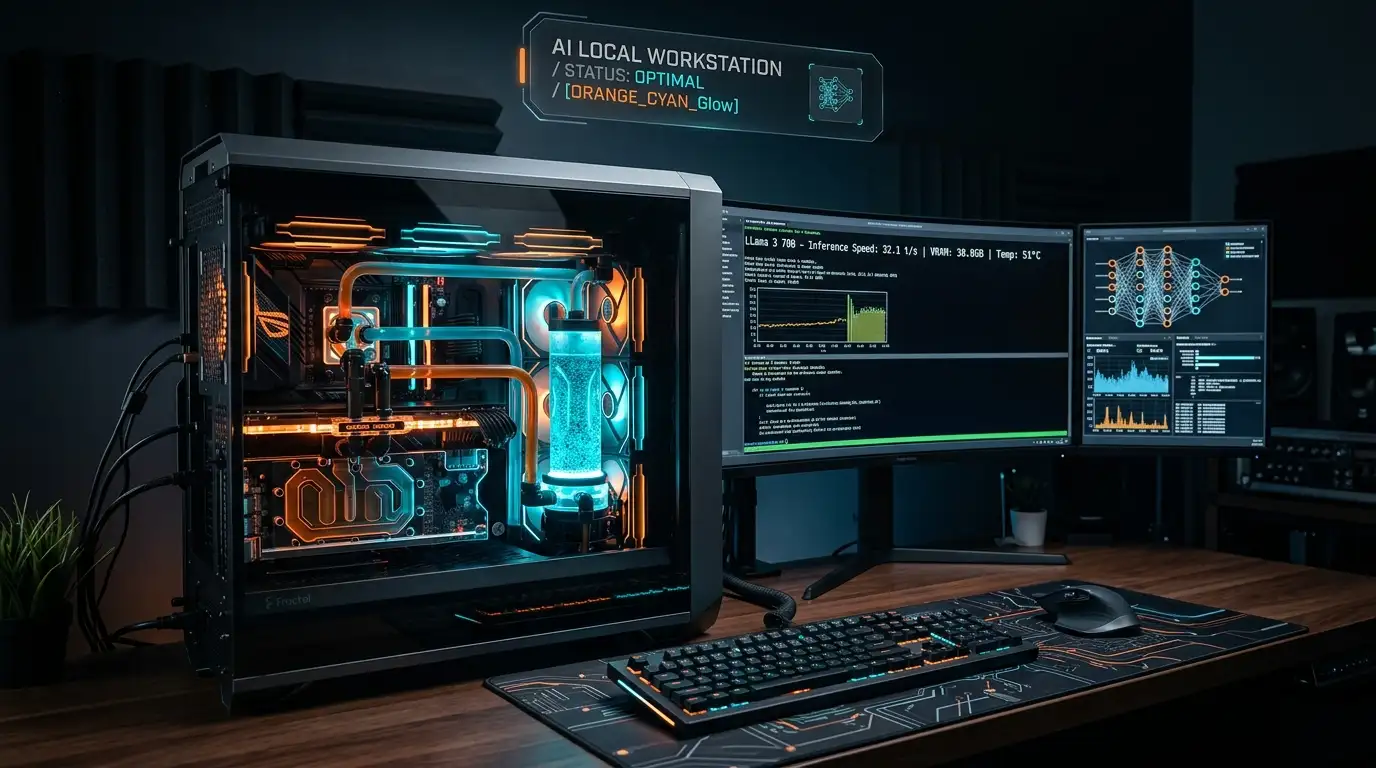
Building an optimal local AI workstation requires matching hardware architecture to model parameter scale, memory bandwidth needs, and precision constraints. The local AI hardware market splits into discrete throughput accelerators led by NVIDIA Blackwell GPUs and unified memory systems represented by Apple M5 Max and AMD Strix Halo.
Enterprise data sovereignty demands, proprietary intellectual property security, and the elimination of cloud API egress fees drive AI engineering teams toward local execution. Running 70B to 100B+ parameter models locally requires configuring High-End Desktop (HEDT) processors, managing 500W+ per-GPU thermal loads, and evaluating interconnect constraints.
Quick Answer: Which Architecture Wins for Local AI?
The choice comes down to raw memory bandwidth versus total addressable memory capacity within budget constraints.
- Single-Stream Peak Throughput: NVIDIA GeForce RTX 5090 delivers 1,792 GB/s bandwidth for models up to 32 GB.
- Maximum Single-Card Capacity: NVIDIA RTX PRO 6000 offers high GDDR6/GDDR7 ECC memory for 70B+ model execution.
- High-Capacity Efficiency Pick: Apple MacBook Pro 16" (M5 Max) (128 GB unified memory at 614 GB/s) runs 70B models smoothly on battery power.
- Top Flagship AI Laptop: MSI Titan 18 HX (RTX 5090) pairs 24GB VRAM with 96GB DDR5 RAM for mobile execution.
laptop Not Sure Which AI Workstation or Laptop to Buy?
Use our free interactive Laptop Finder Tool to filter by budget, GPU VRAM, RAM tier, and local LLM model size. Get personalized recommendations in 60 seconds.
Try the Free Laptop Finder Tool → Updated weekly with latest RTX 50-series GPUs & Apple M5 Max models- The Shifting Infrastructure of Local AI
- The Discrete Accelerator Vanguard: NVIDIA Blackwell
- Overcoming Thermal Limits: Liquid Cooling Systems
- The Rise of Unified Memory Architectures
- Mobile AI Workstations: Desktop Power in Portable Forms
- Foundation Infrastructure: HEDT CPUs and Enterprise Memory
- Logistics, Total Cost of Ownership, and Regional Support
- Frequently Asked Questions
- Token generation is memory bandwidth bound: Decoder speeds scale linearly with VRAM throughput. The NVIDIA RTX 5090 leads consumer builds at 1,792 GB/s.
- NVLink is removed from desktop Blackwell: Inter-GPU communication runs over PCIe 5.0 x16 (64 GB/s), elevating single-card VRAM importance like the NVIDIA RTX PRO 6000.
- Unified memory bypasses the PCIe VRAM wall: Apple M5 Max (614 GB/s) and AMD Strix Halo (256 GB/s) map system RAM directly to GPU shaders.
- Top mobile setups: Flagships like the MSI Titan 18 HX and ASUS ROG Strix SCAR 18 provide 24GB VRAM mobile execution.
Quick take: Token decode speed in local LLMs depends primarily on memory bandwidth, while maximum parameter size depends on total GPU memory volume. Selecting hardware requires deciding whether your priority is maximum tokens per second or running 70B+ models without offloading.
The Shifting Infrastructure of Local AI
Generative model scaling from 7-billion to over 100-billion parameters has altered modern workstation design. Cloud application programming interfaces (APIs) introduce recurring operational expenses and privacy risks for proprietary data. Moving workloads to local silicon guarantees zero data egress fees and maintains strict data governance.
Navigating the 2027 hardware ecosystem requires choosing between two core design philosophies: high-throughput discrete graphics processing units (GPUs) and high-capacity unified memory system-on-chips (SoCs). Selecting the right platform requires evaluating compute precision, thermal envelopes, motherboard PCIe lane allocations, and regional maintenance warranties.
The Discrete Accelerator Vanguard: NVIDIA Blackwell
The NVIDIA Blackwell architecture scales transistor density and compute precision. Fabricated on TSMC custom 4NP nodes, the flagship GB202 silicon measures 750 square millimeters and houses 92.2 billion transistors. Fifth-generation Tensor Cores add native FP4 precision support alongside optimized FP8 and FP16 execution pipelines.
Native FP4 support allows heavily quantized models to run directly on tensor cores without structural accuracy drops. This native execution effectively doubles theoretical mathematical throughput compared to previous Ada Lovelace architectures.
The Consumer Heavyweight: NVIDIA GeForce RTX 5090
The GeForce RTX 5090 leads consumer GPU throughput. It incorporates 21,760 CUDA cores, 680 fifth-generation Tensor Cores, and 32 GB of GDDR7 video memory on a 512-bit bus.
Because single-stream LLM token generation fetches weight tensors repeatedly, memory bandwidth determines decode speed. The 512-bit interface delivers 1,792 GB/s of bandwidth, a 78% increase over the RTX 4090. A 32 GB VRAM buffer runs 13B models at uncompressed FP16 or 32B models under Q4 quantization fully in memory.
| Specification | NVIDIA GeForce RTX 5090 | NVIDIA GeForce RTX 4090 | Generational Delta |
|---|---|---|---|
| Architecture | GB202 (Blackwell) | AD102 (Ada Lovelace) | New Architecture |
| Transistors | 92.2 Billion | 76.3 Billion | +20.8% |
| CUDA Cores | 21,760 | 16,384 | +33.0% |
| VRAM Capacity | 32 GB GDDR7 | 24 GB GDDR6X | +33.3% |
| Memory Interface | 512-bit | 384-bit | +33.3% |
| Memory Bandwidth | 1,792 GB/s | 1,008 GB/s | +78.0% |
| FP32 Compute | ~105.2 TFLOPS | ~82.6 TFLOPS | +27.3% |
| Total Power (TGP) | 575W | 450W | +27.8% |

ASUS ROG Astral NVIDIA GeForce RTX 5090 32GB GDDR7
~$4,329.99 MSRP (32 GB GDDR7)
1,792 GB/s Bandwidth · 21,760 CUDA Cores · 575W TGP · Native FP4 Acceleration
Check Price →High thermal output creates structural requirements. The 575W power rating requires an ATX 3.0 power supply rated at 1000W to 1200W with native 12V-2x6 connectors. Retail pricing also reflects high yield costs and demand pressures.
International pricing shows regional markups. Indian distributors list the RTX 5090 between Rs. 4,49,499 for standard air-cooled designs and up to Rs. 9,99,999 for liquid-cooled flagship models like the ASUS ROG Astral LC.
The Enterprise Solution: NVIDIA RTX PRO 5000 and 6000 Blackwell
For model parameters exceeding 32 GB, NVIDIA's RTX PRO workstation cards implement GDDR7 Error-Correcting Code (ECC) memory configurations.
The RTX PRO 5000 Blackwell features 14,080 CUDA cores, 440 Tensor Cores, and up to 72 GB of GDDR7 memory on a 384-bit bus (1,344 GB/s). Its 300W dual-slot blower format enables high-density multi-GPU chassis stacking.
The flagship RTX PRO 6000 Blackwell provides 24,064 CUDA cores, 752 Tensor Cores, and 96 GB of GDDR7 ECC memory at 1,792 GB/s bandwidth. Dual RTX PRO 6000 cards supply 192 GB of high-speed VRAM, enabling local hosting of 100B+ Mixture of Experts (MoE) networks.

NVIDIA RTX 6000 Ada Generation (48GB VRAM Workstation GPU)
~$7,479 MSRP (48 GB GDDR6 ECC)
960 GB/s Bandwidth · 18,176 CUDA Cores · Dual-Slot Blower · Enterprise AI Training
Check Price →| Specification | RTX PRO 5000 Blackwell | RTX PRO 6000 Blackwell |
|---|---|---|
| CUDA Cores | 14,080 | 24,064 |
| Tensor Cores | 440 (5th Gen) | 752 (5th Gen) |
| VRAM Capacity | 48 GB / 72 GB GDDR7 ECC | 96 GB GDDR7 ECC |
| Memory Bandwidth | 1,344 GB/s | 1,792 GB/s |
| MIG Partitioning | Up to 2 Instances | Up to 4 Instances |
| Max Power Draw | 300W | 600W |
| Slot Form Factor | Dual Slot Blower | Dual Slot Blower |
RTX PRO cards support hardware partitioning into independent isolated instances with dedicated memory allocations. A single RTX PRO 6000 can be divided into four 24 GB execution units to support multi-tenant local model serving.
The Architectural Concession: The Absence of NVLink
Desktop Blackwell GPUs do not include NVLink connector bridges. Physical bridges that allowed direct inter-GPU memory pooling on previous generations are now restricted to data center server architectures such as the GB200 NVL72.
Multi-GPU desktop setups route tensor synchronization over PCIe 5.0 x16 interfaces (64 GB/s bidirectional throughput). While prompt processing and LLM decode operations run effectively over PCIe 5.0, distributed gradient synchronization during model training experiences bus latency. Single-card capacity like the 96 GB RTX PRO 6000 avoids inter-card communication overhead.
AMD Discrete Compute Alternative: Radeon RX 8900 XT
AMD RDNA 4 architecture provides an alternative compute platform. The Radeon RX 8900 XT offers 24 GB of GDDR6/GDDR7 memory complemented by Infinity Cache.
While absolute tensor throughput trails the RTX 5090, software improvements in AMD ROCm expanded PyTorch and ONNX execution compatibility. For framework-agnostic workloads, the RX 8900 XT offers an accessible cost-to-capacity option.
Overcoming Thermal Limits: Liquid Cooling Systems
Combining multiple 500W+ GPUs in standard desktop enclosures requires managing high thermal loads. Air cooling in multi-card builds leads to core clock throttling under sustained training loads.
Custom liquid cooling loops resolve heat accumulation. Systems incorporating full-cover water blocks cool GPU dies, GDDR7 memory modules, and power delivery stages simultaneously. Monitoring coolant flow rate (mL/min) and delta-T metrics ensures stable performance during overnight model execution.
The Rise of Unified Memory Architectures
Unified memory systems address the VRAM boundary inherent to traditional PCIe architectures. Placing CPU cores, GPU compute, and Neural Processing Units on a shared silicon substrate grants all engines access to a central pool of high-speed RAM.
Apple Silicon M5 Max: SoC Efficiency
Apple's M5 Max SoC integrates dedicated matrix-multiplication hardware—Neural Accelerators—directly into its 40 GPU cores. This design delivers up to 70 TFLOPS of FP16 compute.
The memory subsystem supports up to 128 GB of unified memory with 614 GB/s bandwidth. Using frameworks like Apple MLX, the M5 Max achieves efficient token speeds on large quantized models:
- Llama 3 8B (Q4): ~82 tokens/second
- Qwen 3.5 30B (Q4): ~58 tokens/second
- Llama 4 Scout (Q4): ~32 tokens/second
- Llama 3 70B (Q4): ~18 to 35 tokens/second
AMD Ryzen AI Max+ 395 (Strix Halo): x86 Unified Platform
AMD Strix Halo brings unified memory structures to x86 desktop platforms. The Ryzen AI Max+ 395 integrates 16 Zen 5 CPU cores, a 50 TOPS XDNA 2 NPU, and a 40-Compute Unit RDNA 3.5 GPU engine.
The processor addresses up to 128 GB of LPDDR5X-8000 unified memory across a 256-bit interface (256 GB/s bandwidth). This shared architecture allows zero-copy operations between CPU preprocessing and GPU tensor execution.
| Architecture Comparison | NVIDIA RTX 5090 | Apple M5 Max | AMD Ryzen AI Max+ 395 |
|---|---|---|---|
| System Type | Discrete GPU | Unified SoC | Unified APU |
| Max Memory Pool | 32 GB GDDR7 | 128 GB Unified | 128 GB Unified |
| Memory Bandwidth | 1,792 GB/s | 614 GB/s | 256 GB/s |
| Peak Compute | ~105.2 TFLOPS | ~70 TFLOPS (FP16) | ~60 TFLOPS (FP16) |
| Power Consumption | 575W (GPU Only) | ~65-100W (System) | ~55-120W (System) |
| Software Engine | CUDA, TensorRT | MLX, Metal, llama.cpp | ROCm, llama.cpp |
Mobile AI Workstations: Desktop Power in Portable Forms
Field deployment needs have driven technical advancements in mobile hardware platforms.
High-End Laptops: RTX 5090 Mobile Implementations
The NVIDIA RTX 5090 Laptop GPU features 24 GB of GDDR7 VRAM, enabling mobile execution of 30B to 35B models at FP16 precision, or 70B models using 4-bit quantization.
Flagship chassis include the MSI Titan 18 HX, ASUS ROG Strix Scar 18, and Eurocom Raptor X18. These configurations pair high-power mobile GPUs with Intel Core Ultra 9 285HX or AMD Ryzen 9 9955HX CPUs, support up to 96 GB or 256 GB system RAM, and house multi-slot PCIe Gen 5 SSD arrays.

MSI Titan 18 HX — Ultimate RTX 5090 Mobile AI Laptop
~$9,698 MSRP (24 GB GDDR7 VRAM)
Core Ultra 9 285HX · 24GB VRAM · 18" 4K Mini LED · 96GB DDR5 RAM
Check Price →
ASUS ROG Strix SCAR 18 — High-Performance Mobile Workstation
~$6,000 MSRP (24 GB GDDR7 VRAM)
RTX 5090 Laptop GPU · 18" ROG Nebula HDR · Tri-Fan Thermal Design
Check Price →Untethered Option: MacBook Pro 16-inch (M5 Max)
The 16-inch MacBook Pro with M5 Max provides consistent processing speed regardless of power source. Configured with 128 GB of unified memory, it runs 70B parameter models on battery power without discrete clock throttling.

Apple MacBook Pro 16" (M5 Max) — Untethered 128GB Unified AI Workstation
~$4,100 MSRP (128 GB Unified Memory)
614 GB/s Bandwidth · 40-Core GPU · Runs 70B Models on Battery · Thunderbolt 5
Check Price →Foundation Infrastructure: HEDT CPUs and Enterprise Memory
Building a discrete multi-GPU workstation requires selecting a CPU platform with adequate PCIe lane allocation.
AMD Threadripper 9000 Series
AMD Zen 5 Threadripper processors split across two motherboard platforms: TRX50 (4-channel memory, up to 64 cores) and WRX90 (8-channel memory, up to 96 cores).
| Feature | Threadripper 9000 (TRX50) | Threadripper PRO 9000 WX (WRX90) |
|---|---|---|
| Max Cores / Threads | 64 / 128 (TR 9980X) | 96 / 192 (TR 9995WX) |
| Memory Topology | 4-Channel DDR5 | 8-Channel DDR5 |
| Max Memory Capacity | 1 TB RDIMM | 2 TB RDIMM |
| Usable PCIe 5.0 Lanes | 88 Lanes | 128 Lanes |
| Thermal Design Power | 350W | 350W |
The WRX90 platform hosting a Threadripper PRO 9995WX provides 128 usable PCIe 5.0 lanes. This allows hosting four RTX PRO 6000 or four RTX 5090 GPUs at full x16 electrical bandwidth simultaneously without bus multiplexing.
Logistics, Total Cost of Ownership, and Regional Support
Deploying high-end workstations involves evaluating utility power supply requirements, thermal conditioning, and warranty service logistics.
In growing technology sectors like India, national distributors such as Rashi Peripherals (RPtech) handle distribution for ASUS, MSI, and NVIDIA workstation components. Authorized service networks like F1 Info Solutions and Kaizen Infoserve manage component diagnostics and replacements across major tech hubs.
For custom liquid-cooled systems, regional integration specialists assist with pressure testing and thermal validation prior to production deployment.
Frequently Asked Questions
Sources: NVIDIA Architecture Whitepapers (2026-2027), TechPowerUp GPU Database, Apple Engineering Documentation, AMD Threadripper Technical Guides. — Himansh, TheAITechPulse
