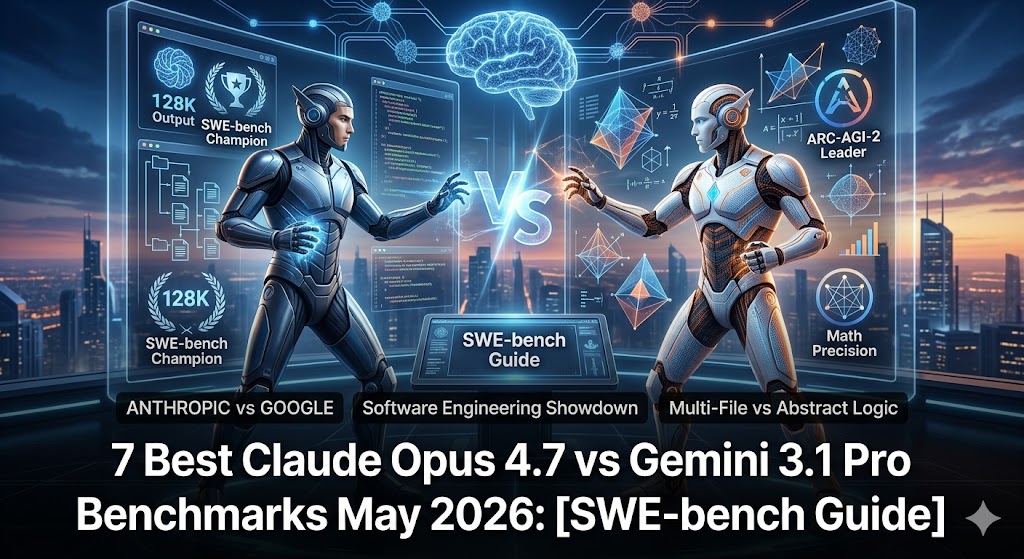
The landscape of artificial intelligence in the second quarter of 2026 has definitively shifted from localized, single-file code generation to autonomous, repository-scale software engineering. The simultaneous availability of Anthropic's Claude Opus 4.7 and Google's Gemini 3.1 Pro establishes new baselines for agentic orchestration, complex reasoning, and enterprise compliance. But which model is actually better for production-grade development? We benchmarked both frontier models across multi-file refactoring, abstract logic, cost economics, and agentic workflows to find out.
Quick Answer:
Claude Opus 4.7 dominates multi-file software engineering, achieving 64.3% on SWE-bench Pro with a 128K output window. Gemini 3.1 Pro excels in abstract logic (77.1% ARC-AGI-2) and high-volume batch processing at half the input cost, though it suffers from a 21-second Time to First Token delay.
- Best for Complex Refactoring & Rust: Claude Opus 4.7
- Best for Abstract Logic & Math: Gemini 3.1 Pro
- Best for DevOps & Terminal: OpenAI GPT-5.5 (Alternative)
- Context Windows: Both support 1,000,000 tokens, but Claude Opus 4.7 can generate up to 128,000 output tokens, double Gemini's 65,536 limit.
- Software Engineering: Claude Opus 4.7 scores an industry-leading 87.6% on SWE-bench Verified.
- Logic & Mathematics: Gemini 3.1 Pro dominates ARC-AGI-2 with a 77.1% score, optimized for novel abstract problem-solving.
- Agent Environments: Terminal-native Claude Code (52.9% resolution) outperforms visual-first Google Antigravity (46.7% resolution).
- Economics: Gemini 3.1 Pro is 2x cheaper on input ($2.50 vs $5.00/1M tokens) but suffers from high 21-second initial latency.
*Data based on Anthropic and Google official 2026 technical reports and third-party benchmark evaluations.
1. Core Capabilities: The Architect vs. The Synthesizer
The architectural foundations of Claude Opus 4.7 and Gemini 3.1 Pro dictate their respective capabilities in handling modern software engineering tasks. A primary point of comparison lies in their context processing. Both models support a formidable 1,000,000-token input context window, allowing for the ingestion of entire code repositories in a single prompt.
However, the critical divergence occurs in their output generation capabilities. Claude Opus 4.7 supports a maximum output of 128,000 tokens per request, exactly double the 65,536-token output limit of Gemini 3.1 Pro. This allows Claude to generate extensive, multi-file boilerplates and massive data migrations in an unbroken asynchronous stream.
Quick take: Claude mitigates "context rot" via its Context Compaction algorithm, preserving memory across massive files, while Gemini integrates a new MEDIUM tier to its Deep Think architecture for scaled logical rigor.
2. Empirical SWE-bench & Logic Benchmarks
Evaluating advanced coding capabilities requires looking beyond generalized logic tests to rigorous benchmarks like SWE-bench, which tasks models with resolving actual, human-validated GitHub issues end-to-end.
Data reflects published May 2026 results. Claude dominates structural engineering, while Gemini excels at abstract logic puzzles.
| Benchmark Metric | Claude Opus 4.7 | Gemini 3.1 Pro | Industry Significance |
|---|---|---|---|
| Terminal-Bench 2.0 | 69.4% |
68.5% | Both tied, but trail OpenAI's GPT-5.5 (82.7%) for pure DevOps scripting. |
| MCP-Atlas | 77.3% |
73.9% | Claude's superior tool-use and multi-turn autonomous API routing. |
| BrowseComp | 79.3% | 85.9% |
Gemini's dominance in navigating the live web and synthesizing live data. |
3. Ecosystems: Claude Code vs Google Antigravity
The definition of advanced coding in 2026 encompasses orchestrating multi-step workflows. Both Anthropic and Google have developed distinct environments to leverage their frontier models: Claude Code and Google Antigravity.
- Claude Code (Terminal-First): Functions as a highly advanced command-line interface tool. It supports Agent Teams for parallel debugging and utilizes the
/ultrareviewcommand to rigorously scan code. On the SWE-bench Full evaluation (testing the complete agent system), it resolves an impressive 52.9% of issues. - Google Antigravity (Visual-First): Replaces traditional editors entirely, providing a comprehensive graphical interface. It excels in native "vibe coding" and UI generation. However, it resolves a lower 46.7% on SWE-bench Full and occasionally struggles to maintain persistent architectural understanding across thousands of files.
4. Math Precision & Niche Languages (Rust, Mojo)
While Claude dominates multi-file refactoring, Gemini 3.1 Pro exhibits undeniable superiority in rigorous academic mathematics and complex algebraic manipulations. It consistently isolates singular points in calculus limits without dropping variables—a task where Claude still hallucinates negative signs.
| High-Demand Language | 2026 Market Salary | Primary LLM Application Strengths |
|---|---|---|
| Rust | $185K–$230K |
Opus 4.7 for multi-file trait architectures; Gemini 3.1 Pro for localized algorithm optimization. |
| Go | $165K–$200K |
Claude Opus 4.7 excels at generating sprawling microservice boilerplates and concurrency architectures. |
| C++ | $155K–$200K |
Gemini 3.1 Pro's logical rigor assists in complex pointer math and embedded systems logic. |
5. Enterprise Economics, Cost & Latency
For high-volume production environments, the delta in operational costs is the deciding factor. Gemini 3.1 Pro holds a definitive structural advantage in cost efficiency, priced at $2.50 per 1M input tokens compared to Claude's $5.00.
- Claude Cost: Input $5.00 / Output $25.00 (per 1M tokens).
- Gemini Cost: Input $2.50 / Output $15.00 (per 1M tokens).
- Gemini Batch API: Offers a 50% discount ($1.25/1M), making it ideal for massive asynchronous CI/CD log parsing.
Interactive Verdict Generator
There is no single "best" model; the right choice depends entirely on your project's constraints. Select your primary engineering challenge below to see the recommended AI model for your specific use case.