GPT-5.5 vs Claude Opus 4.7: The Complete Technical Breakdown (April 2026)
Related Picks — Live Amazon Prices
Verified specs & live Amazon prices • Click any pick to view deals
Find your match in 1 tap:
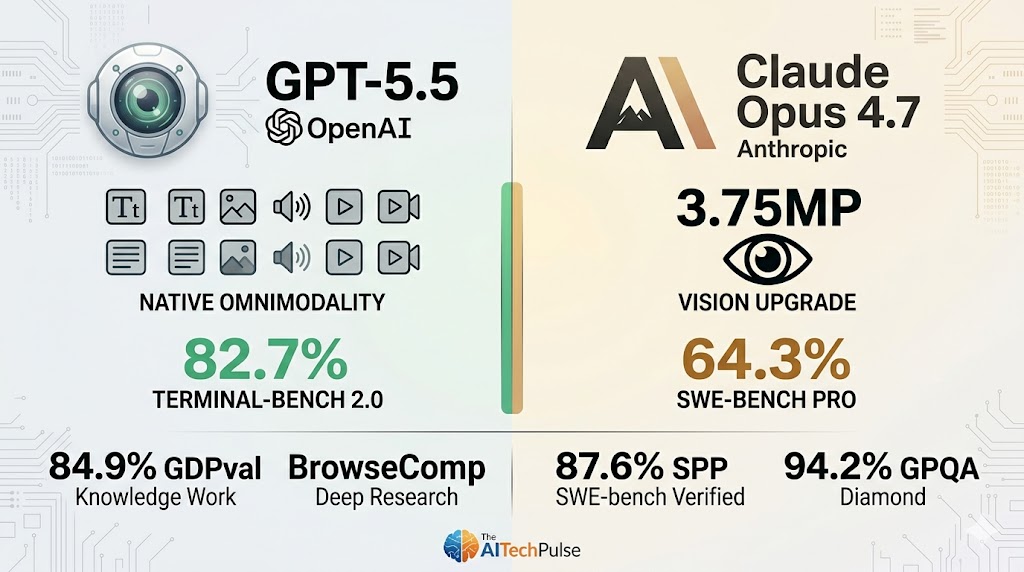
April 2026 just produced the most competitive seven-day stretch in frontier AI history. On April 16, Anthropic shipped Claude Opus 4.7 — a tightly focused upgrade that pushed its SWE-bench Pro score from 53.4% to 64.3% and upgraded vision resolution by 3× to 3.75 megapixels. Then, one week later on April 23, OpenAI fired back with GPT-5.5 (internally codenamed "Spud") — the first fully retrained base model since GPT-4.5, boasting native omnimodality, dramatically improved token efficiency, and state-of-the-art agentic coding on Terminal-Bench 2.0 at 82.7%.
If you're a developer, AI engineer, or enterprise buyer, you now have two of the most capable LLMs ever shipped — available simultaneously, priced similarly, and optimized for subtly different workflows. This article gives you the full technical picture: architecture, benchmarks, pricing economics, agentic capabilities, vision, safety posture, and a practical decision framework.
⚡ TL;DR — Key Takeaways
- GPT-5.5 wins Terminal-Bench 2.0 (82.7% vs 69.4%), OSWorld computer use (78.7% vs 78.0%), GDPval knowledge work (84.9% vs ~80%), BrowseComp web research, FrontierMath, and long-context retrieval at 1M tokens.
- Claude Opus 4.7 wins SWE-bench Pro (64.3% vs 58.6%), SWE-bench Verified (87.6%), MCP-Atlas tool orchestration (77.3% vs 75.3%), GPQA Diamond scientific reasoning (94.2%), Humanity's Last Exam, CursorBench (70%), and visual reasoning (CharXiv 91.0% w/tools).
- Pricing: Both cost $5/M input tokens. Opus 4.7 is $25/M output vs GPT-5.5's $30/M — 17% cheaper per output token. But GPT-5.5 is more token-efficient per task in Codex workflows, which can offset the gap.
- Architecture: GPT-5.5 is natively omnimodal (text+image+audio+video in one system). Opus 4.7 uses a new tokenizer that processes up to 35% more tokens on the same inputs — watch your budget during migration.
- The right answer for most stacks is a routing layer: GPT-5.5 for agentic coding pipelines and computer use, Opus 4.7 for complex multi-file refactors and MCP-heavy orchestration.
Architecture & Fundamental Design Differences
Understanding why these models score differently on different tasks requires understanding how they were built differently.
GPT-5.5: Natively Omnimodal, Fully Retrained
GPT-5.5 is the first OpenAI model since GPT-4.5 to undergo a full base model retraining from scratch rather than a post-training update. OpenAI reports the model uses a Mixture-of-Experts (MoE) architecture with an estimated 3–5 trillion total parameters, paired with optimized sparse attention to sustain its 1M token context window without prohibitive latency overhead. The critical architectural distinction is native omnimodality: text, images, audio, and video are all processed within a single unified system rather than routed through modality-specific encoders. This is what allows GPT-5.5 to reason coherently across interleaved media types in a single pass — and why it shows the strongest gains on multi-modal agentic workflows like OSWorld-Verified.
OpenAI also emphasizes a significant training objective shift. The model was optimized specifically for token efficiency in agentic loops: GPT-5.5 produces better results in Codex with fewer tokens than GPT-5.4, a rare case of simultaneous capability and efficiency improvement. Greg Brockman described it as "a faster, sharper thinker for fewer tokens."
Claude Opus 4.7: Targeted Upgrades on a Proven Foundation
Anthropic's approach with Opus 4.7 was precision over wholesale overhaul. The most impactful architectural changes are a new tokenizer and a high-resolution vision upgrade. The new tokenizer improves performance on a wide range of tasks — but it also uses 1.0–1.35× more tokens than prior models on the same inputs, depending on content type. This is the number one migration risk for enterprise teams with existing Opus 4.6 deployments and tight cost models.
The vision architecture upgrade is decisive for its category: maximum image resolution jumped from 1,568px (1.15MP) on Opus 4.6 to 2,576px (3.75MP) on Opus 4.7 — a 3.3× increase in pixel density. Critically, the model's coordinates are now 1:1 with actual image pixels, eliminating the scale-factor math that complicated earlier computer-use implementations. One early-access partner testing autonomous penetration testing agents reported visual-acuity on screenshots jumping from 54.5% (Opus 4.6) to 98.5% (Opus 4.7) — effectively a different model for vision-dependent workflows.
Opus 4.7 also introduces a new effort parameter: xhigh, positioned between the existing high and max levels. Internal Anthropic data shows xhigh provides a compelling quality-speed-cost sweet spot, approaching max-level performance on coding tasks while spending meaningfully fewer tokens. Claude Code now defaults to xhigh on all plans.
Full Benchmark Comparison Table
All figures are sourced from official OpenAI and Anthropic release materials as of April 23–24, 2026. Cross-lab comparisons should be interpreted with care: labs sometimes evaluate competitors on their own evaluation harnesses, which may not match the conditions under which the competing lab published its own score. Notes on memorization and prompt-tuning are included below.
| Benchmark | What It Measures | GPT-5.5 | Claude Opus 4.7 | Leader |
|---|---|---|---|---|
| Terminal-Bench 2.0 | Complex CLI workflows: planning, iteration, tool coordination | 82.7% | 69.4% | GPT-5.5 |
| SWE-bench Pro | Real-world GitHub issue resolution (end-to-end, single pass) | 58.6% | 64.3% * | Opus 4.7 |
| SWE-bench Verified | 500 human-validated GitHub issues | — | 87.6% | Opus 4.7 |
| Expert-SWE | Long-horizon coding (median ~20hr human tasks) | 73.1% | N/A (not reported) | GPT-5.5 |
| CursorBench | AI coding inside Cursor IDE | — | 70% (↑ from 58%) | Opus 4.7 |
| MCP-Atlas | Complex multi-turn tool-calling / orchestration | 75.3% | 77.3% | Opus 4.7 |
| OSWorld-Verified | Autonomous computer use (real desktop environments) | 78.7% | 78.0% | GPT-5.5 (narrow) |
| GDPval / GDPval-AA | Knowledge work across 44 occupations (Elo-based) | 84.9% / 1,753 Elo | ~80% / ~1,753 Elo | GPT-5.5 |
| GPQA Diamond | Graduate-level scientific reasoning (bio, chem, physics) | — | 94.2% | Opus 4.7 |
| Finance Agent v1.1 | Multi-step financial analysis & modeling | 60.0% | 64.4% | Opus 4.7 |
| BrowseComp | Deep web research retrieval | 89.3–90.1% | 79.3% | GPT-5.5 |
| CharXiv (w/ tools) | Visual reasoning on charts/figures | — | 91.0% | Opus 4.7 |
| FrontierMath Tier 4 | Hardest mathematical reasoning problems | 39.6% | — | GPT-5.5 Pro |
| CyberGym | Vulnerability reproduction | — | 73.1% | Restricted (Mythos: 83.1%) |
| Tau2-bench Telecom | Complex customer-service workflows | 98.0% | — | GPT-5.5 |
* OpenAI notes labs have found signs of memorization on a subset of SWE-bench Pro problems, which may affect the comparison. Anthropic has acknowledged and excluded affected items. Cross-lab eval conditions vary. Always retest on your own workloads before drawing production conclusions.
(Best-in-class CLI/agentic)
(Best available model)
(44-occupation knowledge work)
(Graduate sci. reasoning)
Agentic Coding: The Most Contested Category
Agentic coding — the ability of a model to autonomously plan, execute, debug, and validate multi-step software engineering tasks — is where both labs planted their biggest flags in April 2026. The results are genuinely split depending on task type.
GPT-5.5's Advantage: Long-Horizon Workflows and CLI Fluency
GPT-5.5's 82.7% on Terminal-Bench 2.0 is a 13.3-point lead over Opus 4.7 and a clear state-of-the-art result. Terminal-Bench 2.0 specifically measures multi-step planning, iteration with tool feedback, and tool coordination inside command-line environments — exactly the kind of flow that Codex is designed to orchestrate. On OpenAI's internal Expert-SWE benchmark (tasks with a median estimated 20-hour human completion time), GPT-5.5 reports 73.1%, a category where Opus 4.7 doesn't publish a direct number.
Early testers of GPT-5.5 used phrases like "the first coding model I've used that has serious conceptual clarity." The model understands system architecture at a structural level — not just which line to change, but why the system is failing and what the downstream implications of a fix will be across other modules.
Opus 4.7's Advantage: Multi-File Refactors and MCP Orchestration
For pure code quality on hard multi-file problems, Opus 4.7 maintains an edge. Its 64.3% on SWE-bench Pro (vs 58.6% for GPT-5.5) reflects better multi-file coherence: it is less likely to make a change in one file that breaks a dependency in another. This matters enormously in production codebases where a logical change touches multiple modules.
On MCP-Atlas — the closest benchmark to real production agent behavior, measuring complex multi-turn tool-calling — Opus 4.7 scores 77.3% vs GPT-5.5's 75.3%. For teams building orchestration agents that route to multiple tools in a single workflow, this is the benchmark to weight most heavily. Early-access partner Warp confirmed that Opus 4.7 passed Terminal-Bench tasks that Opus 4.6 had failed, including a concurrency bug that the older model couldn't crack — so the model's own generation-over-generation gains are significant even if GPT-5.5 has the broader Terminal-Bench lead.
/ultrareview command in Claude Code (new in Opus 4.7) provides a senior-engineer-grade multi-pass code review that GPT-5.5 currently has no direct equivalent to.
Vision & Multimodal Capabilities
Vision is where the two models have taken clearly different paths in April 2026.
Claude Opus 4.7: The Vision Leap
The single most significant change in Opus 4.7 is its vision upgrade. Resolution jumped from a maximum of 1,568px (1.15MP) on all prior Claude models to 2,576px (3.75MP) — more than 3× the pixel area. This isn't incremental; it's the difference between a model that approximates what's in a screenshot and one that can read fine print in a dense UI. On CharXiv visual reasoning (with tools), Opus 4.7 scores 91.0%, a 6-point improvement. On a visual navigation benchmark without tools, it goes from 57.7% (Opus 4.6) to 79.5%. The coordinate system is now pixel-exact, making computer use agents far simpler to implement correctly.
GPT-5.5: Natively Omnimodal Across All Modalities
GPT-5.5's vision story is less about resolution-per-image and more about unified cross-modal reasoning. As a natively omnimodal system, it processes text, images, audio, and video in a single forward pass. This means it can handle interleaved video frames, spoken dialogue, and on-screen text simultaneously — a capability class that Opus 4.7's architecture doesn't yet match for audio and video. For teams building multimodal agents that need to reason across more than static images, GPT-5.5's architecture is the more future-proof foundation today.
Pricing & Real-World Cost Economics
The headline prices look nearly identical. The effective economics diverge significantly once you account for architecture differences.
| Cost Factor | GPT-5.5 | Claude Opus 4.7 |
|---|---|---|
| Input tokens | $5 / M | $5 / M |
| Output tokens | $30 / M | $25 / M |
| Batch / Flex pricing | 50% of standard | Available |
| GPT-5.5 Pro / Premium tier | $30 in / $180 out | Mythos Preview (restricted) |
| Context window | 1M (standard pricing) | 1M (no long-context premium) |
| Tokenizer inflation | None (more efficient vs 5.4) | +0%–35% vs Opus 4.6 (by content) |
| API availability | Pending (different safeguards needed) | Live on API, Bedrock, Vertex AI, Foundry |
The key insight: Opus 4.7 is 17% cheaper on output tokens. But GPT-5.5 uses fewer tokens per equivalent task in Codex-style agentic loops — OpenAI claims it delivers better Codex results with fewer tokens than GPT-5.4 across most tasks. For teams with heavy output-token usage (long generations, reasoning traces), Opus 4.7's $25/M output rate is meaningful. For teams with high-volume short generations and agentic loops, GPT-5.5's efficiency gains may offset its higher per-token output price.
/v1/messages/count_tokens before committing to a migration budget. Additionally, setting temperature, top_p, or top_k to any non-default value in the Messages API now returns a 400 error — a breaking change for any pipeline that relied on those parameters.
Key New Features: What Actually Changed
Claude Opus 4.7 New Features
Task Budgets (Public Beta): Developers can set a hard token ceiling for an entire agentic loop — including thinking, tool calls, tool results, and final output. The model receives a running countdown and gracefully prioritizes work as the budget is consumed. This directly addresses the "runaway agent" cost problem that has plagued production deployments.
xhigh Effort Level: A new setting between high and max that fills a gap developers had been papering over with custom prompt engineering. Claude Code defaults to xhigh for all plans, and internal Anthropic data shows it approaches max-level coding performance at meaningfully lower cost.
/ultrareview in Claude Code: A new command designed to simulate a senior engineer code review — going beyond syntax checking to flag subtle design flaws, logic gaps, and edge cases across multiple passes.
Thinking Content Opt-In: Starting with Opus 4.7, thinking blocks appear in the response stream but their content field is empty by default (a silent change that improves latency). Teams that stream reasoning to users must explicitly set "display": "summarized" to restore visible thinking output.
GPT-5.5 New Features
Native Omnimodality: Full text-image-audio-video processing in a single unified system. No modality-specific routing required, which reduces implementation complexity and enables cross-modal reasoning that wasn't previously possible in a single API call.
Improved Contextual Task Planning: The model can receive "messy, multi-part tasks" and autonomously break them into a coherent plan, assign tools, check its own work, and iterate to completion with less user guidance than any prior OpenAI model.
Enhanced Cyber Safeguards: GPT-5.5 ships with stricter classifiers for cybersecurity risk, building on safeguards introduced in GPT-5.2. OpenAI's VP of Research described the approach as "trusted access with robust safeguards that scale with capability."
Agentic Autonomy & Safety Architecture
Both labs are navigating a version of the same tension: the more capable a model is at autonomous, long-horizon tasks, the more dangerous its potential misuse becomes.
Anthropic's approach reflects a deliberate capability tiering. Claude Opus 4.7 is positioned as the most capable publicly available model — but Anthropic explicitly acknowledges that Claude Mythos Preview is more powerful overall. Mythos Preview scored 93.9% on SWE-bench Verified versus Opus 4.7's 87.6%, and 83.1% on CyberGym vs Opus 4.7's 73.1%. Mythos remains restricted precisely because of its cybersecurity capabilities, with Project Glasswing managing controlled access in partnership with external security researchers. Opus 4.7 serves as the testbed for new automated cybersecurity safeguards before they propagate to Mythos-class models.
OpenAI's GPT-5.5, released just one week after Anthropic's Opus 4.7, went through full preparedness evaluations, red teaming for cyber and bio risks, and external expert testing before launch. Critically, the API release of GPT-5.5 is still pending as of April 24 — OpenAI stated that API deployment "requires different safeguards," suggesting the model's cybersecurity profile requires additional guardrails before broad developer access.
Decision Matrix: Which Model Should You Use?
Pick GPT-5.5 For…
- Agentic CLI / Codex pipelines (Terminal-Bench dominance)
- Long-horizon coding tasks (Expert-SWE: 73.1%)
- Autonomous computer use at scale
- Web research-heavy workflows (BrowseComp 90.1%)
- Cross-modal agents (text + audio + video)
- Frontier math and scientific research
- High-volume tasks where token efficiency per call matters
- Telecom / customer service workflow automation
Pick Claude Opus 4.7 For…
- Complex multi-file refactors (SWE-bench Pro 64.3%)
- MCP-heavy tool orchestration (MCP-Atlas 77.3%)
- Vision-critical workflows (3.75MP images, 98.5% visual-acuity)
- Graduate-level scientific reasoning (GPQA Diamond 94.2%)
- Financial modeling & document analysis
- Enterprise deployments on Bedrock / Vertex AI / Foundry (API live now)
- Cost-sensitive output-heavy workloads ($25 vs $30/M output)
- Code review quality via /ultrareview
Market Context: Why This Week Matters
This comparison doesn't happen in a vacuum. GPT-5.5 launched just six weeks after GPT-5.4 (released March 5, 2026) — a turnaround pace that Fortune described as AI model launches starting to look like software updates. OpenAI now counts 900 million weekly active ChatGPT users, 50 million subscribers, and 4 million weekly Codex developers. Despite that scale, the company has been under growing narrative pressure that it has "lost traction among consumers" and fallen behind Anthropic in the enterprise market.
Anthropic, for its part, is riding an extraordinary growth curve. VentureBeat reported Anthropic's annual run-rate revenue reached $30 billion in April 2026, with venture capital firms reportedly extending offers at an $800 billion valuation — more than double the $380 billion Series G from February 2026. Claude Code has become the engine of this growth, with enterprise teams reporting 5–10 hours of weekly productivity savings per developer. The success of Claude Mythos Preview in enterprise sales ("captivating Wall Street" per multiple reports) is precisely why OpenAI needed GPT-5.5 to land strong on agentic coding benchmarks.
Both models represent what happens when frontier labs race at full speed. The winner, for now, depends entirely on your workflow. But the real story is that the gap between the two labs has never been smaller — and the pace of releases means this comparison will need to be rewritten within weeks.
Frequently Asked Questions
Sources: OpenAI GPT-5.5 Technical Report (April 23, 2026), Anthropic Claude Opus 4.7 Release Notes (April 16, 2026), VentureBeat Anthropic Revenue Analysis (April 2026), Fortune AI Model Launch Coverage (April 2026). Updated April 24, 2026. — TheAITechPulse Team, TheAITechPulse