
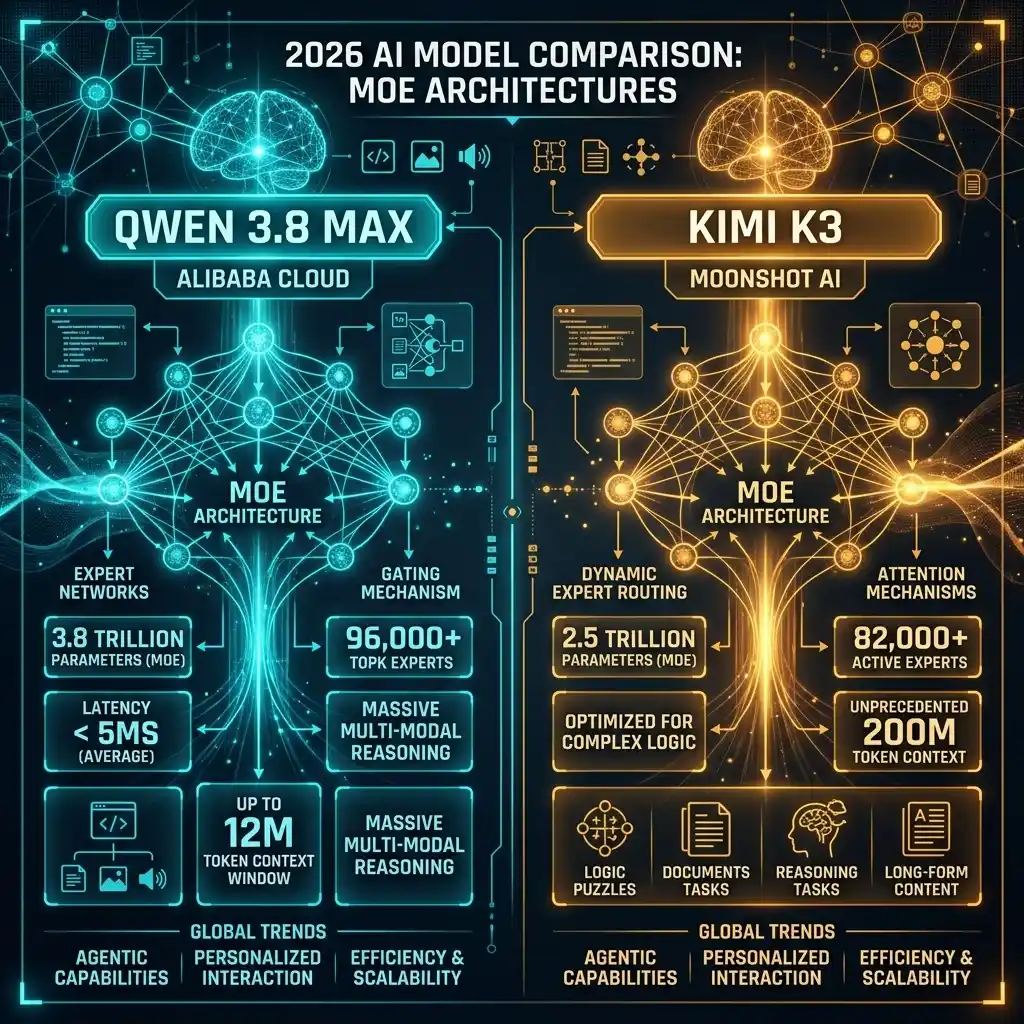
In July 2026, Kimi K3 and Qwen 3.8 Max fundamentally redefined frontier artificial intelligence. Kimi K3 leads in open-weight enterprise hosting with a 2.8T MoE architecture, always-on reasoning, and 90% prompt-caching savings. Qwen 3.8 Max excels in autonomous multi-hour test-time compute loops and native video multimodality backed by Alibaba Cloud's hyperscale infrastructure.
For the preceding two years, the global artificial intelligence landscape operated under a stable geopolitical split: Western laboratories such as OpenAI, Anthropic, and Google dominated abstract reasoning with closed, premium models, while Eastern laboratories provided budget-conscious open-weight alternatives for volume processing. The back-to-back releases of Moonshot AI’s Kimi K3 on July 16, 2026, and Alibaba Cloud’s Qwen 3.8 Max on July 19, 2026, have permanently dismantled this paradigm. Both models directly challenge top proprietary baselines like Claude Fable 5 and GPT-5.6 Sol while establishing new benchmarks for sparse Mixture-of-Experts (MoE) efficiency, test-time compute deliberation, and 1-million-token context window performance.
Quick Answer: Which Model Should You Deploy in 2026?
The choice between Kimi K3 and Qwen 3.8 Max depends on your infrastructure deployment model and task latency requirements:
- For Air-Gapped & Sovereign Enterprise AI: Deploy Kimi K3 (2.8T open-weight MoE activating 16 of 896 experts for local hosting).
- For Asynchronous Agentic Dev & Extended Verification: Use Qwen 3.8 Max (30–80 min autonomous test-time compute loops with Playwright browser self-testing).
- For High-Volume Codebases & RAG Workflows: Choose Kimi K3 ($0.30 per 1M cached input tokens with flat 1M context window pricing).
- 1. Architectural Paradigms: The Multi-Trillion Parameter Era
- 2. Cognitive Frameworks: Test-Time Compute & Latency Dynamics
- 3. Capability Benchmarking & 1M Context Window Efficacy
- 4. Enterprise Unit Economics: Pricing, Caching & TCO
- 5. Real-World Workload Scenario Comparisons
- 6. Open-Weight Shift & Strategic Implications
- 7. The Verdict for Systems Architects
- Frequently Asked Questions
- Kimi K3 Scale: 2.8 Trillion total parameters open-weight MoE activating 16 of 896 experts (1.78% sparsity ratio).
- Qwen 3.8 Max Multimodality: 2.4 Trillion parameter sparse MoE with native late-fusion support for Text, Image, Video, and PDF Documents.
- Steerable Cognitive Effort: Kimi K3 uses an "always-on" thinking mode steerable via
reasoning_effort(low, high, max). - Prompt Caching Advantage: Kimi K3 offers a 90% prompt-caching discount, dropping cached input tokens to $0.30 per 1M tokens.
Data verified against Artificial Analysis, GDPval-AA benchmarks, and official lab release notes as of July 2026.
Quick take: The simultaneous releases of Kimi K3 and Qwen 3.8 Max prove that the capability frontier is no longer a Western monopoly. The primary differentiator for enterprise AI in 2026 has shifted from raw parameter scaling to inference-time deliberation, context caching efficiency, and multi-agent orchestration.
1. Architectural Paradigms: The Multi-Trillion Parameter Era
The defining characteristic of the July 2026 foundation model generation is the massive expansion of parameter counts deployed within hyper-sparse Mixture-of-Experts (MoE) frameworks. Brute-force scaling laws—historically governed by Chinchilla mandates requiring proportional pre-training token scaling—have evolved into architectures designed to maximize latent intelligence while aggressively minimizing active parameter execution during any single inference token pass.
1.1 Kimi K3: The 2.8 Trillion Parameter Open-Weight Behemoth
Moonshot AI’s Kimi K3 features a staggering 2.8 trillion total parameters, representing the largest open-weight AI model ever published. Despite its massive total capacity, Kimi K3 activates only 16 of its 896 internal experts for any given token. This extreme sparsity ratio of approximately 1.78 percent allows the model to house vast repositories of domain-specific latent knowledge—ranging from legal precedent to systems-level C++ memory management—without incurring prohibitive thermal or memory bandwidth penalties.
To manage its 1,048,576-token context window without middle-document degradation, Kimi K3 introduces Kimi Delta Attention combined with Attention Residuals. Crucially, Kimi K3 enforces an "always-on" reasoning mode by default. Rather than toggling an external reasoning switch, developers configure cognitive effort dynamically via the API request parameter reasoning_effort (accepting low, high, or max).
1.2 Qwen 3.8 Max: Multimodal Density and Protocol Fluidity
Alibaba Cloud previewed Qwen 3.8 Max at the World AI Conference (WAIC) in Shanghai as a 2.4 trillion parameter sparse MoE architecture. It represents the first multimodal model in the Qwen family to cross the one-trillion parameter threshold, processing text, images, video streams, and complex PDF documents via late-fusion multimodal encoders.
A strategic highlight of Qwen 3.8 Max is its protocol-fluid API layer. Alibaba engineered its endpoints to parse both OpenAI and Anthropic API header schemas natively. Enterprise engineering teams can drop Qwen 3.8 Max into existing agentic harnesses, Cursor IDE setups, or LangChain pipelines by changing only the baseURL and authorization key—eliminating custom integration code.
2. Cognitive Frameworks: Test-Time Compute & Latency Dynamics
The most consequential shift in 2026 artificial intelligence is the decoupling of model intelligence from pre-training data volume, placing a premium on "test-time compute." Test-time compute refers to the internal chain-of-thought, hypothesis testing, and self-verification loops a model executes after receiving a user prompt but before returning visible output tokens.
2.1 Kimi K3: The Token Cost of Continuous Thought
Kimi K3 leverages its always-on reasoning to deliver rapid, steerable outputs for synchronous developer workflows. Empirical evaluations demonstrate that Kimi K3 resolves asynchronous race condition bugs in single passes that previously required extensive prompt hinting. However, this internal verification increases model verbosity: Artificial Analysis benchmarks confirmed Kimi K3 generated 130 million tokens during a standardized test suite, compared to an industry average of 63 million tokens.
2.2 Qwen 3.8 Max: Asynchronous Autonomy and Extended Deliberation
Conversely, Qwen 3.8 Max operates as an asynchronous autonomous worker rather than a real-time conversational agent. In empirical testing, when tasked with creating a full-stack e-commerce store, Qwen 3.8 Max entered a 35-minute background loop—utilizing the Playwright browser testing framework to independently compile, visually test button bounds, resolve viewport edge cases, and add unprompted checkout features before returning a flawless payload.
reasoning_effort=max can rapidly inflate API bills. Always calibrate reasoning effort parameters for routine tasks.
3. Capability Benchmarking & 1M Context Window Efficacy
Evaluating frontier models in 2026 requires looking beyond saturated legacy benchmarks like MMLU or HumanEval (where top models universally score above 90%). Differentiation relies on graduate-level academic reasoning, multi-modal spatial extraction, and long-context retrieval over 500,000+ tokens.
3.1 Kimi K3: Verified Quantitative Benchmark Dominance
Moonshot AI subjected Kimi K3 to immediate independent evaluation upon launch. On GDPval-AA—an index measuring economically valuable professional work across legal, finance, and engineering sectors—Kimi K3 achieved an Elo rating of 1668, ranking #3 globally.
| Benchmark / Evaluation Metric | Kimi K3 Score | Domain Tested |
|---|---|---|
| GPQA (Diamond) | 93.5% | Graduate-level academic reasoning in physics, biology, and chemistry. |
| MathVision | 97.8% | Mathematical reasoning derived from visual inputs and complex diagrams. |
| CharXiv-R | 91.3% | Complex chart data extraction and financial visual parsing. |
| MMMU-Pro | 81.6% | Massive Multi-discipline Multimodal Understanding. |
| DeepSearchQA | 95.0% | Agentic information retrieval and multi-source synthesis. |
| BrowseComp | 91.2% | Autonomous web browsing and multi-step task completion. |
Data sourced from independent benchmark aggregates as of July 2026.
3.2 1,048,576 Token Context Retrieval Efficacy
In real-world needle-in-a-haystack stress tests loading 650,000 tokens of mixed C++ and TypeScript microservices alongside technical specification docs, Kimi K3 accurately retrieved file-level dependency references from early, middle, and late context regions, missing only a single obscure reference past the 500k token mark.
4. Enterprise Unit Economics: Pricing, Caching & TCO
The commercial strategies of Moonshot AI and Alibaba Cloud highlight contrasting foundation model unit economics. Moonshot AI prices Kimi K3 at $3.00 per 1M input tokens and $15.00 per 1M output tokens—identical to Anthropic's Claude Sonnet tier.
| Pricing & Cost Dimension | Kimi K3 (Moonshot AI) | Qwen 3.8 Max (Alibaba Cloud) | Claude Fable 5 Baseline |
|---|---|---|---|
| Base API Input (1M Tokens) | $3.00 | Subsidized Preview (~$0.30) | $3.00 – $10.00 |
| Base API Output (1M Tokens) | $15.00 | Subsidized Preview (~$1.50) | $15.00 – $37.50 |
| Prompt Cache Discount | 90% ($0.30/1M cached) | Standard Cloud Caching | Variable Tiered |
| Extra-Long Context Penalty | None (Flat across 1M) | None | Tiered Penalty Rates |
| Infrastructure Model | Pure-Play AI Lab (Leased Compute) | Hyperscaler (Internalized Margins) | Proprietary Cloud Partners |
For an enterprise running 20 Million input tokens and 5 Million output tokens monthly with a 70% prompt-cache hit rate, Kimi K3's 90% caching discount drops monthly spend from $135.00 down to $97.00. Conversely, Alibaba Cloud owns its physical real estate, power agreements, and fiber networks. This vertical integration allows Alibaba to treat Qwen 3.8 Max as a loss-leader to drive enterprise adoption across Alibaba Cloud storage and database services.
5. Real-World Workload Scenario Comparisons
✔ Scenario 1: Refactoring a 650K-Token Codebase with Async Race Conditions
network_worker.cpp#L142 and stale promises in session_manager.ts#L88 in a single pass. Returned complete unified diffs within 42 seconds.✔ Scenario 2: One-Shot Full-Stack E-Commerce App Development
✔ Scenario 3: Multi-Page Financial Chart & Video Stream Ingestion
6. Open-Weight Shift & Strategic Implications
The availability of a 2.8 trillion parameter model as an open-weight asset commoditizes the raw software capability frontier. However, self-hosting Kimi K3 requires massive hardware resources: even when aggressively quantized, holding 2.8T parameters in VRAM memory demands over 1TB of high-speed GPU memory (e.g. interconnected NVIDIA H200/B200 clusters).
Consequently, the primary beneficiaries of open-weight behemoths are sovereign states seeking AI independence, enterprise data centers, and tier-two cloud providers. Proprietary Western laboratories face increasing pressure to differentiate through proprietary execution environments, specialized data access, and Generative UI integration.
7. The Verdict for Systems Architects
The simultaneous arrival of Kimi K3 and Qwen 3.8 Max in July 2026 establishes a multipolar artificial intelligence baseline. Enterprise systems architects should deploy dynamic routing frameworks matching task requirements to model strengths:
• Standardize on Kimi K3 for self-hosted enterprise infrastructure, real-time developer workflows, and long-context RAG pipelines where 90% prompt caching provides maximum cost control.
• Utilize Qwen 3.8 Max for asynchronous background agents, one-shot code generation requiring Playwright validation, and video/document multimodal pipelines.
Frequently Asked Questions
Sources: Moonshot AI Kimi K3 Technical Release (July 2026), Alibaba Cloud Qwen 3.8 Max Preview Documentation (WAIC 2026), Artificial Analysis Intelligence Index, GDPval-AA Benchmark Leaderboard. — Himansh, TheAITechPulse
