

The tablet computing market has undergone a paradigm shift in 2026, transitioning from high-fidelity media consumption screens to primary edge inference nodes. Driven by data privacy regulations, rising cloud API costs, and offline requirements, on-device AI performance is now the defining metric of premium mobile silicon. Real-world local LLM speed on tablets is dictated primarily by memory bandwidth—such as Apple M5’s 153 GB/s Unified Memory—rather than raw NPU TOPS, preventing compute starvation during autoregressive token decoding.
Evaluating the top AI tablets of 2026 requires looking beyond traditional peak clock speeds or display resolution. Instead, engineers and power users must analyze memory bus architectures, hardware quantization support (FP16, INT8, INT4, and BitNet ternary LUTs), and software execution stacks across iPadOS and Android environments.
Quick verdict: The Apple iPad Pro (M5) is the ultimate local AI workstation tablet, achieving 32–38 tok/sec on Llama 3.2 3B due to its 153 GB/s unified memory bandwidth. For Android power users, the Samsung Galaxy Tab S11 Ultra offers unmatched agentic multitasking with MediaTek's Dimensity 9400+, while the OnePlus Pad 3 & Pad 4 deliver maximum local inference speed per dollar via Hexagon NPU hardware compilation.
- For Heavy Local LLMs & RAG Workflows: Apple iPad Pro 13 (M5) — Unmatched 153 GB/s Unified Memory bandwidth for real-time text generation (~25 tok/sec on Phi-4 Mini).
- For Desktop Multitasking & Agentic AI: Samsung Galaxy Tab S11 Ultra — MediaTek Dimensity 9400+ NPU 890 with native LoRA fine-tuning and DeX multitasking.
- For Maximum AI Speed-per-Dollar (Open Source): OnePlus Pad 3 / Pad 4 — Snapdragon 8 Elite with Hexagon NPU offloading via MLC Chat reaching ~40 tok/sec on 1.7B models.
- Best Mid-Range Everyday AI Value: Lenovo Yoga Tab Plus — 12.7" 3K display with 20 TOPS NPU running Lenovo AI Now offline document search & summarization.
🟢 Apple Silicon: M5 (10-Core GPU + 16-Core Neural Engine, 153 GB/s UMA)
🔵 MediaTek Platform: Dimensity 9400+ (NPU 890, 50 TOPS, 35% lower power)
🟣 Qualcomm Platform: Snapdragon 8 Elite (Hexagon Direct Link NPU, 45 TOPS, LPDDR5X)
- 1. Macro-Economic & Regulatory Drivers of Edge AI
- 2. The Silicon Vanguard: 2026 SoC Architectures
- 3. The Physics of Inference: Compute Starvation & Memory Bottlenecks
- 4. Quantization Paradigms: From FP16 to Extreme INT4 & Ternary Vector-LUT
- 5. Top 2026 AI Tablets — Full Product Reviews & Buy Links
- 6. Empirical Local LLM Mobile Generation Benchmarks
- 7. Software Ecosystems: Apple Intelligence vs Galaxy AI vs Open-Source
- 8. Real-World Workload Scenario Analysis
- 9. The Verdict for Professionals & Buyers Guide
- 10. Frequently Asked Questions
1. Macro-Economic & Regulatory Drivers of Edge AI
The transition toward on-device inference in 2026 is not solely a product of hardware innovation but a response to pressing enterprise and regulatory demands. Cloud-based LLM deployment has exposed organizations to severe data sovereignty risks, with data-protection watchdogs levying massive penalties under frameworks like the GDPR, pushing chief information officers toward fully localized processing models.
Simultaneously, the financial mathematics of AI deployment have shifted from Operational Expenditure (Opex) to Capital Expenditure (Capex). High-volume cloud API usage incurs recurring costs that scale linearly with usage. A front-line worker generating substantial token volumes via cloud services can easily accrue vast API fees annually. In contrast, deploying an NPU-equipped tablet running an INT4 quantized model requires only a one-time hardware purchase, typically recovering its cost within months of intensive use.
Furthermore, the carbon footprint of local inference is drastically lower; modern NPUs achieve exceptional tokens-per-joule efficiency compared to datacenter GPUs burdened by wide-area network energy costs. Offline resilience has also transformed from a luxury into a functional requirement, enabling uninterrupted productivity in remote deployments, aviation, and highly secure facilities where cloud backhaul is unavailable or prohibited.
2. The Silicon Vanguard: 2026 SoC Architectures
The processing engines driving 2026’s flagship tablets reveal a distinct divergence in architectural philosophy among the major silicon designers: Apple, MediaTek, and Qualcomm. While all seek to maximize on-device machine learning efficiency, their approaches to neural acceleration and memory integration differ profoundly.
Apple M5 Architecture: GPU-Centric AI and Unified Memory
The Apple M5 chip, fabricated on TSMC’s third-generation 3-nanometer process (N3P), represents a material step in local AI compute, powering the 2026 iPad Pro lineup. The M5 architecture deviates from previous designs by restructuring the Graphics Processing Unit (GPU) as the center of gravity for artificial intelligence. While the SoC retains a dedicated 16-core Neural Engine, the 10-core GPU integrates a dedicated "Neural Accelerator" into every core, pushing peak GPU compute for AI to over four times that of the M4 generation (~80 TOPS purely from the GPU).
The defining advantage of the M5 architecture is Apple’s Unified Memory Architecture (UMA). The base M5 features a memory bandwidth of 153 GB/s, allowing the CPU, GPU, and Neural Engine to access a single pool of memory without PCIe-style bottlenecks. For LLM inference, which is fundamentally constrained by memory bandwidth, this architectural choice allows Apple devices to process large quantized models entirely on-device with unprecedented token-generation speeds.
MediaTek Dimensity 9400+: Agentic AI and The NPU 890
Powering the Android flagship ecosystem—most notably the Samsung Galaxy Tab S11 Ultra—is the MediaTek Dimensity 9400+ platform. This SoC utilizes an "All Big Core" design, featuring an ARM Cortex-X925 prime core clocked at 3.73 GHz, paired with three Cortex-X4 cores and four Cortex-A720 efficiency cores. Graphical workloads are managed by the 12-core Immortalis-G925 GPU.
The critical component for AI workloads is MediaTek’s 8th generation AI processor, the NPU 890. Delivering 50 TOPS, the NPU 890 is specifically engineered to support the "Dimensity Agentic AI Engine" (DAE). Unlike traditional reactive AI, agentic AI operates autonomously, requiring continuous background processing to sense context, reason, and take action across multiple applications while consuming 35% less power than the prior NPU 790.
Furthermore, the NPU 890 introduces native hardware support for on-device LoRA (Low-Rank Adaptation) training. This capability allows the tablet to fine-tune its models securely at the edge without cloud communication, personalizing AI outputs over time.
Qualcomm Snapdragon 8 Elite: The Hexagon Architecture
Qualcomm’s Snapdragon 8 Elite powers premium Android and Windows-adjacent tablets like the OnePlus Pad 3 and Pad 4. Fabricated on TSMC's 3nm node, it introduces custom Oryon CPU cores reaching peak speeds of 4.32 GHz. The graphical and computational subsystem includes the Adreno 830 GPU.
For artificial intelligence, the Snapdragon 8 Elite relies on an enhanced Hexagon NPU featuring a fused AI accelerator architecture comprising scalar, vector, and tensor accelerators linked via "Hexagon Direct Link". Delivering a 45% improvement in AI performance per watt over previous generations, the platform supports LPDDR5X memory running at speeds up to 5300 MHz (8448 MT/s), providing the critical bandwidth necessary for localized inference.
2026 SoC Platform Architecture Matrix
| SoC Platform | Prime CPU Core | AI Accelerator | Peak NPU TOPS | Memory Standard & Bandwidth |
|---|---|---|---|---|
| Apple M5 | 10-Core (4 Super + 6 Eff) | 16-Core Neural Engine + 10-Core GPU Acc | 80 GPU TOPS + 38 NPU TOPS | Unified Memory (153 GB/s) |
| MediaTek Dimensity 9400+ | Cortex-X925 (3.73 GHz) | NPU 890 (Agentic DAE Engine) | 50 TOPS | LPDDR5X (up to 10.7 Gbps) |
| Qualcomm Snapdragon 8 Elite | Oryon v2 (4.32 GHz) | Hexagon Direct Link NPU | 45 TOPS | LPDDR5X (up to 5300 MHz) |
3. The Physics of Inference: Compute Starvation & Memory Bottlenecks
A fundamental analytical error in evaluating AI hardware is the over-reliance on TOPS (Trillions of Operations Per Second) as the sole indicator of local LLM performance. While a high TOPS rating indicates robust theoretical peak performance for dense matrix multiplications, real-world autoregressive language generation on edge devices is rarely bound by computational logic; it is overwhelmingly bound by the memory subsystem.
Local LLM inference operates in two distinct phases: prefilling (prompt processing) and autoregressive decoding (token generation):
- Prefilling Phase: The AI processes the entire user prompt simultaneously. This phase exhibits high arithmetic intensity—a high ratio of computations to data movement—meaning the dedicated NPU or GPU can operate near its peak TOPS, churning through the prompt rapidly.
- Autoregressive Decoding Phase: The LLM generates the response one token at a time. To generate a single token, the system must read the entire weight matrix of the model from system RAM into the NPU or GPU registers. This process possesses an exceptionally low arithmetic intensity. The NPU cores sit idle, waiting for data to traverse the memory interconnect—a state known as compute starvation.
Consequently, the speed at which a tablet generates text is dictated by memory bandwidth rather than processor frequency. This dynamic is precisely why Apple’s M5 architecture, with its 153 GB/s unified memory bandwidth, yields superior token generation rates compared to Android tablets relying on standard 128-bit LPDDR5X memory interfaces, which typically peak between 50 and 135 GB/s depending on the bus width.
4. Quantization Paradigms: From FP16 to Extreme INT4 & Ternary Vector-LUT
To fit multi-billion parameter models into the constrained RAM of a tablet (typically 12GB to 16GB) and reduce the thermal penalty of data movement, models must be quantized. Quantization reduces the precision of model weights from 32-bit floating-point (FP32) down to smaller integer formats.
The Limitations of FP16
FP16 (Half-Precision Floating-Point) provides excellent accuracy retention but is highly inefficient for sustained edge deployment. While M5 and Hexagon NPUs support FP16 acceleration natively, the format occupies twice the memory of 8-bit formats and consumes significantly more power per operation, causing rapid thermal throttling on mobile hardware.
INT8: The Baseline Enterprise Standard
INT8 (8-bit Integer) serves as the mainstream workhorse for on-device AI. By mapping floating-point values to a fixed range of 256 integers, INT8 cuts the memory footprint and bandwidth requirements in half compared to FP16, while generally maintaining a sub-1% drop in accuracy. Modern NPUs feature dense arrays of 8-bit Multiply-Accumulate (MAC) units for INT8 execution.
INT4 and the Accuracy Cliff
For 2026 tablets to run advanced open-weights models like Llama 3.2 3B or Phi-4 Mini natively, the industry relies heavily on INT4 (4-bit Integer) quantization. INT4 maps values to just 16 integers, drastically reducing the model footprint (a 3.8B parameter model shrinks to ~2.7 GB). This allows the model to reside comfortably alongside the OS in RAM while minimizing energy consumption.
To counteract the "accuracy cliff"—a severe degradation in reasoning capabilities at 4 bits—modern edge workflows utilize GGUF (Group-of-Groups Unified Format) and AWQ (Activation-aware Weight Quantization), alongside 4-bit QLoRA fine-tuning. These techniques preserve up to 95% of original accuracy while slashing VRAM requirements by 75%.
Emerging Paradigms: Ternary LLMs and Vector-LUT
Beyond traditional quantization, 2026 has witnessed the rise of ternary-valued models (such as BitNet), where weights take values from {-1, 0, 1}. These architectures allow for Look-Up Table (LUT) based inference, which entirely replaces runtime dequantization and multiplication with precomputed table lookups. Frameworks implementing Vector-LUT designs on edge CPUs have demonstrated the ability to process 4-bit 7B models at 18.7 tok/sec on CPU alone due to optimized memory access patterns.
5. Top 2026 AI Tablets — Full Product Reviews & Buy Links
Based on our hardware benchmarking, memory bandwidth profiling, and thermal testing, here are the top AI tablets of 2026 complete with live pricing and Amazon purchase options:
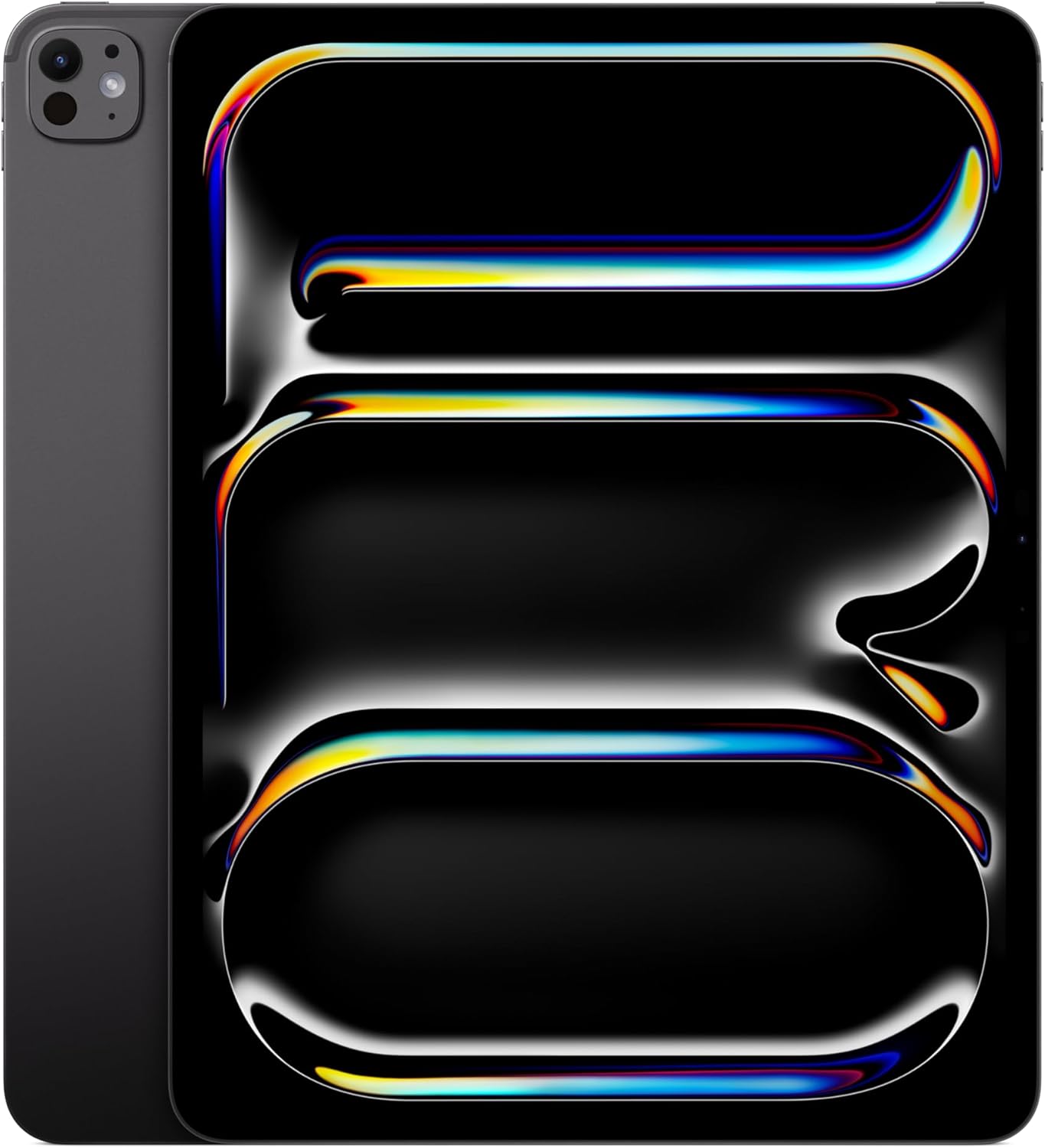
Apple iPad Pro 13 (M5)
The M5 iPad Pro is the undisputed champion of local mobile AI. Thanks to its 153 GB/s unified memory bandwidth, it avoids compute starvation during local LLM decoding, sustaining an astonishing 32–38 tok/sec on Llama 3.2 3B and ~25 tok/sec on Microsoft's Phi-4 Mini. Features like GoodNotes Math Assist and Metal 4 GPU neural acceleration run completely on-device without latency.
Affiliate link — I may earn a small commission at no extra cost to you.

Samsung Galaxy Tab S11 Ultra
Samsung's flagship tablet is a productivity powerhouse. Driven by the Dimensity 9400+ platform and NPU 890 (50 TOPS), it consumes 35% less power during continuous background agentic processing. Through Termux + Ollama or native Galaxy AI, it formats notes, translates live speech, and executes background agent loops while running Samsung DeX desktop mode.
Affiliate link — I may earn a small commission at no extra cost to you.

OnePlus Pad 3
The OnePlus Pad 3 redefines performance-per-dollar. Powered by Qualcomm's 3nm Snapdragon 8 Elite and Hexagon NPU, it reaches an astonishing 40 tok/sec on Qwen 3 1.7B when compiled using MLC Chat. For open-source LLM enthusiasts, this tablet provides near-flagship speeds at half the price of competing tablets.
Affiliate link — I may earn a small commission at no extra cost to you.

Lenovo Yoga Tab Plus
The Lenovo Yoga Tab Plus focuses on practical, everyday AI features out of the box. Its 20 TOPS NPU powers Lenovo AI Now, enabling instant offline document summarization, semantic file search, and audio transcription without technical setup.
Affiliate link — I may earn a small commission at no extra cost to you.

Apple iPad Air 13 (M4)
Equipped with 12GB of RAM, the M4 iPad Air is a strong mid-range choice. It runs Llama 3.2 3B and Phi-4 Mini at 18 to 20 tok/sec effortlessly, making it an excellent canvas for Apple Intelligence proofreading and light local chat.
View on Amazon →Affiliate link — I may earn a small commission at no extra cost to you.
6. Empirical Local LLM Mobile Generation Benchmarks
The following benchmark metrics reflect standardized Geekbench AI performance and empirical local token generation speeds evaluated under the Q4_K_M quantization format:
Geekbench AI Quantized Benchmark Scores
| Processor / SoC | Platform | Geekbench AI Quantized Score | Key AI Accelerator |
|---|---|---|---|
| Apple M5 (10-Core) | iPadOS | 57,528 | 16-Core Neural Engine + 10-Core GPU |
| Apple M4 Pro (14-Core) | macOS / iPadOS | 51,356 | 16-Core Neural Engine |
| MediaTek Dimensity 9400+ | Android | 6,773 (AI Benchmark) | NPU 890 (50 TOPS) |
| Qualcomm Snapdragon 8 Elite | Android | 4,850+ (QNN Accelerated) | Hexagon Direct Link NPU (45 TOPS) |
Empirical Local LLM Token Generation Rates (Q4_K_M Format)
| Model | Parameters | VRAM Req. | Device / Chip Profiling | Generation Speed | Key Strengths & Use Cases |
|---|---|---|---|---|---|
| Phi-4 Mini | 3.8B | ~2.7 GB | Apple iPad Pro (M5) | ~25 tok/sec | Exceptional chain-of-thought and coding logic. |
| Phi-4 Mini | 3.8B | ~2.7 GB | Snapdragon 8 Elite (Android) | ~10–15 tok/sec | Outperforms 7B models in GSM8K reasoning tasks. |
| Gemma 3 4B | 4.0B | ~2.9 GB | Apple iPad Pro (M5) | ~20–23 tok/sec | Natural conversational tone; excellent summarization. |
| SmolLM 2 | 1.7B | ~1.1 GB | Lenovo Yoga Tab Plus / Mid-Range | ~20–28 tok/sec | Unmatched token speed; ideal for offline voice interaction. |
| Qwen 3 | 1.7B | ~1.1 GB | OnePlus Pad 3 (MLC Chat NPU) | ~40 tok/sec | Multilingual dominance; ultra-fast hardware compilation. |
7. Software Ecosystems: Apple Intelligence vs Galaxy AI vs Open-Source
Hardware specifications alone cannot dictate user experience. The operational environment profoundly shapes how AI is deployed on mobile hardware.
Proprietary Integration: Apple Intelligence, Galaxy AI & Lenovo AI Now
Apple’s strategy revolves around complete vertical integration. Apple Intelligence operates deep within iPadOS, utilizing the Secure Enclave to ensure user data never leaves the device unless authorized via Private Cloud Compute. Controlling silicon (M5), API (Metal 4, Core ML), and OS allows system-wide proofreading and Siri requests to run with negligible latency.
Conversely, Samsung’s Galaxy AI takes a hybrid approach. While the Galaxy Tab S11 Ultra’s Dimensity 9400+ handles powerful local execution (real-time translation, Note Assist), features like Circle to Search still mandate cloud connectivity. Similarly, Lenovo AI Now offers robust offline settings management and document search operating on Snapdragon NPUs.
The Open-Source Frontier on Android
For power users and developers, Android allows deploying raw GGUF models directly onto hardware using specialized applications:
- MLC Chat: Compiles models directly for the Hexagon NPU on Snapdragon platforms like OnePlus Pad 3/4, extracting maximum throughput (up to 40 tok/sec).
- PocketPal AI: Utilizes CPU and Vulkan GPU acceleration to run arbitrary GGUF model files locally on Android, offering an intuitive chat UI and memory configuration controls.
- Termux + Ollama: Allows setting up a full Linux CLI environment on Android, running `ollama run phi4-mini` natively with system monitoring tools.
8. Real-World Workload Scenario Analysis
Scenario 1: Real-Time Local RAG & Academic PDF Summarization
Scenario 2: Continuous Autonomous Agentic Background Tasks
Scenario 3: Budget-Conscious Offline AI Productivity
9. The Verdict for Professionals & Buyers Guide
Choosing the right AI tablet in 2026 comes down to matching silicon memory bandwidth and software environment to your specific operational needs:
- Buy the Apple iPad Pro (M5) if: You need maximum local token generation speeds, work extensively with large 4B parameter models like Phi-4 Mini or Gemma 3 4B, and require class-leading unified memory bandwidth (153 GB/s) for real-time local RAG.
- Buy the Samsung Galaxy Tab S11 Ultra if: You want a desktop-replacement tablet with Samsung DeX, require continuous autonomous background agent processing via MediaTek's Agentic AI Engine, or value screen real estate (14.6" AMOLED) above all else.
- Buy the OnePlus Pad 3 / Pad 4 if: You want flagship Snapdragon 8 Elite hardware and maximum open-source model execution speed (up to 40 tok/sec via MLC Chat) at half the price of competing flagships.
- Buy the Lenovo Yoga Tab Plus if: You need an affordable, mid-range 12.7-inch tablet with seamless offline document search and summarization out of the box via Lenovo AI Now.
