

The paradigm of artificial intelligence computing has shifted definitively toward localized edge inference in 2026. For developers, data scientists, and creative professionals in the United States, this migration is driven by the necessity for absolute data privacy, zero-latency execution, and continuous offline availability. At the core of this revolution is the Neural Processing Unit (NPU), specialized silicon engineered for tensor operations within constrained power envelopes.
This exhaustive analysis evaluates optimal NPU-equipped laptops available in the US retail market as of mid-2026, dissecting silicon architectures from Qualcomm, AMD, Intel, and Apple with empirical benchmarking data and framework ecosystem maturity assessments.
Quick Answer: Which NPU Laptop Should You Buy?
- ML Engineers & Data Scientists: MacBook Pro 16 M4 Max (48-128GB unified memory) View on Amazon →
- Enterprise CUDA Workflows: Dell XPS 16 with RTX 4070 Ti View on Amazon →
- Edge AI Prototypers: ASUS Zenbook A16 (Snapdragon X2 Elite Extreme, 48GB RAM) View on Amazon →
- Students & General Users: Lenovo Yoga Slim 7 (Intel Core Ultra 7 258V) View on Amazon →
- 40 TOPS Minimum: Microsoft Copilot+ baseline, but serious AI work needs 60+ TOPS with 32GB+ RAM.
- Memory Bandwidth Wins: Dense 70B models require 500+ GB/s bandwidth (only Apple M4 Max delivers this).
- MoE Models Essential: x86/ARM Windows laptops like the ASUS Zenbook A16 excel with Sparse Mixture of Experts models.
- Software Maturity Matters: Intel OpenVINO leads on x86—available in the Lenovo Yoga Slim 7.
Quick take: NPU TOPS alone don't determine AI performance—memory bandwidth is the true bottleneck. A 70B model at 20 tokens/sec requires 800 GB/s throughput, mathematically impossible on standard dual-channel laptops regardless of NPU specifications.
NPU Fundamentals & Memory Bandwidth Physics
To rigorously evaluate AI laptop efficacy, one must understand the division of labor across heterogeneous compute architectures. Advanced on-device AI implementations utilize disaggregated inference to maximize efficiency and minimize latency.
Hybrid Execution in RAG Workflows
A localized Retrieval-Augmented Generation (RAG) application requires seamless orchestration of embedding models, vector databases, and LLMs. On modern architectures like AMD Ryzen AI, this workflow distributes across CPU, GPU, and NPU to prevent bottlenecks.
The LLM execution bifurcates into two phases: the prefill phase (compute-bound, offloaded to NPU) and the decode phase (memory-bandwidth bound, routed to iGPU). Because high-end iGPUs possess wider data paths to the memory controller than NPUs, decode dynamically shifts to the GPU for maximum token generation speed.
The Memory Bandwidth Bottleneck
The most significant physical constraint in local AI inference is system memory bandwidth, not raw NPU TOPS. The mathematical reality of autoregressive text generation dictates:
Required Bandwidth (GB/s) = Model Size (GB) × Tokens/sec × 2
A dense 70-billion parameter model at 4-bit quantization requires ~40 GB RAM. To generate 20 tokens/sec, the system must shuttle 800 GB/s from RAM to processor. Traditional dual-channel LPDDR5X-8533 yields only 128-150 GB/s theoretical maximum, limiting 70B models to under 3 tokens/sec on standard Windows laptops—rendering them useless for interactive workflows.
Silicon Architecture Comparison (2026)
Four major semiconductor designers contest the AI processor landscape, each exhibiting distinct engineering philosophies regarding NPU topology, thermal dynamics, and memory integration.
Qualcomm Snapdragon X2 Series: ARM Efficiency King
Fabricated on TSMC's 3nm process, Snapdragon X2 Elite doubles NPU performance from 45 TOPS (2024) to 80-85 TOPS baseline. The flagship X2E-96-100 pushes 85 dedicated NPU TOPS with platform-wide capacity exceeding 100 TOPS. Empirical benchmarks show Stable Diffusion image generation in 7.25 seconds consuming merely 41.23 Joules. Primary advantage: 15-20+ hours battery life, representing 40% efficiency improvement over x86 equivalents.
AMD Ryzen AI 300/400 Series: x86 Hybrid Power
AMD centers strategy on native x86 compatibility with XDNA 2 NPU architecture. Ryzen AI 400 ("Gorgon Point") delivers 60 TOPS; Ryzen AI 300 ("Strix Point") provides 50 TOPS. Despite impressive specs on chips like Ryzen AI 9 HX 370 (12 CPU cores, Radeon 890M iGPU), direct NPU programming via ROCm remains complex, forcing reliance on ONNX Runtime. Practical LLM deployments often bypass NPU entirely, using Radeon 890M iGPU via Vulkan APIs.
Intel Core Ultra: Lunar Lake & Panther Lake
Intel focuses on enterprise framework integration via OpenVINO toolkit. Core Ultra 200V (Lunar Lake) delivers 48 TOPS (NPU 4) with 120 platform TOPS. Unique advantage: native FP16 support (vs. INT8-only on AMD/Qualcomm). Panther Lake (Core Ultra Series 3, 18A process) bumps NPU to 50 TOPS but enhances total platform capability to nearly 180 TOPS via Xe3 graphics. OpenVINO's Hugging Face endpoints earn universal developer acclaim.
Apple Silicon: M4 Max Unified Memory Dominance
Apple ceased publishing Neural Engine TOPS after M5 (October 2025), instead driving AI acceleration through per-core GPU Neural Accelerators. M4 Max integrates 16-core CPU, 40-core GPU, 16-core Neural Engine with up to 128GB unified memory exceeding 500 GB/s bandwidth. This structural advantage enables massive dense model execution without bandwidth bottlenecks crippling x86/ARM-Windows machines.
| Architecture Family | NPU TOPS | Precision Max | Memory Strategy | Primary Advantage |
|---|---|---|---|---|
| Qualcomm Snapdragon X2 Elite | 80-85 | INT8 | Dual-Channel LPDDR5X | Supreme battery life (20+ hrs) |
| AMD Ryzen AI 400 Series | 60 | INT8 | Dual/Quad-Channel LPDDR5X | x86 compatibility, robust iGPU |
| Intel Panther Lake | 50 | FP16 | On-Package LPDDR5X | OpenVINO maturity, FP16 |
| Apple M4 Max / M5 | ~38 (legacy) | Mixed | Unified Memory (>500 GB/s) | Unmatched bandwidth for dense models |
Real-World LLM Inference Benchmarks
Hardware specifications frequently diverge from real-world performance when executing quantized LLMs. The software stack—drivers, inference engines, quantization methods, decoding algorithms—dictates raw compute realization.
Benchmarking AMD Ryzen AI 9 HX 370
- Llama 3.2 1B Instruct (Q4): 551 tok/s prompt, 67.0 tok/s generation, TTFT 2.53s
- Llama 3.1 8B Instruct (Q4): 99 tok/s prompt, 12.9 tok/s generation, TTFT 13.61s
- Qwen 2.5 14B Instruct (Q4): 7.1 tok/s generation, TTFT 26.30s
- DeepSeek-Coder-V2-Lite (MoE): 155.16 tok/s generation
To circumvent dense model bandwidth bottlenecks, developers favor Sparse Mixture of Experts (MoE) models like Mixtral 8x7B or DeepSeek-Coder-V2. Testing DeepSeek-Coder-V2-Lite-Base-Q8_0 on HX 370 reported extraordinary 155.16 tok/s generation, proving high-speed local inference viable on x86 when model architecture matches hardware constraints.
Benchmarking Apple M4 Max
By stark contrast, M4 Max operates in distinct performance echelon. Massive 500+ GB/s unified memory bandwidth enables 70B parameter Llama 3 (Q4) at sustained 20-25 tok/s—indistinguishable from commercial cloud-hosted inference speeds. Up to 128GB unified RAM allocation allows simultaneous massive models, vector databases, and containerized microservices without page file swapping.
US Market Devices & Pricing (Q3 2026)
Pricing reflects NPU tier, display technology (predominantly 2K/3K OLEDs), and critically, RAM capacity. Industry consensus: 16GB RAM is absolute floor for Copilot+ features; 32GB minimum for active AI development; 48-64GB essential for Docker containers, VMs, and massive datasets.
1. ASUS Zenbook A16 — Best Value for AI Developers

1. ASUS Zenbook A16 — 48GB RAM, 85 TOPS NPU
~$1,699.99 MSRP
Snapdragon X2 Elite Extreme • 48GB LPDDR5X • 16" 3K OLED 120Hz
Check Price →One of the only ultra-portables offering massive 48GB RAM paired with top-tier 85 TOPS X2 Elite Extreme processor. Specifically engineered to host medium-to-large quantized LLMs (14B-32B) while maintaining multi-day battery life.
2. HP EliteBook X G2q — Enterprise Security Champion
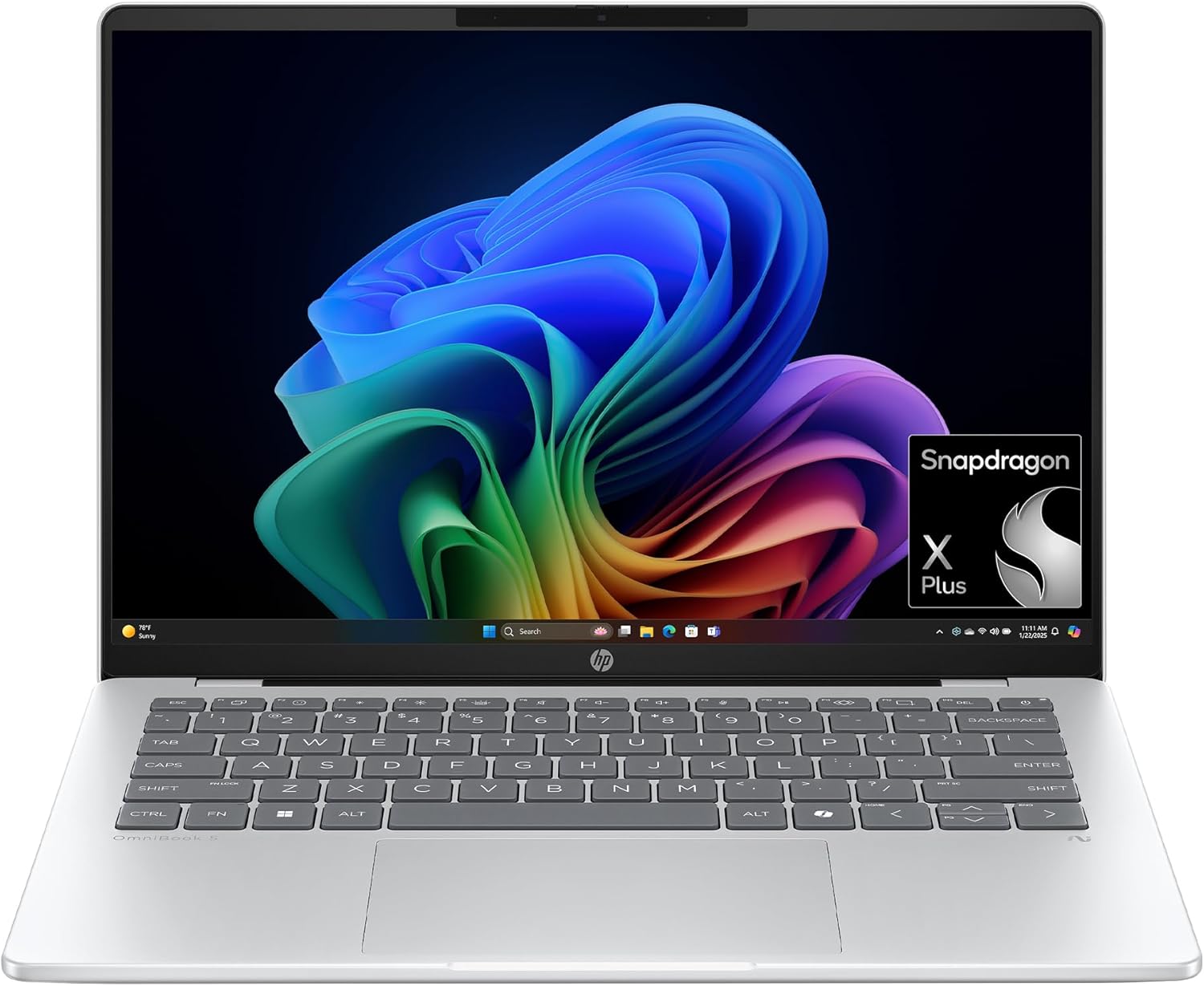
2. HP EliteBook X G2q — MIL-STD Durability, 64GB RAM Option
~$3,028.37 MSRP
Snapdragon X2 Elite • 32GB LPDDR5X • HP Wolf Security • MIL-STD-810H
Check Price →Targets data scientists and security analysts requiring sensitive proprietary datasets processed locally on ARM without cloud egress. Features sophisticated hardware security and configurations scaling to 64GB RAM.
3. Dell XPS 16 9645 — CUDA Workflow Beast

3. Dell XPS 16 9645 — RTX 4070 Ti, Native CUDA
Premium / Varies
Intel Core Ultra 9 285K • RTX 4070 Ti 12GB VRAM • 32GB LPDDR5X • 16" 4K OLED
Check Price →Hybrid computational behemoth combining Intel NPU with NVIDIA RTX 4070 Ti's 12GB dedicated VRAM circumvents memory bandwidth bottlenecks through brute-force GPU horsepower. Native CUDA support enables PyTorch/TensorFlow acceleration without experimental NPU driver pains.
4. Lenovo Yoga Slim 7 — Optimal Student Machine

4. Lenovo Yoga Slim 7 — Best for AI Students
~$1,099.00 MSRP
Intel Core Ultra 7 258V • 32GB RAM • 47 TOPS NPU • 14" 2.8K OLED
Check Price →Heralded as optimal machine for engineering/data science students running local Python environments, Jupyter Notebooks, and PyTorch. Eliminates memory constraints plaguing 16GB baseline models during complex late-night model training.
Persona-Driven Recommendations
- Web Developers: MacBook Pro 14 M3/M4 (16GB+ RAM) for native Unix terminal and Docker. Windows alternative: ASUS ROG Zephyrus G14.
- Data Scientists & ML Engineers: MacBook Pro 16 M4 Max (48-128GB unified memory) apex for Python/R/TensorFlow. Windows alternative: Dell XPS 16 with RTX GPUs.
- Graphic Designers & Video Editors: ASUS ProArt Studiobook 16 OLED (100% DCI-P3, NVIDIA RTX) for Adobe Creative Cloud and DaVinci Resolve.
- Game Developers: Windows laptops with discrete RTX 4060+ GPUs and 32GB RAM (e.g., ASUS ROG Zephyrus G14) for Unity/Unreal/Godot.
Framework & Ecosystem Maturity
Intel and Apple lead industry maturity: Both rated exceptional for documentation and ecosystem integration. Intel's OpenVINO toolkit provides seamless CPU/GPU/NPU scaling with native Hugging Face endpoints. Apple's CoreML documentation, WWDC sessions, MLX tutorials, and tight macOS integration allow rapid prototyping.
Qualcomm and AMD closing gap: Qualcomm's AI Engine Direct and QAI AppBuilder improving rapidly. AMD faces steepest climb—ROCm 7.2 supports Ryzen AI Halo systems, but direct NPU programming remains friction point, forcing reliance on ONNX Runtime and Windows ML paths.
Frequently Asked Questions
Sources: Local AI Master NPU Comparison 2026, AMD Developer Resources, The Gadgeteer Snapdragon X2 Elite Reviews, Best Buy US Retail Data, Reddit r/LocalLLaMA Community Benchmarks. — Himansh, TheAITechPulse
