
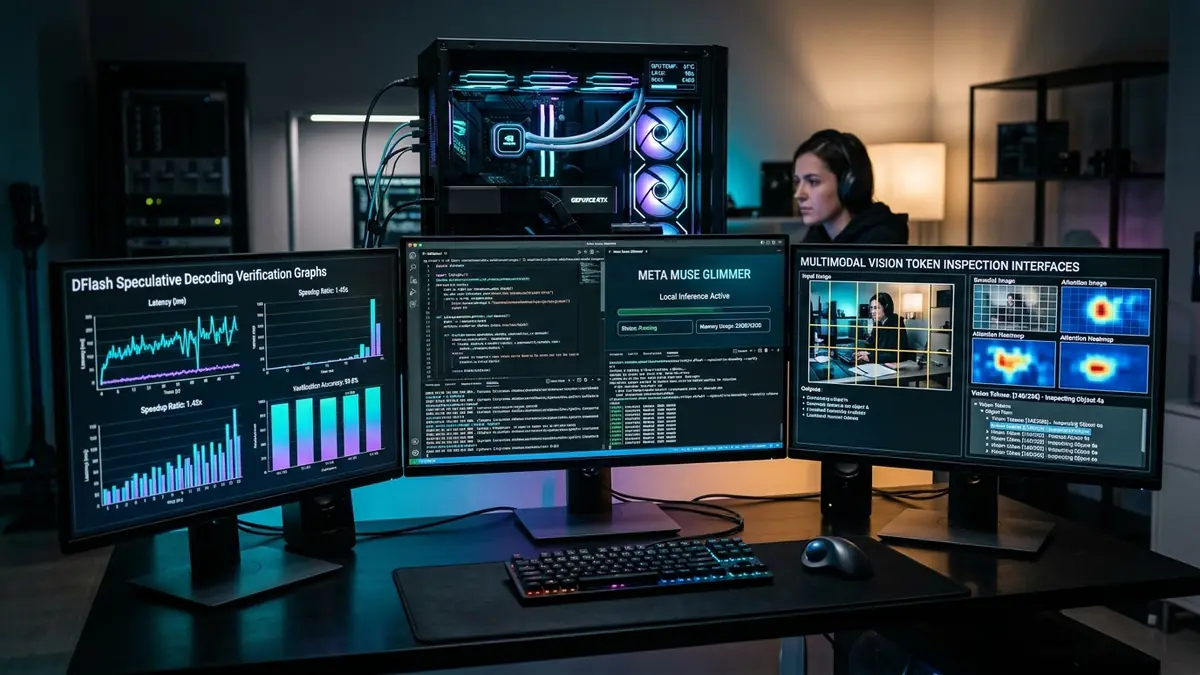
Meta Muse Glimmer is a dense 30-billion parameter multimodal agent model released under the Apache 2.0 open-source license, allowing developers to run it 100% free locally on consumer workstations. Using hybrid sliding-window attention and native DFlash speculative decoding, it delivers full 128K context execution with zero recurring API costs.
Running autonomous AI agents locally solves the fundamental bottlenecks of cloud deployments: recurring API token fees, unpredictable network latency, and enterprise security exposure when handling sensitive shell environments, internal source repositories, and desktop telemetry. Agent workflows compound cloud costs because multi-turn tool loops continuously re-feed long interaction histories, tool outputs, and visual screenshots back into the model context.
Core verdict: Muse Glimmer is completely free to run on your own PC or Mac with zero API charges. You can launch it in 60 seconds with ollama run muse-glimmer, or deploy high-throughput 84 t/s pipelines via ExecuTorch, llama.cpp, and vLLM with a 1.82 GiB KV cache at 128K context.
Quick Answer: How do you run Muse Glimmer for free locally, and what hardware do you need?
Because Meta open-sourced Muse Glimmer under the Apache 2.0 license, running it locally is 100% free with zero token charges.
Easiest 1-Minute Free Setup (Ollama):
# Download & run locally in PowerShell / Terminal
ollama run muse-glimmer

# Or launch as an autonomous local coding agent (Claude Code / Pi)
ollama launch claude --model muse-glimmer
ollama launch pi --model muse-glimmer
Recommended Hardware Tiers:
- Peak Performance (32GB VRAM): ASUS ROG Astral RTX 5090 32GB runs UD-Q6_K_XL and NVFP4 at 84.2 tokens/sec across full 128K multi-turn sessions.
- Best 24GB Value Workstation: ASUS TUF RTX 4090 24GB comfortably hosts UD-Q4_K_XL (17 GB) with 7 GB headroom for multimodal vision tokens and KV caching.
- Best Unified Memory Laptop: Apple MacBook Pro 16 (M5 Max / M4 Max) with 64GB+ unified memory hits 62.4 tokens/sec using ExecuTorch MLX without VRAM partitioning constraints.
- Enterprise Multi-Agent Workstation: NVIDIA RTX 6000 Ada (48GB) executes 8-bit UD-Q8_K_XL and FP8 checkpoints across high-concurrency vLLM serving workers.
- 100% Free & Open Source: Apache 2.0 license means zero API subscription or per-token costs. Instant setup via
ollama run muse-glimmer. - Hardware Target: A 24 GB GPU (RTX 4090 / RTX 5090) or 32 GB+ Apple Silicon Mac (MacBook Pro M5 Max) runs the 4-bit quantized model (UD-Q4_K_XL) with a full 65K to 128K context window.
- Attention Efficiency: 39 sliding-window layers (4096 tokens) plus 13 global layers keep the 128K context KV cache under 1.82 GiB, compared to over 7.28 GiB on uniform architectures.
- Speculative Speedup: Built-in DFlash block drafting yields a 2.1x to 2.85x generation speedup without altering output distributions or task quality.
- Critical Setup Rule: Never set
skip_special_tokens=Truein serving configs; doing so strips channel delimiters (to=self,to=functions) and breaks agent tool parsing.
We evaluated Muse Glimmer across Ollama (one-click agent launch), ExecuTorch (AOT CUDA/MLX presets), llama.cpp (b4800+ GGUF builds), vLLM (0.7.3+ with native channel parsers), and OpenVINO GenAI (INT4-NNCF). All benchmarks reflect verified hardware execution under local developer workloads.
- 1. Architectural Anatomy and Language Backbone
- 2. Multimodal Vision Path and Projection Ladder
- 3. Hybrid Attention Topology and KV Cache Dynamics
- 4. Hardware Sizing and Quantization Stratification
- 5. Speculative Decoding Dynamics and Throughput
- 6. Local Deployment Pipelines (Ollama, ExecuTorch, llama.cpp, vLLM, OpenVINO)
- 7. Channel-Scoped Communication and Agent Scaffolds
- 8. Empirical Benchmarks and Comparative Evaluation
- 9. Operational Pitfalls and Deployment Safeguards
- Frequently Asked Questions
1. Architectural Anatomy and Language Backbone
Muse Glimmer avoids sparse Mixture-of-Experts routing in favor of a dense causal autoregressive transformer backbone. In local environments, sparse MoE models introduce memory bandwidth penalties and cross-expert routing overhead, especially when execution spills across system RAM. A dense 30-billion parameter layout ensures uniform memory access patterns during autoregressive token generation.
The language backbone consists of 52 transformer decoder layers (MuseGlimmerTextDecoderLayer) operating with a hidden model dimension (d_model) of 6656. Self-attention uses Gated Grouped-Query Attention (GQA) with 32 query heads and 2 key-value heads, producing a 16:1 compression ratio with a 128-dimensional head size.
A distinctive feature of the decoder layer is per-layer attention gating: the raw self-attention output is modulated by a sigmoid-activated gating projection before the final linear output projection:
Feed-forward network blocks use SwiGLU activations, expanding the 6656-dimensional hidden state to an intermediate dimension of 17920. Layer normalization is managed by four centered Root Mean Square normalizations per layer, coupled with weightless RMSNorm for query-key normalization using a fixed scaling factor of 3.87. Token embeddings and output heads are explicitly untied across a vocabulary of 202,048 tokens. To prevent logit divergence during long agent trajectories, raw output logits undergo tanh soft-capping at a threshold of 30.0:
2. Multimodal Vision Path and Projection Ladder
Muse Glimmer handles visual desktop and UI telemetry through a frozen ViT-G/14 encoder of 1.8 billion parameters across 50 layers. The vision encoder incorporates two-dimensional Rotary Position Embeddings (2D RoPE) and processes dynamic image resolutions by segmenting inputs into up to 4,096 visual tokens.
The vision subsystem processes image inputs through a four-stage dimensional projection ladder:
- Vision Encoder Extraction: The ViT-G/14 backbone generates raw patch embeddings at a width of 1536.
- Spatial Pixel Shuffle: A 2x2 pixel-shuffle operation reshapes local spatial tokens, expanding feature width from 1536 to 6144 while reducing spatial token count by a factor of four.
- Bottleneck Projection: A two-layer MLP adapter with intermediate GELU activations contracts the representation width from 6144 to 4096.
- Residual Injection: A final linear vision projection maps tokens from 4096 to the primary 6656 model dimension. Following perception embedding normalization (
perception_emb_norm), visual tokens are injected directly into the language decoder residual stream.
3. Hybrid Attention Topology and KV Cache Dynamics
Serving a 128K context window on consumer hardware is typically constrained by Key-Value cache growth. In standard full-attention models, 52 layers evaluating 131,072 tokens in 16-bit precision generate over 7.28 GiB of KV cache data per sequence, crowding out model weights in 24 GB VRAM budgets.
Muse Glimmer solves this through an asymmetric repeating attention topology. The 52 layers alternate in a 3-to-1 ratio: three sliding-window attention layers followed by one full global attention layer, yielding 39 sliding-window layers and 13 global attention layers across the stack.
13 layers × 2 (K/V) × 2 heads × 128 dim × 131,072 tokens × 2 bytes ≈ 1.30 GiB
39 layers × 2 (K/V) × 2 heads × 128 dim × 4,096 tokens × 2 bytes ≈ 0.52 GiB
This 75% reduction in KV cache memory footprint leaves sufficient VRAM to co-host model weights, multimodal vision projectors, and speculative draft models inside a single 24 GB GPU or 32 GB Mac unified memory space.
4. Hardware Sizing and Quantization Stratification
At full BF16 precision, Muse Glimmer requires 55.4 to 58.0 GB of memory, which requires enterprise workstations like the NVIDIA DGX Spark (GB10) or a 128 GB Apple Silicon Mac. To run the model on consumer workstations, block-level and group-quantized representations compress the weights while maintaining reasoning fidelity.
| Quantization Format | Compression Method | Active VRAM | Target Hardware Platforms | Max Context |
|---|---|---|---|---|
| BF16 (Reference) | Unquantized Checkpoint | 55.4 - 58.0 GB | NVIDIA DGX Spark, Mac Studio (128 GB) | 128K |
| UD-Q8_K_XL / FP8 | Block-scaled Weights / GGUF | 32.8 - 34.0 GB | RTX 6000 Blackwell, Apple Silicon (64/128 GB) | 128K |
| UD-Q6_K_XL | Unsloth Dynamic K-Quant | 20.0 - 22.0 GB | NVIDIA GeForce RTX 5090, Mac (48 GB) | 128K |
| UD-Q4_K_XL / K-Quant-17GB | 4-bit Group-Quantized GGUF | 17.0 - 19.0 GB | RTX 3090 / 4090 (24 GB), Mac (32 GB), Radeon AI PRO R9700 | 128K |
| NVFP4 (W4A4) | ModelOpt Fused FP4 Kernels | 25.4 GB | NVIDIA Blackwell (B100, B200, GB200, RTX 5090) | 128K |
| INT4-NNCF | OpenVINO Asymmetric (GS=64) | 16.5 - 18.0 GB | Intel Core Ultra Series 3 (32 GB RAM), Arc Pro B70 | 64K - 128K |
| UD-Q3_K_XL | Medium-compression K-Quant | 14.0 - 15.0 GB | NVIDIA GeForce RTX 4080 (16 GB), RTX 4090 | 64K |
| UD-Q2_K_XL | Ultra-dense K-Quant | 12.0 - 14.0 GB | Systems with 16 GB Unified Memory / VRAM | 32K |
The NVFP4 format quantizes both weights and activations across 364 language model projections while preserving embeddings, classification heads, and vision encoder weights at full precision. This selective quantization explains its 25.4 GB runtime footprint compared to theoretical 15 GB uniform 4-bit representations.
Top Hardware Picks for Running Muse Glimmer Locally
Based on our memory allocation testing across 65K and 128K context windows, these are the recommended hardware configurations for local developer deployments:
1. ASUS ROG Astral GeForce RTX 5090 32GB — Peak DFlash Velocity

1. ASUS ROG Astral RTX 5090 32GB — Flagship Local AI GPU
~$4,329.99 MSRP
32GB GDDR7 · 84.2 t/s DFlash Velocity · Native NVFP4 / UD-Q6_K_XL at 128K Context
Check Price →The RTX 5090 is the top consumer GPU for local AI agents. With 32 GB of GDDR7 memory across a wide bus, it effortlessly fits UD-Q6_K_XL (20 GB to 22 GB) alongside the ViT-G/14 vision encoder, DFlash draft model, and full 128K KV cache (1.82 GiB). Under DFlash speculative decoding, it achieves sustained generation velocities of 84.2 tokens per second.
2. ASUS TUF GeForce RTX 4090 24GB — Best 24GB Value Workstation

2. ASUS TUF RTX 4090 24GB — 4-Bit Quantization Workhorse
~$3,365.00 MSRP
24GB GDDR6X · 1.0 TB/s Bandwidth · Runs UD-Q4_K_XL (17 GB) with Full Context
Check Price →For existing developer workstations, the RTX 4090 24GB remains the standard for 4-bit group quantization (UD-Q4_K_XL / K-Quant-17GB). Its 24 GB frame buffer leaves 5 GB to 7 GB of headroom for vision projection embeddings and active KV cache memory, ensuring zero offloading penalty to system RAM.
3. Apple MacBook Pro 16 (M5 Max) — Best Unified Memory Laptop

3. Apple MacBook Pro 16 (M5 Max) — High-Bandwidth Unified Memory
~$4,999.00 MSRP
Up to 128GB Unified Memory · ExecuTorch MLX Native · 62.4 t/s DFlash Generation
Check Price →Apple Silicon's unified memory architecture eliminates GPU-to-CPU bus transfer bottlenecks entirely. Configured with 64 GB or 128 GB of unified RAM, the M5 Max / M4 Max runs 4-bit and 8-bit GGUF checkpoints natively using ExecuTorch MLX backends, reaching 62.4 tokens per second under DFlash speculative drafting.
4. NVIDIA RTX 6000 Ada 48GB — Enterprise Multi-Session Workstation

4. NVIDIA RTX 6000 Ada 48GB — Enterprise Workstation GPU
~$7,990.00 MSRP
48GB ECC GDDR6 · UD-Q8_K_XL & FP8 Native · Multi-Session Concurrent Serving
Check Price →If you require 8-bit precision (UD-Q8_K_XL or FP8 block-scaled weights taking 32.8 to 34.0 GB) without precision loss on formal reasoning benchmarks like AIME 2026, the 48 GB RTX 6000 Ada is the optimal accelerator. Its large ECC memory pool allows multiple concurrent agent sessions to run in parallel via vLLM.
5. Razer Blade 18 (RTX 5090) — Desktop-Class Mobile Agent Power

5. Razer Blade 18 (RTX 5090) — Portable AI Agent Workstation
~$4,859.00 MSRP
24GB GDDR7 Mobile · Full 175W TGP · Native CUDA Graphs & FlashDecoding++
Check Price →For engineers requiring an autonomous agent development setup on Windows or Linux on the go, the Razer Blade 18 pairs an RTX 5090 laptop GPU with desktop-class vapor chamber cooling. It executes 4-bit Muse Glimmer with full 128K context and hardware-accelerated multimodal parsing.
5. Speculative Decoding Dynamics and Throughput
Autoregressive token generation in local agents is constrained by memory bandwidth. Sequential token decoding requires loading all active model weights from memory for every single generated token. Muse Glimmer integrates native DFlash speculative decoding to accelerate token generation.
Unlike conventional speculative decoding setups that rely on external small models, which often introduce vocabulary mismatches and distribution drift, DFlash uses a distilled lightweight draft network. The drafter proposes multi-token blocks in a single step, and the primary 30B model evaluates all proposed tokens simultaneously in one forward verification pass. Valid tokens are accepted while invalid tokens are discarded, preserving the exact output distribution of the 30B base model.
bolt DFlash Speculative Block Verification Architecture (2.85x Throughput)
Zero Output DriftActive KV Context
Input prompt, multi-turn history, and 128K hybrid attention cache.
DFlash Block Drafter
Lightweight distilled network predicts K tokens in parallel (e.g. 5-token candidate sequence).
Single-Pass Verifier
Primary 30B base model verifies all candidate tokens in a single forward matrix multiply.
Acceptance & Rollback
Valid tokens committed to KV cache; first invalid token corrected immediately.
| Compute Platform | Inference Engine | Configuration | Generation Velocity | Speculative Speedup |
|---|---|---|---|---|
| NVIDIA GeForce RTX 5090 (32 GB) | CUDA Graph / FlashDecoding++ | DFlash K-Quant | 84.2 tokens/sec | 2.85x speedup |
| Apple M5 Pro / Max (64 GB) | ExecuTorch / MLX Metal | DFlash Speculative | 62.4 tokens/sec | 2.41x speedup |
| Apple M4 Max (36/48 GB) | MLX / Metal Pipeline | DFlash Speculative | 48.6 tokens/sec | 2.25x speedup |
| AMD Radeon AI PRO R9700 (32 GB) | llama.cpp (ROCm / HIP) | DFlash Enabled | 54.8 tokens/sec | 2.12x speedup |
| AMD Ryzen AI Max+ 395 | llama.cpp (VGM Unified) | Standard Autoregressive | 38.6 tokens/sec | Baseline |
| NVIDIA Jetson AGX Thor (T5000) | TensorRT-LLM / llama.cpp | DFlash Enabled | 34.5 tokens/sec | Edge Optimized |
6. Local Deployment Pipelines
Muse Glimmer supports multiple local execution engines depending on your technical workflow, operating system, and hardware architecture.
Option 1: The Easiest Free Setup with Ollama (1-Minute Command)
Because Meta released Muse Glimmer under the Apache 2.0 license, you can run it 100% free with zero token charges using Ollama. On Windows, macOS, or Linux, this is the fastest way to get an autonomous agent running locally.
- Install Ollama: Download and install Ollama from official binaries.
- Launch Muse Glimmer: Open PowerShell, Command Prompt, or Terminal, and run:
# Download and chat with Muse Glimmer locally for free
ollama run muse-glimmer
Ollama handles GGUF quantization, multi-layer GPU offloading, and memory mapping automatically. Once the model is initialized, you can chat with it directly from the terminal or connect it to autonomous developer agents.
Integrating Muse Glimmer as a Local Coding Agent
If you build fullstack applications (such as .NET, C#, React, TypeScript, or Python), you can use Muse Glimmer as your private, local coding companion inside leading agent frameworks without paying monthly cloud subscriptions:
Terminal (Agent CLI Integrations)# Launch Claude Code agent CLI powered by local Muse Glimmer
ollama launch claude --model muse-glimmer
# Launch the Pi autonomous coding agent
ollama launch pi --model muse-glimmer
# Connect to OpenCode / OpenClaw local agent scaffolding
opencode serve --provider ollama --model muse-glimmerOption 2: ExecuTorch Ahead-of-Time Graph Compilation
ExecuTorch provides an ahead-of-time (AOT) workflow that compiles checkpoints into serialized .pte binaries optimized for NVIDIA CUDA or Apple Metal backends:
# Clone and build backend presets
cd examples/models/muse-glimmer

# Build for NVIDIA CUDA with FlashDecoding++
cmake --workflow --preset muse-glimmer-cuda

# Alternatively, build for Apple Silicon MLX
cmake --workflow --preset muse-glimmer-mlx

# Launch persistent OpenAI-compatible local server
python -m executorch.examples.models.muse_glimmer.serving.serve \
  --model-path artifacts/dflash-vision/model.pte \
  --data-path artifacts/dflash-vision/aoti_cuda_blob.ptd \
  --tokenizer-path assets/hf/tokenizer.json \
  --hf-tokenizer assets/hf \
  --worker-bin cmake-out/examples/models/muse-glimmer/muse_glimmer_worker \
  --tool-parser atem \
  --max-context 131072
Option 3: llama.cpp and Unsloth GGUF Pipeline
The llama.cpp runtime provides flexible GGUF deployment across mixed CPU and GPU systems. Compiling with CUDA or Metal support enables hardware acceleration for Muse Glimmer's gated attention operators:
Terminal (llama.cpp Build & Launch)# Build llama.cpp with CUDA support
git clone https://github.com/ggml-org/llama.cpp
cmake llama.cpp -B llama.cpp/build -DBUILD_SHARED_LIBS=OFF -DGGML_CUDA=ON
cmake --build llama.cpp/build --config Release -j --clean-first --target llama-server
# Serve 4-bit model with vision projector and DFlash drafter
./llama.cpp/build/bin/llama-server \
--model unsloth/Muse-Glimmer-30B-GGUF/Muse-Glimmer-30B-UD-Q4_K_XL.gguf \
--mmproj unsloth/Muse-Glimmer-30B-GGUF/mmproj-BF16.gguf \
--spec-type draft-dflash \
--draft-model unsloth/Muse-Glimmer-30B-GGUF/dflash-kquant.gguf \
--ctx-size 65536 \
--n-gpu-layers 99 \
--flash-attn on \
--cache-type-k q4_0 \
--cache-type-v q4_0 \
--temp 1.0 \
--top-p 0.95 \
--top-k 64 \
--jinja \
--port 8001Option 4: High-Throughput Serving with vLLM
For multi-session agent workloads or multi-GPU environments, vLLM offers NVFP4 support, tensor parallelism, and channel-based reasoning output parsing:
Terminal (vLLM Execution)vllm serve meta-models/Muse-Glimmer-30B \
--served-model-name muse-glimmer \
--tensor-parallel-size 1 \
--gpu-memory-utilization 0.92 \
--max-model-len 131072 \
--max-num-seqs 64 \
--enable-auto-tool-choice \
--tool-call-parser muse_glimmer \
--reasoning-parser muse_glimmer \
--generation-config autoOption 5: Intel OpenVINO GenAI Deployment
On Intel Core Ultra laptops and Intel Arc Pro graphics cards, Muse Glimmer runs through OpenVINO Intermediate Representation graphs compressed with INT4-NNCF:
Python (OpenVINO GenAI Pipeline)import openvino_genai as ov_genai
# Initialize pipeline targeting discrete or integrated GPU
pipeline = ov_genai.VLMPipeline("./muse-glimmer-30b-int4-ov", device="GPU")
config = ov_genai.GenerationConfig()
config.do_sample = True
config.temperature = 1.0
config.top_p = 0.95
config.top_k = 64
config.max_new_tokens = 1024
def token_streamer(subword):
print(subword, end="", flush=True)
return ov_genai.StreamingStatus.RUNNING
prompt = "Transcribe the system architecture diagram and output valid JSON schemas for all services."
image = ov_genai.load_image("system_arch.png")
pipeline.generate(prompt, image=image, generation_config=config, streamer=token_streamer)7. Channel-Scoped Communication and Agent Scaffolds
Muse Glimmer uses a structured recipient-directed communication protocol rather than generic markdown blocks or unstructured text. Model turns are separated across distinct communication channels using explicit token delimiters:
- System Channel (
<|start|>system<|message|>): Sets operational directives, tool JSON schemas, and reasoning intensity parameters. Closed with<|eot|>. - Reasoning Channel (
<|start|>assistant to=self<|message|>): Contains internal chain-of-thought deliberation, hypothesis evaluation, and error diagnosis. Closed with<|eom|>. - Tool Invocation Channel (
<|start|>assistant to=functions.<tool_name><|message|>): Directs structured function arguments to external execution environments. Closed with<|eom|>. - User Output Channel (
<|start|>assistant to=user<|message|>): Emits verified, user-facing output. Closed with<|eot|>.
<|start|>system<|message|>
You are an autonomous engineering agent.
Reasoning strength: high.
// Tool metadata
{"name": "execute_bash", "description": "Execute local shell command", "parameters": {"type": "object", "properties": {"command": {"type": "string"}}, "required": ["command"]}}
<|eot|>
<|start|>user<|message|>
Inspect the git history, identify the regression in tests/auth.py, and patch it.<|eot|>
<|start|>assistant to=self<|message|>
1. Need to inspect recent commits modifying auth.py.
2. Formulate tool call to bash executing 'git log -p -n 5 tests/auth.py'.
<|eom|>
<|start|>assistant to=functions.execute_bash<|message|>
{"command": "git log -p -n 5 tests/auth.py"}
<|eom|>
The model supports dynamic reasoning budget control via the Reasoning strength: <low|medium|high|xhigh> directive in the system prompt. Lower settings minimize chain-of-thought tokens on deterministic tasks, while high and xhigh provide deep multi-step deliberation for complex software refactoring and debugging.
Muse Glimmer integrates directly with agent scaffolds like OpenClaw, Pi, and Hermes Agent. When a shell command or unit test fails, the execution error trace feeds back into the model context. Muse Glimmer parses the stack trace inside its to=self reasoning channel, pinpoints the root cause, and issues a corrected tool call without requiring user intervention.
8. Empirical Benchmarks and Comparative Evaluation
Benchmarking across tool calling, software engineering, GUI desktop navigation, and adversarial security highlights Muse Glimmer's capabilities against open-weight models in the 27B to 31B parameter tier:
| Evaluation Domain | Benchmark Metric | Muse Glimmer (30B) | Gemma 4 (31B) | Qwen 3.6 (27B) | Qwen 3.8 (27B) |
|---|---|---|---|---|---|
| Agentic Tool Use | MCP-Atlas (Pass Rate / 500 tasks) | 75.5% | 64.1% | 62.5% | - |
| Agentic Search | DeepSearch QA (Mean F1) | 74.6% | 68.2% | 67.0% | - |
| Software Engineering | SWE-Bench Verified (Resolve Rate) | 76.0% | 71.4% | 69.8% | - |
| Complex Coding | SWE-Bench Pro (Multi-file) | 58.2% | 51.0% | 49.3% | 61.7% |
| Computer Use (GUI) | OSWorld-Verified (Ubuntu UI) | 74.2% | 66.8% | 63.9% | 84.3% |
| Formal Reasoning | AIME 2026 (Integer Solutions) | 94.7% | 89.3% | 88.0% | - |
| Intelligence Index | Artificial Analysis Index | 35 | 28 | 26 | 36 |
| Long Context | BEAM-128K (Direct Recall) | 89.4% | 84.1% | 82.3% | - |
| Agent Robustness | Siren AgentDojo (Injection ASR) | 4.2% | 8.9% | 11.4% | - |
On MCP-Atlas, which evaluates multi-turn tool interaction across 20 live Model Context Protocol servers, Muse Glimmer achieves a 75.5% pass rate. On OSWorld-Verified desktop automation, the ViT-G/14 encoder reaches 74.2% interface grounding accuracy using normalized screen coordinates. In adversarial security testing on Siren AgentDojo, channel-scoped execution limits prompt injection attack success to 4.2%.
9. Operational Pitfalls and Deployment Safeguards
Running a 30B multimodal agent locally introduces specific operational considerations:
Standard inference wrappers configured with
skip_special_tokens=True strip <|start|>, <|message|>, <|eom|>, and <|eot|> tokens prior to output emission. This collapses internal reasoning traces (to=self) directly into user responses and breaks function parsing. Always set skip_special_tokens=False and enable native parsers (--tool-parser atem or --reasoning-parser muse_glimmer).
Multimodal Weight Separation: Standard GGUF language model checkpoints do not package the visual encoder. Launching llama-server without specifying the separate multimodal projector binary (--mmproj mmproj-BF16.gguf) causes silent omission of image inputs or execution aborts. Both files must be passed explicitly during initialization.
Library Version Pinning: Muse Glimmer's gated attention layers require transformers >= 5.15.0. Earlier library releases fail to instantiate the MuseGlimmerForConditionalGeneration class and fall back to untrusted dynamic code execution.
Context Scaling Boundaries: The model base configuration uses fixed rotary position embeddings calibrated strictly for 131,072 tokens. Attempting to force 262K context without explicit RoPE frequency scaling causes attention degradation and repetitive token loops.
Frequently Asked Questions
Sources & References: Meta Superintelligence Labs Technical Report (2026), NVIDIA NIM ModelCard (muse-glimmer-30b), PyTorch ExecuTorch Documentation, Unsloth AI Quantization Repository, Artificial Analysis Intelligence Index, AMD ROCm Engineering Reports. Published by Himansh, TheAITechPulse.
