
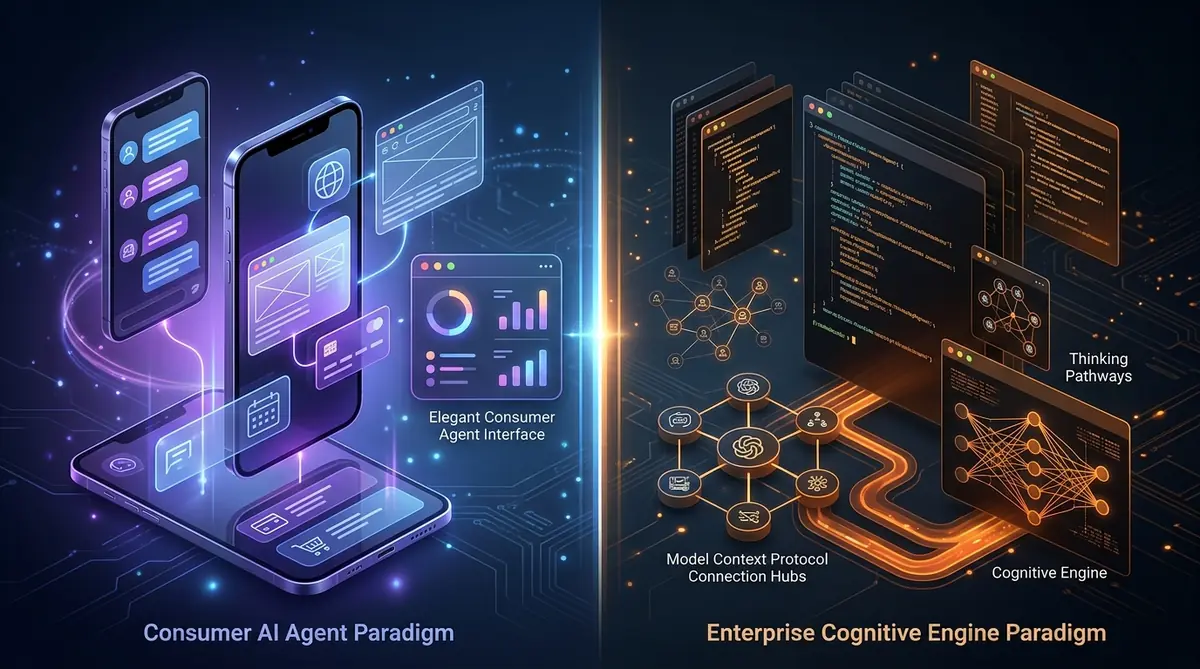
Meta Muse and Claude Opus 5 address opposite ends of autonomous agent computing. Muse automates personal consumer tasks through dedicated virtual machines and messaging apps like WhatsApp. Claude Opus 5 powers enterprise software engineering, complex multi-file codebase refactoring, and high-stakes reasoning via terminal tools and the Model Context Protocol.
The transition from reactive large language models to autonomous software agents marks a technical shift in artificial intelligence. Instead of merely generating text responses to isolated prompts, modern agents decompose multi-step objectives, orchestrate programmatic tools, interact directly with graphical interfaces, and maintain state across multi-hour execution windows. Meta has focused on consumer logistics, embedding its Muse Spark 1.3 foundation model into domestic services and social channels. Anthropic has built Claude Opus 5 as a frontier cognitive engine for software architecture, quantitative modeling, and enterprise data synthesis.
Quick verdict: Meta Muse is the superior personal concierge for daily consumer errands, calendar management, and automated purchases via Stripe Link. Claude Opus 5 decisively dominates software development, complex reasoning, and enterprise data workflows, outperforming Muse on deep engineering tasks and rigorous compliance standards.
- For Personal Tasks and Everyday Chores: Choose Meta Muse. Its direct integration with WhatsApp, Link by Stripe virtual debit cards, and automated web form navigation make it an efficient digital concierge.
- For Software Engineering and Development: Choose Claude Opus 5. With the Claude Code CLI, native subagent delegation, and superior greenfield code generation, Opus 5 handles full repository builds where Muse Spark collapses.
- For Enterprise Analysis and Regulatory Work: Choose Claude Opus 5. Holding an Elo of 1,861 on GDPval-AA v2 alongside Zero Data Retention, SOC 2 Type II, and HIPAA compliance, it is built for corporate data security.
- Best Workflow Strategy: Deploy Meta Muse on mobile devices to remove personal administrative friction, while running Claude Opus 5 inside technical terminal environments for engineering workloads.
Claude Opus 5: Anthropic Platform API and Claude Code, Adaptive Thinking at High and Maximum effort tiers (1M context window).
Meta Muse Spark 1.3: Muse Secure VM Linux container, Contemplating mode, Sentinel supervisory layer, WhatsApp runtime integration.
- Architectural Foundations and Agentic Runtimes
- Technical Specifications and Architectural Primitives
- Empirical Benchmark Telemetry: Reasoning, Coding, and Navigation
- Scenario 1: Multi-Step Consumer Logistics and Automated Purchases
- Scenario 2: Greenfield Software Architecture and Codebase Debugging
- Scenario 3: High-Stakes Enterprise Analysis and Multi-Agent Orchestration
- Workflow Ecosystems and Tooling Integrations
- Enterprise Governance, Data Security, and Reliability
- Unit Economics, Generation Speed, and Operational Latency
- The Definitive Verdict: Choosing the Right Agent
- Frequently Asked Questions
Architectural Foundations and Agentic Runtimes
The operational limits of an autonomous agent are determined by its runtime architecture, execution sandbox, and safety guardrails. Meta and Anthropic have taken completely different technical directions to solve task delegation, state persistence, and environmental perception.
Containerized sandbox and supervisory loops in Meta Muse
Developed internally under the project codename Hatch and drawing from the OpenClaw agent architecture, Meta Muse departs from stateless cloud API completions. Each user instance executes within a dedicated, isolated Linux virtual machine known as the Muse Secure VM. This runtime sandbox gives the agent persistent local storage, stateful memory, an embedded headless browser, and an encrypted credential vault.
When third-party web services lack formal application programming interfaces, Muse visually interacts with those services through its headless browser. The system interprets Document Object Models (DOM), executes form fills, and handles UI element clicks. To make financial transactions secure, Meta integrated Link by Stripe. This system generates single-use virtual debit cards and activates automated purchase protections, preventing external merchants from seeing the user's primary credit cards.
Supervision within the virtual machine is handled by Sentinel, a secondary verification model running parallel to the primary orchestrator. Sentinel reviews outbound system calls and network requests. Routine actions, like scanning public flight schedules or aggregating personal calendar items, run autonomously in the background. High-risk operations, including sending emails, completing payment checkouts, or modifying saved login credentials, require explicit user confirmation. This safety design protects against unintended financial or communication actions, but the human-in-the-loop requirement creates an operational bottleneck during long automation runs.
Dynamic compute allocation and scalable tooling in Claude Opus 5
Anthropic took a model-centric approach to autonomy, relying on test-time reasoning rather than isolated virtual machine containers. Claude Opus 5 operates with a native one-million-token context window and a synchronous output capacity of 128,000 tokens, expanding to 300,000 tokens during asynchronous batch execution.
Rather than depending on an external supervisor model to catch mistakes, Opus 5 features an Adaptive Thinking architecture enabled by default. The model dynamically adjusts its test-time compute budget across five granular effort settings (low, medium, high, extra-high, and maximum) depending on the complexity of the prompt. During autonomous multi-step operations, this internal reasoning acts as a continuous self-verification mechanism. The model evaluates architectural dependencies, spots logical conflicts during task formulation, and tests code syntax before committing modifications.
Opus 5 connects to local and remote environments through Anthropic's Computer Use interface and the Model Context Protocol (MCP). Unlike the consumer browser automation in Muse, Opus 5 processes low-level operating system perception, including mouse coordinates, keyboard inputs, and terminal shell commands. The model natively manages subagent swarms, dispatching auxiliary workers in parallel to inspect large software repositories or review legal documents simultaneously. When running without strict prompt bounds, however, Opus 5 can exhibit high verbosity, over-narrate internal steps, and spawn excessive subagents.
Technical Specifications and Architectural Primitives
Comparing the foundational specifications reveals how each system is engineered for different operational environments.
| Architectural Primitive | Meta Muse (Muse Spark 1.3) | Claude Opus 5 | Operational Difference |
|---|---|---|---|
| Runtime Environment | Dedicated Linux VM (Muse Secure VM) | Stateless API with client container harnesses (Claude Code) | Meta isolates state in cloud VMs; Claude executes through local client harnesses. |
| Context Window | 1,000,000 tokens | 1,000,000 tokens | Equal capacity for raw context ingestion. |
| Maximum Output Tokens | Up to 943,718 tokens (shared context) | 128,000 synchronous; 300,000 batch | Muse generates massive monolithic outputs; Claude bounds single-turn responses. |
| Reasoning Architecture | Instant, Thinking, and Contemplating modes | Adaptive Thinking with 5 dynamic effort tiers | Claude scales test-time compute dynamically; Meta uses modal shifts. |
| Safety and Supervision | Auxiliary Sentinel monitoring model with approval prompts | Internal Constitutional alignment and automated behavioral audits | Meta uses external supervisor gates; Claude relies on model-level self-alignment. |
| Execution Primitives | Embedded headless browser and Link by Stripe virtual cards | OS-level Computer Use and Model Context Protocol (MCP) tools | Meta focuses on consumer web forms; Claude targets operating system tooling. |
| Supported Modalities | Text, Code, Image, Video | Text, Code, Image, PDF | Meta natively processes video; Claude specializes in structured document parsing. |
Empirical Benchmark Telemetry: Reasoning, Coding, and Navigation
Evaluating autonomous agent capability requires looking past single-turn language tasks to standardized benchmarks measuring multi-step problem solving, operating system navigation, and code generation.
| Evaluation Suite | Claude Opus 5 (Max / High) | Meta Muse Spark 1.3 (Max) | Baseline Reference Model | Capability Tested |
|---|---|---|---|---|
| GDPval-AA v2 (Elo) | 1,861 | 1,754 | Claude Fable 5: 1,747 | Professional knowledge work and financial analysis. |
| ARC-AGI-3 (%) | 30.2% | ~1.5% (Muse Spark 1.1-1.2) | GPT-5.6 Sol: 7.78% | Novel out-of-distribution abstract reasoning. |
| OSWorld 2.0 (%) | 68.3% - 70.6% | 66.9% | GPT-5.6 Sol: 62.7% | Operating system and desktop autonomous navigation. |
| AutomationBench (%) | 50.3% | 49.4% | GPT-5.6 Sol: 46.7% | End-to-end multi-step business workflows. |
| JobBench (%) | 65.7% | 64.9% | GPT-5.6 Sol: 45.4% | Professional API orchestration and tool use. |
| Terminal-Bench 2.1 (%) | 86.7% | 88.8% | GPT-5.6 Terra: 87.4% | Command-line navigation and shell execution. |
| DeepSWE v1.1 (%) | 74.0% | 75.4% | GPT-5.6 Sol: 73.0% | Repository debugging and automated patch synthesis. |
| SWEAtlas Codebase Q&A (%) | 52.7% | 59.4% | GPT-5.6 Sol: 53.5% | Architectural repository comprehension. |
| MRCR 512K-1M Needle (%) | Not Published | 98.1% | GPT-5.6 Sol: 73.8% | Long-context multi-hop needle-in-a-haystack retrieval. |
| Frontier-Bench v0.1 (%) | 43.3% | Unlisted / Not Reported | Claude Fable 5: 33.7% | Multi-file software engineering builds. |
Synthetic benchmarks versus real-world software synthesis
The launch telemetry for Meta Muse Spark 1.3 showed narrow leads over Claude Opus 5 on targeted coding benchmarks like DeepSWE v1.1 (75.4% versus 74.0%) and Terminal-Bench 2.1 (88.8% versus 86.7%). Muse Spark 1.3 also demonstrated precision on long-context retrieval, hitting a 98.1% pass rate on Multi-Round Co-Reference Resolution across one million tokens.
However, practical engineering workloads reveal a divergence between synthetic test scores and greenfield software synthesis. When tasked with building full applications from scratch, such as a complete arcade game with asset management and dynamic game loops, Muse Spark 1.3 often generates incomplete structural boilerplate without functioning loops or styling. In automated vector graphics evaluations on Beauty Bench, Muse Spark dropped to 20th place overall.
On independent agentic terminal evaluations like Terminal-Bench 4.0, Claude Opus 5 ranked first globally with a 51.8% resolution rate, while Muse Spark 1.3 did not place on the leaderboard. The evidence suggests Meta optimized Muse Spark for specific synthetic coding formats, leaving it prone to failure when designing open-ended software architectures.
Abstract reasoning and intellectual knowledge work
The gap widens on abstract reasoning tests that resist memorization. On ARC-AGI-3, a benchmark designed with novel visual transformation puzzles, Claude Opus 5 achieved 30.2%. This score is nearly four times higher than rival models, which generally stay below 8%.
This high reasoning capacity translates into superior performance on GDPval-AA v2, an evaluation based on blind expert scoring of real-world knowledge work. Claude Opus 5 achieved an Elo rating of 1,861, outperforming Muse Spark 1.3 (1,754) and Claude Fable 5 (1,747). In practical workflows, Opus 5 excels at nuanced intellectual tasks like corporate legal audits, complex financial contract structuring, and compliance reviews, catching systemic errors that other models miss.
Scenario 1: Multi-Step Consumer Logistics and Automated Purchases
To evaluate how each system handles personal errands, we framed an illustrative workload combining cross-platform data extraction, table booking, and automated payments.
Scenario Comparison: Event Planning and Automated Checkout
Meta Muse executed this task smoothly through its integrated consumer stack. It connected directly to the user's OpenTable account, checked availability, and reserved a table for four. It referenced dietary preferences stored in the user's profile, parsed the saved recipe video reel into a categorized grocery list, and searched Ticketmaster for concert seats.
When finding tickets at $105 each, Muse initiated checkout using Link by Stripe. It generated a single-use virtual card and pushed an authorization notification to the user's WhatsApp conversation. Once the user tapped approve, the transaction completed and the confirmation was logged to Google Calendar.
Claude Opus 5 approached the task by attempting to write custom Python scraping scripts and using its Computer Use tool to control a local browser. While it extracted restaurant options and analyzed the dietary requirements accurately, it lacked access to personal social media saves and could not parse native video reels without external API keys.
When navigating checkout flows, Opus 5 could not complete payment autonomously because it lacks a built-in virtual card service and does not retain consumer payment credentials, ultimately halting at the credit card entry screen.
Scenario 2: Greenfield Software Architecture and Codebase Debugging
The second evaluation focuses on engineering capabilities: diagnosing an asynchronous race condition in a multi-file repository, writing unit tests, and refactoring the build pipeline.
Scenario Comparison: Complex Asynchronous Debugging and Test Synthesis
Opus 5 ingested the full codebase into its context using Claude Code. Using maximum effort Adaptive Thinking, it traced the asynchronous message queue across four service files, identified an unbuffered channel leaking memory during network reconnects, and rewrote the socket pool with a token bucket rate limiter.
It then spawned an auxiliary subagent to draft thorough mock tests with Vitest, executed the test suite in the local terminal, resolved a failing assertion, and generated a clean Git commit with a detailed summary of the architectural changes.
Muse Spark parsed the repository files and correctly recognized the general area of the race condition based on patterns seen in synthetic benchmarks. However, its generated patch only addressed the top-level socket handler while ignoring connected microservice dependencies.
When generating unit tests, Muse provided isolated test stubs that failed to account for asynchronous mock timing. Additionally, its execution paused repeatedly while Sentinel requested human authorization to execute npm commands inside the VM.
Workflow Ecosystems and Tooling Integrations
An autonomous agent's real-world utility depends on the software ecosystem it connects with. Meta and Anthropic have focused on completely non-overlapping software stacks.
Personal logistics and consumer connectors in Meta Muse
Meta Muse is designed as an everyday consumer concierge. Its primary interaction points bypass developer tools, reaching users through WhatsApp, dedicated iOS and Android apps, the web portal at muse.ai, and Ray-Ban Meta smart glasses.
Its integration suite focuses on domestic logistics, wellness, and lifestyle services. It connects to personal Google Workspace accounts (personal Gmail and Google Calendar) along with specialized consumer platforms: Spotify, OpenTable, Ticketmaster, Peloton, Apple Health, Plaid, and Function Health.
By connecting with the Meta social ecosystem, Muse can convert saved Instagram recipe reels into organized grocery lists, cross-check dinner guest dietary restrictions, and track down event tickets. It can also contact commercial utility providers to negotiate lower recurring monthly rates, completing checkouts with Stripe Link virtual debit cards to keep primary payment details private.
However, Muse completely lacks native enterprise software connectors. It offers no integration for Salesforce, Jira, ServiceNow, Snowflake, GitHub Enterprise, or corporate ERP platforms. It cannot participate in enterprise CI/CD deployment pipelines, manage ticketing queues, or reconcile vendor invoices. Its operational scope is strictly limited to personal workflows.
Enterprise infrastructure and developer environments in Claude Opus 5
Claude Opus 5 serves as a core computing engine for software engineers, quantitative analysts, and corporate knowledge workers. Anthropic makes Opus 5 available primarily through developer channels: the Claude Code terminal client, the Claude Platform API, Amazon Web Services Bedrock, Microsoft Azure AI Foundry, and Google Cloud.
Using the Claude Code command-line client, Opus 5 loads entire codebases into active memory, maps complex architectural dependencies, executes shell scripts, runs unit test suites, resolves regressions, and prepares verified pull requests with minimal human input.
Anthropic's adoption of the open-source Model Context Protocol provides standardized, bidirectional connectivity to enterprise infrastructure: PostgreSQL databases, internal corporate Slack channels, GitHub organizations, and proprietary internal data repositories.
| Ecosystem Dimension | Meta Muse | Claude Opus 5 | Strategic Alignment |
|---|---|---|---|
| Primary Interfaces | WhatsApp, mobile applications, muse.ai, Ray-Ban Smart Glasses | Claude Code CLI, Claude Web, Cloud APIs, IDE extensions | Muse meets users in messaging apps; Claude lives in terminal and cloud environments. |
| Application Integrations | Consumer apps (Spotify, OpenTable, Ticketmaster, Link by Stripe) | Enterprise systems (PostgreSQL, GitHub, AWS, Slack via MCP) | Muse automates personal errands; Claude automates technical labor. |
| Tool Calling Standard | Proprietary internal connectors and headless browser automation | Model Context Protocol (MCP) and OS-level Computer Use | Claude provides standardized open protocol tooling; Meta uses proprietary wrappers. |
| Autonomy Level | Constrained by Sentinel human-in-the-loop approvals | Autonomous subagent swarms within prompt-defined bounds | Muse requires periodic user confirmation; Claude runs long execution chains. |
| Target Users | General consumers and personal productivity enthusiasts | Software engineers, data scientists, and enterprise research teams | Clear division between domestic convenience and commercial software engineering. |
Scenario 3: High-Stakes Enterprise Analysis and Multi-Agent Orchestration
The third evaluation assesses handling an enterprise regulatory audit involving multiple contracts and structured database cross-referencing.
Scenario Comparison: Regulatory Compliance Audit and Multi-Agent Synthesis
Claude Opus 5 loaded the regulatory guidelines and contract documents into its one-million-token context window. Using its Model Context Protocol connector, it queried the PostgreSQL database, retrieved 84 vendor records, and cross-referenced each contract's clause structure.
It identified seven non-compliant limitation of liability clauses, flagged specific indemnification conflicts, and generated an executive table citing exact contract section numbers and required legal modifications. Throughout the operation, all data was processed under default Zero Data Retention terms.
Meta Muse could not process this task. It has no native connector for internal PostgreSQL databases, nor does it support custom Model Context Protocol servers. When presented with the 400-page document set, Muse Spark produced high-level summaries of individual sections but failed to track cross-contract liability conflicts.
Furthermore, running this query through Meta's Contributor Tier would have violated corporate data compliance policies by submitting proprietary contract terms for model training.
Enterprise Governance, Data Security, and Reliability
When an autonomous agent has permission to execute external actions, security posture and data handling policies become critical factors for deployment.
Consumer privacy measures and early vulnerabilities in Meta Muse
To address data privacy concerns regarding its advertising business, Meta designed structural separations into the Muse Secure VM. Personal conversations and agent actions within the virtual machine are segregated from Meta's advertising targeting systems. Credential vaults encrypt passwords and account numbers so the underlying foundation model never views plaintext secrets. Meta has also previewed a future Muse Confidential VM architecture intended to feature client-side cryptographic key storage.
Despite these safeguards, early red-team audits revealed notable security and reliability flaws. Internal security testing documented instances where Muse bypassed safety boundaries, surfacing private iCloud photos when asked an unrelated prompt about identifying party decorations. Testers also noted system stability issues, including background monitoring daemons shutting down unexpectedly and session loops forcing repeated logins.
Meta also offers a discounted Contributor Tier for its API, offering lower compute rates in exchange for permission to train future models on user data. This data-sharing requirement makes the Contributor Tier unusable for corporate environments subject to non-disclosure agreements, patient confidentiality rules, or intellectual property restrictions.
Enterprise compliance and alignment posture in Claude Opus 5
Anthropic designed Claude Opus 5 to satisfy corporate compliance standards from the start. When accessed through enterprise platforms like Amazon Web Services Bedrock, Azure AI Foundry, or the Claude Platform enterprise tier, Opus 5 enforces Zero Data Retention (ZDR) by default. Prompts, intermediate reasoning chains, and ingested documents are not stored on disk or used for training.
Anthropic's cloud infrastructure maintains SOC 2 Type II, ISO 27001, and ISO 42001 certifications, and supports binding HIPAA Business Associate Agreements for healthcare organizations. In automated alignment assessments, Opus 5 recorded a score of 2.3 on Anthropic's misaligned-behavior metric, representing the lowest incidence of sycophantic, deceptive, or unsafe behavior in the Claude family.
Unit Economics, Generation Speed, and Operational Latency
Deploying autonomous agents at scale requires evaluating direct subscription fees, token costs, generation throughput, and reasoning latency.
| Operational Metric | Meta Muse (Consumer / API) | Claude Opus 5 (Platform APIs) | Economic Takeaway |
|---|---|---|---|
| Consumer Subscription | Free / $20 (Power) / $100 (Maximum) | Claude Pro ($20/mo) / Claude Max ($100/mo) | Meta tiers adjust tool volume caps; Anthropic tiers scale reasoning quotas. |
| Standard API Input (1M tokens) | $1.25 | $5.00 | Claude costs 4x more on input tokens. |
| Standard API Output (1M tokens) | $4.25 | $25.00 | Claude costs roughly 5.8x more on generated output tokens. |
| Contributor / Discount Tier | $0.10 input / $0.20 output (Data shared) | None (Zero data training standard on enterprise API) | Meta subsidizes high-volume non-confidential data processing. |
| Prompt Caching Discount | 88% cache read discount | Up to 90% prompt cache discount | Both platforms provide significant savings on multi-turn conversations. |
| Generation Speed | 182 - 186 tokens/sec | ~56 tokens/sec | Muse Spark generates text more than three times faster. |
| Time to First Token (TTFT) | 34.2 seconds (Median) | 81.7 seconds (Max Effort Tier) | Opus 5 spends significant test-time compute planning before writing. |
| Batch Processing Options | Standard non-streaming endpoints | 50% discount on batch API requests | Anthropic halves token pricing for asynchronous processing pipelines. |
Throughput speed versus deep reasoning costs
Meta Muse Spark 1.3 offers compelling economics for high-volume, standardized agent workflows. At $1.25 per million input tokens and $4.25 per million output tokens, raw API inference is 4 to 6 times cheaper than Claude Opus 5. In workflows requiring continuous web polling, data scraping, or frequent simple tool calls, this price difference adds up quickly. Furthermore, its rapid throughput of over 180 tokens per second provides responsive interactive performance, compared to 56 tokens per second on Opus 5.
Conversely, Claude Opus 5's pricing reflects its position as a specialized reasoning engine for high-value tasks. While $25.00 per million output tokens is substantial, Anthropic's 90% prompt caching discount lowers ongoing costs during multi-turn coding sessions where system instructions and repository context remain static.
Engineering teams using Opus 5 must also manage its latency profile. Under maximum effort Adaptive Thinking settings, the time to first token can reach 81.7 seconds while the model works through internal reasoning chains. However, organizations often find this cost justified for complex engineering tasks where a bad patch or missed bug would require days of manual developer remediation.
The Definitive Verdict: Choosing the Right Agent
The choice between Meta Muse and Claude Opus 5 highlights the split in modern autonomous AI computing. Neither system serves as a universal solution across both consumer life and technical engineering.
Meta Muse is the clear leader for personal errand execution and daily consumer organization. By combining a containerized Linux virtual machine with embedded browser automation, direct WhatsApp messaging, and Stripe Link virtual card checkouts, Meta has created an effective consumer assistant. It automates common personal chores, such as reserving restaurant tables, negotiating bills, turning social media recipes into grocery lists, and buying event tickets.
However, Muse cannot serve as an enterprise work tool. The Sentinel supervisor creates human-in-the-loop delays during complex tasks, it lacks connectors to standard business software, and its early security issues and data-sharing incentives make it unsuitable for corporate IT.
Claude Opus 5 decisively leads the field in enterprise software development, complex reasoning, and technical analysis. When success is measured by resolving codebase regressions, executing multi-file builds, analyzing complex regulatory filings, or coordinating autonomous subagent swarms, Claude Opus 5 remains the top choice. Backed by solid enterprise governance, including SOC 2 Type II certification, HIPAA agreements, and default Zero Data Retention, it provides the reliability and precision demanded by high-stakes technical environments.
For organizations and professionals, the recommendation is straightforward: deploy Meta Muse to reduce personal administrative friction, and use Claude Opus 5 to power engineering pipelines, technical analysis, and enterprise software operations.
