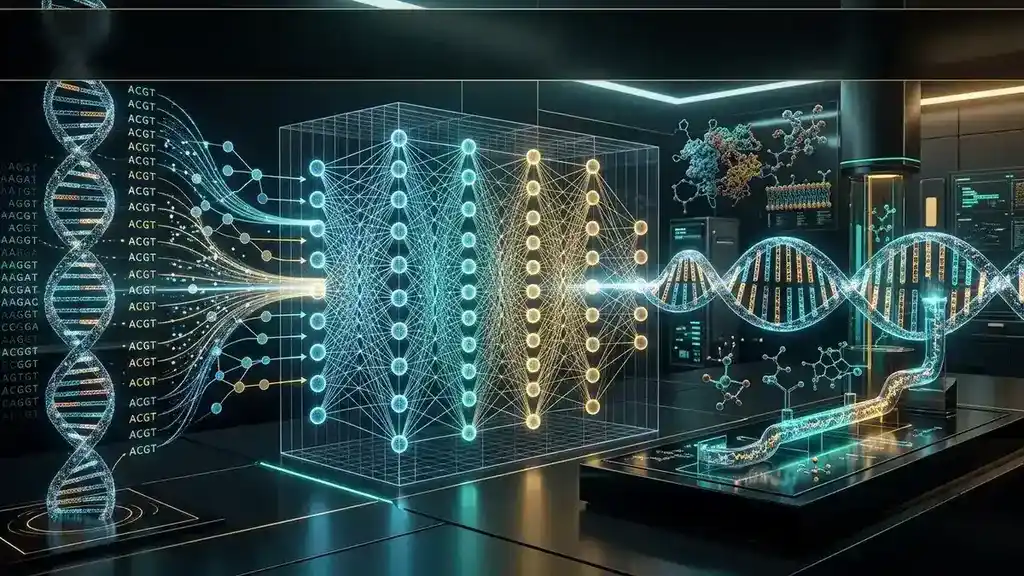
Moderna and Merck's mRNA-4157 (intismeran autogene, V940) represents a foundational transition in oncology: shifting cancer therapy from mass-produced static chemical molecules to patient-specific algorithmic software compilation. The platform ingests tumor sequencing files, uses deep learning to identify 34 immunogenic neoantigens, optimizes mRNA nucleotide code, and triggers robotic synthesis in weeks.
Unlike off-the-shelf monoclonal antibodies or broad-spectrum chemotherapies, individualized neoantigen therapy (INT) operates as a dynamic compiler. The input is raw, highly unstructured biological data extracted from a patient's biopsy. The output is a single synthetic messenger RNA strand encapsulated in a lipid nanoparticle (LNP) formulated specifically for that single individual. This architecture turns oncology into a distributed computing, cloud orchestration, and molecular optimization workflow.
Core Architectural Verdict: mRNA-4157 proves that the modern pharmaceutical intellectual property moat has shifted from static chemical patents to machine learning model architectures, bioinformatics workflow execution, and automated cloud-to-robotics supply chain orchestration.
- Genomic Ingestion: Personalis ImmunoID NeXT executes dual WES and RNA-Seq on 1mm³ biopsy samples, streaming raw FASTQ reads into AWS VPC-isolated data lakes.
- Algorithmic Variant Calling: Directed Acyclic Graphs (DAGs) running BWA-MEM, MuTect2, STAR, and OptiType isolate somatic mutations and resolve patient HLA haplotypes.
- EchoNeo Deep Learning: Multimodal neural networks evaluate peptide-HLA presentation, proteasomal cleavage, and immune tolerance avoidance to rank the top 34 neoantigens.
- Molecular In-Silico Compilation: Concatenates neoepitopes with non-immunogenic Glycine-Serine linkers, adds MITD trafficking domains, and optimizes CAI versus MFE using LinearDesign.
- Automated Edge Synthesis: Cloud state machines dispatch compiled nucleotide sequences to Norwood robotics for IVT synthesis, LNP encapsulation, and real-time IoT digital twin QA.
Because the machine learning algorithm dictates the chemical composition of each patient's custom vial, the FDA classifies the predictive software as part of the biologic drug itself. Model weights are frozen during Phase 3 clinical trials, requiring physical hardware archival with regulatory bodies to prevent model drift.
- 1. The Biological Computing Stack: Mapping Biology to Software Architecture
- 2. Mutanome Digitization: Ultra-Deep Sequencing and Variant Calling DAGs
- 3. Algorithmic Neoantigen Selection: Beyond Unimodal Binding to EchoNeo Deep Learning
- 4. Regulatory MLOps: Deterministic Model Lock-Down and Trial Auditing
- 5. Compiling the mRNA Construct: Linker Engineering and Codon Optimization
- 6. Cloud Architecture: AWS HealthOmics, Batch Compute, and Distributed State Machines
- 7. Edge Manufacturing: Real-Time AI Scheduling and IoT Digital Twins at Norwood
- 8. Clinical Validation, Pan-Cancer Horizon, and Biological Foundation Models
- Frequently Asked Questions
1. The Biological Computing Stack: Mapping Biology to Software Architecture
Traditional pharmaceutical drug discovery resembles searching a vast physical library for a pre-existing chemical structure that happens to fit a biological lock. Individualized neoantigen therapy (INT) inverts this approach completely. The human immune system possesses sophisticated search and destroy capabilities through cytotoxic CD8+ and helper CD4+ T-cells, but requires specific training data to differentiate malignant tissue from healthy cells.
In this framework, biological structures map directly to classical computer science abstractions. DNA acts as non-volatile read-only storage. Messenger RNA functions as transient executable memory loaded into the cellular CPU (the ribosome). The proteasome operates as a tokenizing parser, while Human Leukocyte Antigen (HLA) complexes function as standard output buses displaying internal peptides to the T-cell intrusion detection system.
| Biological Component | Computer Science Analogue | mRNA-4157 Pipeline Implementation |
|---|---|---|
| Tumor DNA | Corrupted Non-Volatile Storage (Disk) | Patient tumor exome containing somatic mutations compared against germline blood DNA. |
| Synthetic mRNA | Compiled Executable Script (RAM) | Custom in-silico compiled transcript injected via lipid nanoparticle. |
| Ribosome | Central Processing Unit (CPU) | Reads mRNA codons at 3 to 5 amino acids per second to synthesize the polyepitope protein. |
| Proteasome | Parser / String Tokenizer | Cleaves the translated polyprotein concatemer into individual 9-mer to 11-mer peptide fragments. |
| TAP Transporter | Bus / Inter-Process Message Queue | Transports cleaved peptides across the endoplasmic reticulum membrane. |
| HLA Molecule | Standard Output Display (STDOUT) | Binds candidate peptides in an open groove and presents them on the outer cell membrane. |
| T-Cell Receptor (TCR) | Intrusion Detection System (IDS) | Scans presented HLA peptides, detects non-self mutational anomalies, and triggers apoptosis. |
2. Mutanome Digitization: Ultra-Deep Sequencing and Variant Calling DAGs
The input layer of the pipeline begins with physical tissue: a formalin-fixed paraffin-embedded (FFPE) tumor sample or fresh surgical resection, paired with a peripheral blood sample representing healthy germline DNA. Moderna collaborates with Personalis to use the ImmunoID NeXT platform, performing universal extraction of high-quality DNA and RNA from minimal tissue volumes (as little as 1mm³ or 5 FFPE slides).
Dual Sequencing Streams
Digitizing the tumor requires two distinct data acquisition channels:
- Whole Exome Sequencing (WES): Sequences approximately 20,000 protein-coding genes in both the tumor and healthy germline control at ultra-high depth (200x or greater). Comparing the two isolates somatic variants unique to the cancer from benign inherited variations. High sequencing depth is necessary to capture sub-clonal mutations that exist in only a fraction of heterogeneous tumor cells.
- Whole Transcriptome Sequencing (RNA-Seq): Quantifies gene expression levels. DNA sequencing indicates which mutations exist in the genome, but RNA-Seq verifies whether the cell is actively transcribing those mutated genes into mRNA. Targeting a mutation that is transcriptionally silent produces zero immune response.
Raw sequencing output yields hundreds of gigabytes of unstructured FASTQ text files per patient, containing millions of short nucleotide base-call reads paired with Phred quality scores.
Cloud-Native Ingestion and Variant Calling DAG
FASTQ data streams securely into Moderna's AWS Virtual Private Cloud (VPC), landing in encrypted Amazon S3 buckets. To comply with HIPAA and GxP standards without exposing genomic payloads to external SaaS intermediaries, Moderna deploys pipeline orchestration tools like Etleap to run isolated ingest jobs within their private cloud perimeter.
Raw short reads from tumor and normal FASTQ files are mapped against human reference assemblies (such as GRCh38). DNA reads are aligned using BWA-MEM, while RNA reads pass through splice-aware aligners like STAR, producing coordinate-sorted Binary Alignment Map (BAM) files.
Probabilistic Bayesian variant callers evaluate aligned tumor BAMs against matched normal BAMs. Algorithms calculate the posterior probability of genuine somatic single nucleotide variants (SNVs) and short insertions/deletions (indels) while filtering out sequencing artifacts, generating a Variant Call Format (VCF) file.
High-resolution in-silico genotyping algorithms analyze normal sequencing reads to determine the patient's exact 4-digit Major Histocompatibility Complex alleles (e.g., HLA-A*02:01, HLA-B*07:02). Because HLA genes are the most polymorphic across the human genome, exact allele identification is mandatory for subsequent binding predictions.
| Pipeline Stage | Algorithmic Tool | Computational Output | AWS Cloud Infrastructure |
|---|---|---|---|
| Ingestion & QC | FastQC, Etleap | Cleaned FASTQ read streams | Amazon S3, AWS Data Exchange, AWS PrivateLink |
| Alignment | BWA-MEM, STAR | Coordinate-sorted BAM files | AWS Batch on memory-optimized EC2 (r6i/r7i) |
| Variant Calling | MuTect2, Strelka | Validated somatic VCF files | AWS HealthOmics Workflows, Nextflow |
| HLA Typing | OptiType, Polysolver | 4-digit HLA Class I & II alleles | AWS Step Functions, AWS Lambda |
| Expression Quantification | RSEM, Salmon | Transcripts Per Million (TPM) scores | Amazon EMR, Amazon Athena |
3. Algorithmic Neoantigen Selection: Beyond Unimodal Binding to EchoNeo Deep Learning
A heavily mutated tumor can present hundreds of candidate somatic alterations. However, only a small fraction of mutations stimulate a cytotoxic T-cell response. Selecting the wrong targets causes the body to manufacture inert peptides, wasting immune capacity.
The Failure of Early Binding Affinity Models
Early computational oncology pipelines relied almost exclusively on unimodal peptide-MHC binding affinity models (such as legacy NetMHCpan). These systems used artificial neural networks trained on in-vitro synthetic peptide assays to predict half-maximal inhibitory concentrations (IC50). Mutations with predicted IC50 values below 500 nM were classified as potential targets.
In clinical reality, this approach yielded a high false-positive rate. Empirical mass spectrometry data proved that fewer than 5% of peptides predicted to have high MHC binding affinity were actually processed and presented on living tumor cell membranes. Unimodal binding models missed key upstream cellular filters, including proteasomal cleavage preferences and transporter efficiency.
Multimodal Deep Learning: The EchoNeo Architecture
To overcome unimodal limitations, Moderna developed multimodal immunogenicity frameworks, including the EchoNeo platform. EchoNeo models antigen processing as an end-to-end biological system rather than an isolated binding event.
• Peptide-HLA Compatibility: Attention-based neural networks evaluate 9-mer to 11-mer peptide sequences against the patient's resolved HLA class I and class II binding cleft geometries.
• Proteasomal Cleavage Probability: Machine learning models predict whether the cellular proteasome will cut the protein backbone at precise terminal residues.
• Transporter Associated with Antigen Processing (TAP): Algorithmic scores model the binding and translocation efficiency of the peptide across the endoplasmic reticulum membrane.
• RNA Expression Weighting: Transcripts Per Million (TPM) metrics act as scalar multipliers. High-affinity mutations within unexpressed genes are downranked.
• Self vs. Non-Self Divergence: Evaluates the biochemical distance between the mutated peptide and the healthy wild-type sequence to avoid central immune tolerance.
The neural network generates a unified ranking score for every detected mutation. The pipeline then selects the top 34 ranked neoantigens to construct the final patient-specific therapeutic payload.
4. Regulatory MLOps: Deterministic Model Lock-Down and Trial Auditing
In standard enterprise software, Machine Learning Operations (MLOps) emphasizes continuous integration, automated retraining, and dynamic model updates as new data arrives. In clinical oncology, this standard operating procedure is legally prohibited.
Because the machine learning algorithm directly determines the chemical composition of the drug injected into the patient, regulatory agencies treat the code as an active pharmaceutical ingredient. Under FDA guidelines, allowing an AI model to update its weights dynamically during an ongoing clinical trial introduces uncontrolled statistical variables.
To satisfy FDA requirements for Phase 3 clinical trials like INTerpath-001, Moderna locked the neoantigen selection algorithm. The mathematical weights, feature extraction pipelines, and inference code were archived onto physical hard drives, transported securely, and lodged with regulatory authorities. Every patient across the global trial must be processed using the exact same frozen mathematical model.
While production models remain frozen during trial execution, data science teams train shadow models in parallel on Amazon SageMaker. Iterations like EchoNeo 2.0 undergo retrospective validation against historic outcomes, requiring formal supplemental regulatory filings prior to clinical deployment.
5. Compiling the mRNA Construct: Linker Engineering and Codon Optimization
Selecting 34 amino acid targets is only half the engineering challenge. The pipeline must assemble these distinct peptides into a single synthetic messenger RNA transcript capable of efficient intracellular translation.
Concatenation and the Hazard of Junctional Neoepitopes
Directly connecting 34 peptide sequences end-to-end creates novel artificial amino acid sequences at the joining points, termed junctional neoepitopes. If the cellular proteasome cleaves across these artificial boundaries, the immune system risks mounting a defense against synthetic junction artifacts rather than actual tumor proteins, reducing therapeutic efficiency and introducing autoimmune risks.
To eliminate junctional artifacts, the compiler algorithm automatically inserts engineered spacers between each neoantigen sequence:
- Glycine-Serine (GS) Flexible Linkers: Sequences such as
GGSGGGGSGGprovide structural flexibility without triggering immune recognition, acting as null separators. - AAY Cleavage Motifs: Insertion of specific tripeptide motifs (such as Alanine-Alanine-Tyrosine) introduces high-affinity target sites for proteasomal endopeptidases, ensuring clean separation of the intended 34 epitopes.
Intracellular Routing Sequences
To ensure translated antigens reach the cell surface, the compiler appends biological routing headers and footers to the construct:
- 5' Secretory Signal Peptide (SP): Directs the newly synthesized polypeptide into the endoplasmic reticulum during ribosomal translation.
- 3' MHC Class I Trafficking Domain (MITD): Routes the processed antigens directly to intracellular loading compartments, maximizing peptide complexing with HLA molecules.
Codon Optimization: Balancing CAI and MFE
Due to codon degeneracy, multiple three-letter nucleotide sequences translate to the same amino acid. An mRNA transcript encoding 34 neoantigens presents an astronomical number of possible nucleotide combinations. The compiler resolves this combinatorial optimization problem across two competing constraints:
- Codon Adaptation Index (CAI): Uses codons corresponding to high-abundance human tRNA pools to maximize translation speed by the ribosome.
- Minimum Free Energy (MFE): Secondary structure folding must remain within optimal stability bounds. Transcripts with high secondary structure (like dense hairpins) stall ribosomal elongation, while unstructured transcripts degrade rapidly.
The compiler uses algorithms such as LinearDesign and Multi-Seed Searching Algorithms (MSSA) with Boltzmann-guided sampling to identify the global optimum that maximizes protein output while maintaining structural stability.
| mRNA Construct Region | Structural Element | Biological & Engineering Purpose |
|---|---|---|
| 5' Flank | Cap 1 Analog & 5' UTR | Prevents exonuclease degradation; enhances ribosomal initiation complex binding. |
| N-Terminal Signal | Secretory Signal Peptide (SP) | Guides nascent polypeptide chain directly into the endoplasmic reticulum lumen. |
| Payload Concamer | 34 Neoantigen Epitopes | Patient-specific mutated 20-mer to 30-mer tumor targets. |
| Spacers | GS / AAY Linkers | Forces precise proteasomal cleavage; prevents junctional neoepitopes. |
| C-Terminal Tag | Trafficking Domain (MITD) | Forces peptide retention in HLA class I presentation pathways. |
| 3' Flank | 3' UTR & Poly(A) Tail (100-120nt) | Acts as an internal timer regulating transcript half-life before degradation. |
| Chemical Backbone | N1-Methylpseudouridine (m1Ψ) | Replaces all standard uridines to evade Toll-like receptor (TLR7/8) innate detection. |
6. Cloud Architecture: AWS HealthOmics, Batch Compute, and Distributed State Machines
Executing individualized sequencing, variant calling, neural network scoring, and molecular optimization within strict clinical timelines (under 45 days) requires elastic cloud infrastructure. Moderna runs its computational biology platform on Amazon Web Services (AWS).
Core AWS Architecture Stack
- AWS HealthOmics: Manages large-scale genomic sequence stores and executes standardized bioinformatics pipelines (WDL, Nextflow, CWL). It handles raw sequence alignment and variant calling with reproducible execution logs.
- AWS Step Functions: Serves as the central state machine orchestrating the end-to-end pipeline. It coordinates data transfers, tracks pipeline dependencies, handles automated retries, and records digital audit trails for GxP validation.
- AWS Batch & Amazon EC2: Dynamic provisioning of heterogeneous compute clusters. High-memory compute instances (e.g., r7i instances) execute sequence alignments, while GPU instances (NVIDIA L4 and L40S) run deep learning inference for the EchoNeo model.
- Amazon S3 & AWS Lake Formation: Encrypted object storage lakes managing raw FASTQ files, intermediate BAM/VCF tensors, and compiled mRNA files with fine-grained IAM access boundaries.
Local Prototyping Hardware for Deep Learning & Bioinformatics
Before dispatching scaled pipelines to AWS Batch and HealthOmics clusters, data science and computational biology teams prototype neural network weights, run biological tokenizers, and evaluate structural embeddings locally. High-VRAM workstations and laptops with high memory bandwidth provide the necessary headroom for zero-latency local development:
7. Edge Manufacturing: Real-Time AI Scheduling and IoT Digital Twins at Norwood
Once AWS Step Functions validates the compiled mRNA sequence, the digital pipeline connects directly to physical hardware at Moderna's manufacturing facility in Norwood, Massachusetts.
Individualized manufacturing creates complex logistical challenges. In traditional pharma, a bioreactor run produces hundreds of thousands of doses of a single batch. In INT manufacturing, each batch consists of an individualized single-patient vial requiring separate enzymatic synthesis, purification, and sterile formulation.
AI Scheduling and Robotic Execution
To prevent floor bottlenecks, Moderna uses custom reinforcement learning schedulers deployed on AWS. The algorithm processes real-time telemetry across cleanroom facilities, robotic liquid handlers, enzyme reagent stocks, and quality control queues, continuously recalculating batch workflows to prevent pipeline contention.
1. DNA Template Synthesis: Automated oligonucleotide synthesizers physically build the DNA template based on the AWS-compiled sequence.
2. In-Vitro Transcription (IVT): T7 RNA polymerase transcribes the DNA template into synthetic mRNA, incorporating N1-methylpseudouridine.
3. Enzymatic Capping & Purification: Addition of 5' Cap-1 structure and magnetic bead purification to remove double-stranded RNA (dsRNA) contaminants.
4. Microfluidic LNP Encapsulation: Microfluidic mixers combine purified mRNA with ionizable lipids, cholesterol, and PEG-lipids to form the protective lipid nanoparticle.
5. Automated Quality Assurance: Capillary electrophoresis and mass spectrometry confirm sequence length, purity, and encapsulation efficiency before release.
The entire facility is connected through an IoT telemetry backbone. Physical instruments stream process metrics (temperature, pressure, pH, fluid velocity) back to AWS data lakes. These digital twins process telemetry data in real time, tracking GxP batch lineage from initial tumor biopsy to final packaged vial.
8. Clinical Validation, Pan-Cancer Horizon, and Biological Foundation Models
The clinical efficacy of this computational pipeline was demonstrated in the Phase 2b KEYNOTE-942 / mRNA-4157-P201 trial and validated in the ongoing Phase 3 INTerpath-001 trial. In patients with resected high-risk stage III/IV melanoma, adjuvant administration of mRNA-4157 combined with pembrolizumab (Keytruda) reduced the risk of recurrence or death by 49% compared to Keytruda monotherapy, maintaining durable efficacy at three years.
Modular Pan-Cancer Expansion
Because the lipid nanoparticle delivery vehicle and manufacturing framework remain identical regardless of the target cancer, the mRNA-4157 pipeline is modular. Moderna and Merck are expanding the INTerpath program into multiple solid tumor indications:
- INTerpath-002: Non-small cell lung cancer (NSCLC).
- INTerpath-004: Adjuvant renal cell carcinoma (RCC).
- INTerpath-005: Muscle-invasive urothelial (bladder) carcinoma.
Biological Foundation Models
The future of computational neoantigen prediction is shifting toward biological foundation models. Large language models trained on hundreds of billions of protein sequences, genomic alignments, and evolutionary structures (such as ESM and Evo) are replacing isolated heuristics. These models enable zero-shot prediction of tertiary protein folding, proteasomal cleavage patterns, and TCR binding affinity directly from raw nucleotide inputs.
The combination of elastic cloud infrastructure, multimodal neural networks, and automated edge robotics proves that scalable, patient-specific medicine is fundamentally a software and computational engineering discipline.
Frequently Asked Questions
References & Scientific Literature
- Moderna-Merck mRNA Vaccine: The AI Mechanism Explained (2026), https://explainx.ai/blog/moderna-merck-ai-designed-mrna-cancer-vaccine-phase3-august-2026
- Merck and Moderna Announce Phase 3 INTerpath-001 Trial Results, https://www.merck.com/news/merck-and-moderna-announce-phase-3-interpath-001-trial-results
- FDA Guidance on Novel Individualized Neoantigen Therapies and Computational Validation, https://www.fiercebiotech.com/biotech/fdas-peter-marks-cancer-vaccines
- Bioinformatics Algorithm of mRNA-4157 Identifies Neoantigens with TIL Reactivities, AACR Cancer Research Abstract 6539
- Personalis ImmunoID NeXT Platform for Clinical Dual DNA/RNA Extraction, https://www.personalis.com/for-biopharma/immunoid-next/
- Patent US20210268086A1: Personalized Cancer Vaccine Epitope Selection Algorithms, Google Patents US20210268086A1
- Patent US20190008938A1: Concatemeric Peptide Epitope RNAs and Linker Formulations, Google Patents US20190008938A1
- Multi-Seed Searching Algorithm for Integrated Codon Optimization of mRNA Vaccines, Briefings in Bioinformatics (2026)
- AWS for Genomics & HealthOmics Architecture Documentation, https://aws.amazon.com/healthomics/
- Moderna Case Study: Cloud-Native Biotechnology Platform and Norwood Manufacturing, AWS Enterprise Solutions