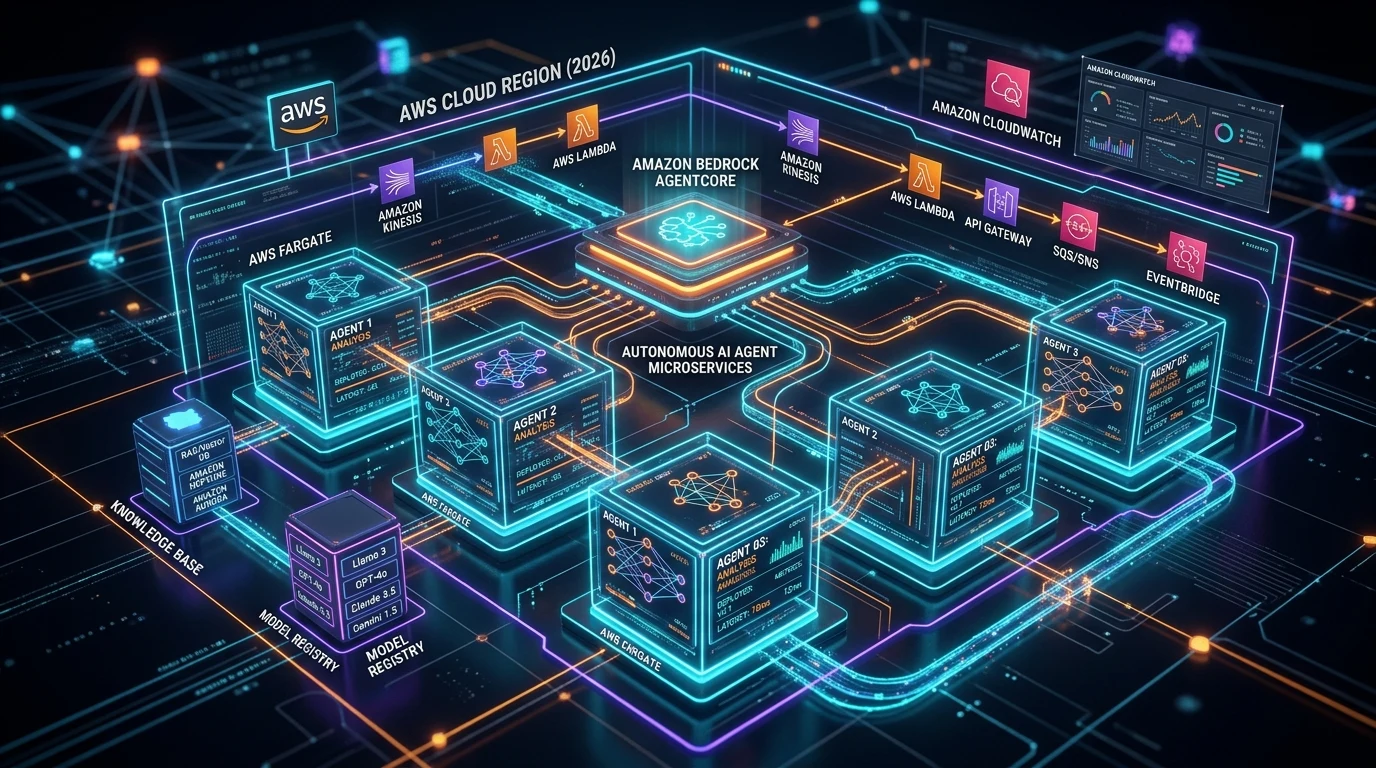
Production enterprise AI systems have shifted decisively away from single conversational prompts toward distributed autonomous agent microservices. On AWS, scaling multi-agent workloads reliably in 2026 requires decoupled runtimes like Amazon Bedrock AgentCore, open inter-agent protocols like MCP and A2A, deterministic Cedar policy-as-code governance, and serverless microVM sandboxing to prevent state bloat, cascading hallucination loops, and catastrophic execution failures.
Early implementations relied on single model loops tasked with maintaining conversation history, decomposing high-level objectives, constructing tool parameters, and evaluating execution results simultaneously. Under production concurrency, these monolithic loops collapsed due to context window saturation and wide blast radiuses where a single malformed tool output caused total trajectory failure. Modern architectures treat agents as specialized, independent microservices governed by deterministic boundaries.
Architectural verdict: Never let foundation models self-govern tool access or memory commits. Production reliability requires a strict division of labor: stateless model inference via Cross-Region profiles, deterministic gateway authorization enforced by Cedar, ephemeral microVM execution sandboxing, and tiered memory stores updated strictly via asynchronous background extraction pipelines.
- Orchestration Strategy: Replace monolithic loops with hierarchical supervisor topologies or distributed A2A peer networks based on administrative boundaries.
- Runtime Substrate: Deploy agent logic to Amazon Bedrock AgentCore Runtime inside ephemeral, microVM-isolated containers with automated session recycling.
- Context Optimization: Structure prompts with static prefixes first to gain up to 90% cost reductions and 85% lower time-to-first-token latency through exact-prefix KV caching.
- Deterministic Tool Security: Guard APIs with external Cedar policies at the AgentCore Gateway to enforce deny-by-default access rules that prompt injection cannot bypass.
- Memory Pipelines: Store raw turns synchronously for immediate context, but extract semantic facts, user preferences, and episodic graph links through asynchronous background workers.
- 1. Architectural Paradigms and Multi-Agent Orchestration Patterns
- 2. Protocol Foundations: Model Context Protocol and Agent-to-Agent Specifications
- 3. Taxonomy of Agentic Execution Topologies
- 4. Foundational Compute and Runtime Infrastructure
- 5. Serverless MicroVM Session Isolation and Lifecycle Management
- 6. Compute Infrastructure Comparison: AgentCore vs ECS vs Lambda
- 7. Tiered Memory, Context Optimization, and State Management
- 8. Context Window Optimization: Exact-Prefix Prompt Caching Mechanics
- 9. Resilient Foundation Model Inference and Dynamic Routing
- 10. Enterprise Security, Identity Federation, and Policy-as-Code
- 11. Observability, Distributed Tracing, and Online Evaluation
- 12. End-to-End Enterprise Reference Architecture Blueprint
- 13. Operational Best Practices and Architectural Anti-Patterns
- 14. Frequently Asked Questions
Architectural Paradigms and Multi-Agent Orchestration Patterns
The Evolution of Agentic Topologies: From Monolithic Loops to Distributed Agent Microservices
Early generative AI agent designs deployed single model instances in closed recursive loops. The model carried the entire conversation transcript, decomposed complex multi-step user queries, generated schema-compliant JSON tool parameters, and analyzed API responses. Under production loads, this design fails consistently. Context window limits fill rapidly, attention mechanisms dilute over long token sequences, and any single parsing failure or malformed payload crashes the entire execution run.
The modern architectural standard breaks monolithic execution into loosely coupled agent microservices coordinated through deterministic graphs, dynamic swarms, or hierarchical delegation trees. In a hierarchical supervisor structure, an orchestrator agent receives incoming user intent, synthesizes top-level execution plans, and delegates discrete subtasks to downstream specialist agents. Each specialist operates with a dedicated system prompt, specialized retrieval mechanisms, and a restricted toolset.
This microservice separation establishes explicit fault domains. If a document parsing agent encounters an unreadable file format, the supervisor catches the structured exception, reroutes the subtask to an optical character recognition worker, or prompts the user for clarification without losing the broader workflow state. Treating agents as autonomous microservices enables independent scaling, fine-grained lifecycle management, and isolated testing regimens across distributed engineering teams.
Protocol Foundations: Model Context Protocol and Agent-to-Agent Specifications
Inter-agent communication and tool execution rely on standardized, language-agnostic interface protocols to avoid proprietary runtime lock-in. Two open standards form the foundation of this tier: the Model Context Protocol (MCP) and the Agent-to-Agent (A2A) protocol.
The Model Context Protocol establishes an open client-server contract that exposes external enterprise systems, databases, and third-party APIs to agents as standardized resources, prompts, and tools. MCP provides formal JSON Schema declarations for tool inputs, enforces bidirectional streaming via standard transports such as Server-Sent Events (SSE) and Streamable HTTP, and encapsulates underlying authentication mechanisms. By decoupling tool definition from agent code, MCP enables tool reuse across disparate frameworks and isolates foundation models from direct API integration logic.
While MCP governs deterministic agent-to-tool operations, the Agent-to-Agent (A2A) protocol coordinates autonomous collaboration among independent agents. Under the A2A specification, each agent exposes a standardized Agent Card at the path /.well-known/agent-card.json. This JSON document defines the agent's identity, administrative provider, authentication requirements, streaming transport capabilities, and discrete functional skills alongside execution tags and example invocation schemas.
Rather than sending rigid function parameters, calling systems dispatch goal-oriented, natural-language or semi-structured payloads to remote A2A endpoints. The receiving agent parses the request, executes autonomous reasoning cycles, maintains its own scratchpad, and streams partial results, state transitions, and completed deliverables back to the caller. This protocol abstraction enables cross-organization agent delegation across diverse cloud environments without sharing internal agent logic or database models.
Taxonomy of Agentic Execution Topologies
The structural positioning of agent compute processes dictates system concurrency, network latency, and administrative isolation boundaries. Selecting an orchestration topology requires balancing operational complexity against data governance and fault isolation requirements.
| Orchestration Topology | Execution Mechanism | Latency Profile | Blast Radius & Isolation | Common Enterprise Use Cases |
|---|---|---|---|---|
| Single-Runtime Multi-Agent (In-Process) | Supervisor and specialist subagents run within a unified container process, coordinating via shared in-memory event buses or framework loops. | Lowest overhead (<10ms inter-agent dispatch); zero network serialization penalty. | Shared blast radius; single process crash or memory leak impacts all subagents; unified IAM identity and local file system. | Rapid prototyping, tightly coupled reasoning loops, short-lived transactional tasks, and self-reflection scratchpads. |
| Agent-as-MCP Tool (Hierarchical Hub-and-Spoke) | Supervisor agent invokes specialized remote agents exposed as standard MCP tool endpoints through a centralized AI gateway. | Moderate overhead (50 to 150ms network hop via HTTP/JSON-RPC serialization over TLS). | Independent runtime per specialist; distinct execution boundaries; tool-level authorization policies enforced at the gateway. | Departmental workflows, domain-specific task offloading (e.g., SQL generation, ticket updating, document parsing). |
| Distributed A2A Peer Network (Decentralized Mesh) | Fully autonomous agents communicate via standard A2A protocol contracts using dynamic discovery via Agent Cards and bi-directional streaming. | Network bound (variable latency; asynchronous event streaming via SSE or WebSockets). | Complete physical and logical isolation; autonomous microVM execution; distinct cryptographic identities and cross-account IAM boundaries. | Cross-enterprise workflows, multi-organization supply chains, autonomous negotiations, and federated agent swarms. |
Foundational Compute and Runtime Infrastructure
Amazon Bedrock AgentCore Runtime Architecture
The compute substrate for enterprise agents requires flexible runtime execution, low cold-start latency, and durable connection management for long-running reasoning chains. Amazon Bedrock AgentCore Runtime provides a fully managed, serverless execution plane purpose-built for agentic workloads. The architecture abstracts underlying host provisioning by deploying containerized agent runtimes directly from Amazon Elastic Container Registry (ECR) into managed compute partitions.
The service exposes standardized entry points via an /invocations endpoint supporting synchronous request-response semantics and Server-Sent Events (SSE) for streaming progressive thoughts and intermediate tool outputs back to calling systems. For conversational voice interactions or interactive shell execution, AgentCore Runtime provisions bidirectional streaming sockets via WebSockets and WebRTC, supported by integrated Session Traversal Utilities for NAT (STUN) and Traversal Using Relays around NAT (TURN) services through Amazon Kinesis Video Streams.
At the edge of the compute environment, Amazon CloudFront and AWS WAF inspect incoming traffic, mitigating web vulnerabilities and rate-limiting abusive request volumes. Traffic routes directly to the Amazon Bedrock AgentCore Gateway, which enforces protocol-level translation, identity claim inspection, and tool discovery. Beneath the gateway, AgentCore Runtime instantiates lightweight microVM execution boundaries to run the core agent frameworks, which interact bidirectionally with external reasoning loops, memory session managers, and tool dispatch engines.
Serverless MicroVM Session Isolation and Lifecycle Management
To mitigate risks associated with untrusted model outputs and data cross-contamination, AgentCore Runtime implements micro-isolation using lightweight microVM virtualization. Each incoming interaction is bound to an isolated session identified via the Mcp-Session-Id header. The execution lifecycle establishes strict temporal and resource limits.
The runtime engine enforces configurable session boundaries through an idleSessionTTLInSeconds parameter, commonly defaulting to 1,800 seconds (30 minutes). During this window, ephemeral working directories and execution states remain pinned to the session context. If an agent hangs within an uncontrolled reasoning loop, built-in run limits terminate execution to prevent resource exhaustion and runaway token generation costs. Workspaces use ephemeral, encrypted scratch disks that are sanitized immediately upon microVM recycling, ensuring that transient files, tool secrets, and local logs never leak across tenants.
Framework Portability and Interoperability
AgentCore Runtime avoids opinionated SDK constraints by treating agent code as arbitrary containerized executables. Organizations can package applications written in LangGraph, CrewAI, LlamaIndex, Strands Agents, or custom Python and TypeScript implementations without refactoring internal state-machine logic.
The operational handoff between open-source logic and managed AWS infrastructure is mediated by the AgentCore Starter Toolkit and CLI (@aws/agentcore). Developers register entry-point scripts with standard runtime decorators, and the deployment tooling packages dependencies via container virtualization, pushes images to private Amazon ECR repositories, and generates execution roles with least-privilege AWS Identity and Access Management (IAM) permissions. This portability allows engineering teams to test complex multi-agent graphs locally in standardized environments before deploying them without modification to serverless AWS infrastructure.
Compute Infrastructure Comparison: AgentCore vs ECS vs Lambda
Determining the appropriate compute substrate depends on execution duration, networking needs, and operational overhead. The following matrix contrasts the three primary compute engines available on AWS for agent hosting.
| Infrastructure Platform | Provisioning & Packaging | Execution Duration Limits | Inter-Agent Communication Overhead | Operational Complexity |
|---|---|---|---|---|
| Amazon Bedrock AgentCore Runtime | Container-based via ECR; automated provisioning with zero server management; managed microVM isolation. | Native support for extended, multi-hour asynchronous runs with configurable idle timeouts. | Ultra-low when co-located; sub-second overhead for managed MCP and A2A service dispatch. | Low; eliminates the need to build custom session managers, WebSocket tunnels, or container orchestrators. |
| Amazon ECS on AWS Fargate | Standard OCI containers; requires custom task definitions, VPC networking, Application Load Balancers, and scaling policies. | Indefinite; ideal for continuous, long-lived background workers and constant polling services. | Dependent on service mesh configuration (AWS App Mesh or Amazon ECS Service Connect); adds internal hop latency. | Moderate to High; teams manage container health checks, cluster autoscaling, and target groups. |
| AWS Lambda | Zip archives or container images; serverless execution initiated by events or API Gateway triggers. | Hard cap of 15 minutes per invocation; unsuitable for autonomous loops with extended human-in-the-loop steps. | Dependent on cold start times (sub-second to several seconds) and external network transit. | Low; automated scaling and fine-grained execution billing, but limited by ephemeral disk and non-persistent memory. |
Tiered Memory, Context Optimization, and State Management
Hierarchical Memory Partitioning: Short-Term Scratchpads to Long-Term Cognitive Storage
Autonomous agents require sophisticated memory hierarchies to maintain coherent decision-making over long-horizon tasks. Relying exclusively on model context windows is technically and economically impractical; unbounded history injection increases processing latency, inflates token spend, and distracts attention mechanisms.
The 2026 reference architecture bifurcates memory into two interconnected operational planes managed by Amazon Bedrock AgentCore Memory: high-fidelity short-term session storage and persistent long-term cognitive memory. Short-term memory captures raw, turn-by-turn conversational interactions, prompt scratchpads, and execution parameters within a specific execution thread. It is scoped strictly by an actor_id (representing the invoking user, system, or upstream agent) and a session_id. Systems enforce lifecycle rules via an eventExpiryDuration configuration, ranging from a few hours up to 365 days, after which unindexed raw interaction logs are purged.
Long-term memory operates asynchronously, decoupling the immediate generation loop from context processing. As events conclude within short-term storage, managed background workers extract facts, operational metrics, and user preferences, consolidating them into structured, vector-indexed records associated with persistent entity namespaces.
Asynchronous Memory Extraction Pipelines and Strategies
Extracting durable insights from unstructured execution logs requires structured distillation. AgentCore Memory incorporates automated ingestion pipelines governed by declarative extraction strategies.
The extraction mechanism begins immediately when the agent reasoning loop commits interaction turns via the data-plane create_event API call. Within the AgentCore Memory resource container, raw turns are saved directly to encrypted, high-fidelity storage, where they remain instantly accessible for short-term conversational context retrieval via the session manager. Simultaneously, committing an event triggers an asynchronous processing pipeline that buffers, batches, and routes the raw text through lightweight extraction models.
This asynchronous extraction worker computes dense vector embeddings and applies declarative prompt templates that structure unstructured dialogue into formal, semantic memory records. The resulting entities, facts, and preferences are committed into partitioned memory namespaces associated with the specific actor. During subsequent invocations, the agent's runtime SDK performs targeted, metadata-filtered semantic searches against these namespaces, retrieving only the most relevant historical context and injecting it directly into the model scratchpad without placing extraction overhead on active requests.
Memory Strategy Specifications and Behavioral Properties
Configuring memory requires matching organizational data needs against specialized extraction primitives.
| Memory Strategy Type | Extraction Objective | Operational Scope | Storage & Indexing Engine | Behavioral Characteristics |
|---|---|---|---|---|
| Semantic Strategy | Extracts declarative facts, environmental variables, and domain relationships (e.g., enterprise team structures, active projects). | Global or tenant-wide; accessible across diverse actors and workflow types. | Vectorized similarity index; queried using approximate nearest neighbors (ANN). | Identifies entities across multi-turn interactions; enriches RAG by bridging disparate queries with durable knowledge. |
| Summary Strategy | Compresses long-running conversational transcripts into rolling, executive abstracts capturing critical inflection points. | Scoped per session or workflow execution identifier. | Structured document text store with versioned milestone tracking. | Minimizes token load when resuming prior interactions; provides situational context without parsing historical turns. |
| User Preference Strategy | Identifies personal interaction preferences, coding paradigms, communication styles, and recurring constraints. | Scoped strictly to specific actor_id profiles. | Key-value attribute store integrated with metadata-filtered semantic indexes. | Proactively adjusts agent persona, response formatting, and default choices without explicit prompting. |
| Episodic Strategy | Preserves historical task trajectories, capturing the steps taken, tools invoked, errors encountered, and final results. | Scoped across complex, iterative workflow runs. | Hybrid graph-relational structures and temporal sequence stores. | Facilitates reflection and continuous learning, preventing agents from repeating failed execution paths. |
Context Window Optimization: Exact-Prefix Prompt Caching Mechanics
While memory systems handle cross-session retention, prompt caching optimizes in-session context processing. In autonomous agent architectures, foundational system instructions, expansive MCP tool schemas, and shared contextual documents are repeatedly passed to foundation models across every reasoning step.
Amazon Bedrock Prompt Caching evaluates incoming prompts for exact-prefix token alignments. When an agent submits a call containing static definitions, such as hundreds of tool declarations or corporate policy constraints, the runtime caches the pre-computed attention keys and values (KV cache) directly on accelerator memory. Subsequent reasoning iterations matching this prefix bypass standard compute-intensive prefill stages.
This optimization delivers significant efficiency gains: cached prefix tokens provide up to 90% cost savings on input token billing and up to 85% reductions in time-to-first-token (TTFT) latency. To maximize cache hit rates, architectures must construct prompt prefixes hierarchically, ordering static system definitions first, general tool schemas second, entity context third, and dynamic scratchpad turns last.
Resilient Foundation Model Inference and Dynamic Routing
Cross-Region Inference Systems and Capacity Balancing
At enterprise scale, autonomous agents generate variable bursts of inference requests, often resulting in HTTP 429 (Too Many Requests) throttling when pinned to a single AWS Region's service quotas. Model quotas are governed by strict token-per-minute (TPM) and request-per-minute (RPM) constraints. Amazon Bedrock Cross-Region Inference (CRIS) mitigates regional quota exhaustion by abstracting underlying Regional endpoints behind regional and global inference profiles.
When an agent invokes an inference profile identifier, Bedrock dynamically monitors capacity across target regions. Inbound calls evaluate local Region availability first; if local capacity approaches threshold saturation, the request automatically reroutes across the high-speed AWS private global network backbone to a destination Region with available capacity. This dynamic load distribution expands usable throughput up to 2x standard in-Region quotas without requiring application-level failover logic.
CRIS operations incur zero cross-region data transfer fees, and token consumption is billed at the source Region's standard on-demand rate. While inter-region routing introduces minor double-digit millisecond latency overheads, this tradeoff is far preferable to application timeouts and exponential client backoff cycles.
Inference Routing Profiles and Resilience Trade-offs
Selecting an inference routing strategy requires evaluating latency requirements against data residency and compliance mandates.
| Profile Architecture | Geographic Boundaries | Quota & Throughput Profile | Compliance & Sovereignty Implications | Operational Trade-off |
|---|---|---|---|---|
| Single-Region In-Region | Bound strictly to a single target AWS Region (e.g., us-east-1 or eu-central-1). | Baseline Service Quota limits; vulnerable to localized surges and capacity limits. | Maximum data residency compliance; guarantees that prompt data never traverses geographic or regional borders. | Simple architecture, but lowest ceiling; susceptible to 429 throttling under concurrent multi-agent swarms. |
| Geographic Multi-Region Profile | Traverses predefined Regions within designated legal jurisdictions (e.g., US: us-east-1, us-west-2; EU: eu-central-1, eu-west-1). | Up to 2x default in-region throughput capacity; automatic burst absorption across regional boundaries. | Complies with regional sovereignty laws (e.g., GDPR in the EU) by confining payload transit within defined geopolitical borders. | Balanced configuration for production workloads; delivers resilience without violating enterprise compliance boundaries. |
| Global Routing Profile | Dynamic routing across all available commercial AWS Regions containing model capacity. | Maximum throughput ceiling; resilient against continental network partitions or localized infrastructure outages. | Prompts and completions may leave local jurisdictions, potentially violating Service Control Policies (SCPs) and strict compliance rules. | Optimal for latency-tolerant, non-regulated enterprise intelligence tasks and batch workflows; unsuitable for sovereign data. |
Token-Deduction Lifecycles and Cost-Latency Optimization Vectors
Maximizing agent performance requires precise management of the token deduction lifecycle. Foundation model serving platforms calculate preliminary quota reservations upon request receipt based on the declared max_tokens parameter. If an agent sets max_tokens: 8192 for simple classification or tool routing decisions that only generate 50 tokens, the infrastructure temporarily reserves the full 8,192 tokens against the tenant's TPM quota. In high-concurrency systems, this artificial reservation triggers premature quota exhaustion, causing subsequent agent operations to fail.
To maintain optimal throughput, architectures right-size max_tokens dynamically based on the specific agent step, allocating narrow caps (256 to 512 tokens) for structured tool selection and expanding limits only during synthesis and final code generation. Cost and latency are further optimized through model tiering and Intelligent Prompt Routing. Less demanding tasks (such as intent extraction, schema mapping, and memory tagging) are routed to highly efficient models like Amazon Nova Lite or Anthropic Claude 3.5 Haiku, reserving flagship foundation models like Anthropic Claude 3.5 Sonnet or Claude 4.0 for complex multi-step orchestration and system planning.
Enterprise Security, Identity Federation, and Policy-as-Code
Deterministic Tool Governance: Cedar Policy Engines at the Gateway
A primary vulnerability of autonomous agent deployments is prompt injection, where malicious adversarial inputs hijack model reasoning and manipulate the agent into executing unintended tools. Relying solely on system prompts for security boundaries is inherently probabilistic and insufficient for enterprise workloads.
The 2026 reference architecture implements deterministic tool authorization by pairing Amazon Bedrock AgentCore Gateway with the Cedar policy language, standardizing access rules via policy-as-code. Cedar is an open-source, expressive authorization language designed for automated reasoning and sub-millisecond evaluation. The policy engine intercepts every tool invocation request (tools/call) outside the model context, evaluating parameters before underlying services are called.
// Restricts financial tool execution based on OAuth scope and transaction thresholds
permit (
principal is AgentCore::OAuthUser,
action == Action::"invoke_tool:execute_settlement",
resource == Resource::"FinancialSystem::SettlementGateway"
)
when {
context.requestParameters.arguments.amount <= 10000 &&
principal.hasTag("department") &&
principal.getTag("department") == "TreasuryOperations"
};
forbid (
principal,
action == Action::"invoke_tool:execute_settlement",
resource
)
when {
context.requestParameters.arguments.settlementCurrency != "USD"
};
Cedar operates on a closed-world assumption: access is denied by default unless explicitly permitted. Furthermore, Cedar enforces a strict forbid-overrides-permit evaluation hierarchy. Even if an agent's broad execution role allows tool execution, an explicit condition-based forbid policy halts the request immediately. Policy evaluation occurs in a dedicated validation layer completely isolated from the model's reasoning trace, ensuring that prompt injection attacks cannot circumvent enterprise guardrails.
AgentCore Identity Architecture: Inbound JWT and Outbound Token Vaults
Enterprise agents must integrate securely with organizational identity providers without creating long-lived credential vulnerabilities. Amazon Bedrock AgentCore Identity separates authentication into distinct inbound and outbound control planes.
Inbound identity authentication validates callers accessing the AgentCore Runtime or Gateway. The platform supports AWS IAM (using SigV4 signatures) alongside JSON Web Tokens (JWT) issued by OpenID Connect (OIDC) identity providers such as Okta, Microsoft Entra ID, Ping Identity, and Amazon Cognito. The inbound gateway validates token signatures, confirms client application identities via claims matching, and extracts user attributes without exposing core backend components to unauthorized network traffic.
Outbound credential management addresses the secret-zero dilemma, where agents require external credentials to interact with third-party software-as-a-service (SaaS) platforms like Salesforce, GitHub, Slack, and Jira. AgentCore Identity incorporates a managed Token Vault backed by AWS Secrets Manager and AWS Key Management Service (KMS). The Token Vault securely handles both two-legged OAuth for machine-to-machine integrations and three-legged OAuth delegation for executing tasks on behalf of an authenticated human user.
Sandboxed Execution and Defense-in-Depth Guardrails
Executing untrusted model-generated code or browsing external web pages presents significant security challenges, including remote code execution (RCE) and Server-Side Request Forgery (SSRF) vulnerabilities. AgentCore addresses these threats through managed, pre-configured execution sandboxes.
The Code Interpreter Sandbox provides an isolated micro-container environment for executing dynamically generated Python, shell commands, and mathematical algorithms without access to the host agent's root filesystem, metadata APIs, or surrounding AWS VPC infrastructure. Complementing code sandboxing, the Managed Browser Tool executes headless browsing sessions (powered by engines such as Playwright and Nova Act) within isolated network compartments, enabling agents to parse enterprise documentation without exposing internal networks to web threats.
To enforce complete runtime safety, systems apply Amazon Bedrock Guardrails across both user prompts and model completions. To verify factual reliability in Retrieval-Augmented Generation (RAG) loops, Guardrails applies a contextual grounding check that evaluates completions against source documentation. The Grounding Score quantifies the factual alignment of the output against retrieved source documents, automatically blocking responses that fall below a defined threshold (commonly 0.85) to prevent hallucinations, while the Relevance Score verifies that the generated response directly answers the user query.
Governance Matrix: Security Boundaries Across the Agentic Lifecycle
Multi-agent deployments establish multiple defense-in-depth boundaries to maintain operational integrity across every execution phase.
| Lifecycle Phase | Primary Enforcement Mechanism | Supporting AWS Services | Security Objective | Target Threat Mitigation |
|---|---|---|---|---|
| Inbound Gateway Entry | JWT validation; OIDC claims inspection; AWS IAM SigV4 verification. | AgentCore Gateway, AWS WAF, Cognito, Entra ID, Okta. | Verifies caller identity and validates enterprise access scopes. | Unauthorized API invocation; request spoofing; unauthenticated ingress. |
| Tool Execution Evaluation | Deterministic Cedar policy evaluation; deny-by-default filtering; argument boundary checks. | AgentCore Policy Engine, Amazon Verified Permissions. | Enforces fine-grained permissions per tool call, completely outside LLM logic. | Prompt injection attacks; privilege escalation; parameter tampering. |
| External Integration | Token Vault credential exchange; scoped on-behalf-of OAuth tokens. | AgentCore Identity, AWS Secrets Manager, AWS KMS. | Delivers short-lived, least-privilege credentials for downstream tool invocations. | Credential exposure; static secret leaks; over-privileged service accounts. |
| Dynamic Execution | Ephemeral microVM virtualization; non-persistent, encrypted local scratch disks. | AgentCore Built-In Sandboxes (Code Interpreter, Browser Tool). | Isolates runtime environments and untrusted code execution from backend VPCs. | Remote code execution (RCE); lateral network pivoting; SSRF. |
| Model Completion Verification | Contextual grounding scoring; PII redaction; automated reasoning guardrails. | Amazon Bedrock Guardrails. | Validates factual grounding and suppresses harmful or policy-violating model outputs. | Factual hallucinations; data exfiltration; toxic content generation. |
Observability, Distributed Tracing, and Online Evaluation
Unified OpenTelemetry Instrumentation and CloudWatch Telemetry
The non-deterministic, multi-step nature of autonomous agent workflows makes debugging production issues uniquely challenging. Reasoning paths fluctuate based on runtime context, tool outputs, and model decisions. Traditional application performance monitoring solutions that merely capture outer HTTP request durations fail to provide visibility into internal reasoning loops.
Amazon Bedrock AgentCore natively incorporates the OpenTelemetry (OTel) standard, instrumenting all runtime components with granular tracing spans exported to Amazon CloudWatch, AWS X-Ray, and third-party observability platforms. These spans explicitly record internal thoughts, dynamic planning graphs, and task handoff transitions between collaborating entities. Tracing also logs exact tool dispatch parameters, call durations, and raw payload structures alongside Cedar authorization audit verdicts.
At the foundation model boundary, instrumentation logs exact token economics, differentiating between standard prompt input tokens, cache-read input tokens, and completion output tokens. Correlating these spans via standardized W3C trace context propagation enables engineers to visualize complete multi-agent execution trees, identify latency bottlenecks, and pinpoint unhandled exceptions across distributed microVM partitions.
Continuous Online Evaluation and Trajectory Auditing
Offline evaluations using static benchmarks are insufficient for monitoring agents operating against dynamic real-world tools and changing enterprise databases. The 2026 reference architecture implements continuous online evaluation using automated LLM-as-a-Judge evaluation pipelines.
AgentCore Evaluations provisions asynchronous background workers that sample live production traces and evaluate them against built-in and custom evaluation matrices. Evaluator models systematically assess recorded trajectories across multiple quantitative criteria:
- Goal Completion: Verifying whether the multi-agent system fulfilled the user explicit intent without stalling or exceeding reasoning limits.
- Context Faithfulness: Checking whether synthesized responses adhere strictly to retrieved memory records and tool payloads rather than introducing ungrounded assertions.
- Execution Efficiency: Identifying pathological loops, redundant tool calls, and wasted token cycles.
- Policy Compliance: Verifying that all actions taken aligned with enterprise operational rules.
- Trajectory Drift: Watching for systemic decreases in completion rates following underlying tool or prompt modifications.
Evaluation scores stream into Amazon CloudWatch Metrics as continuous time-series data. When evaluation metrics breach established operational baselines, automated alarms alert engineering teams and route anomalous execution traces to human review queues for prompt tuning or policy refinement.
End-to-End Enterprise Reference Architecture Blueprint
Logical Component Decomposition and Request Trajectory
The reference architecture structures agentic operations into seven decoupled functional planes to maximize performance, security, and administrative maintainability:
- Client and Ingress Plane: Client requests traverse Amazon CloudFront and AWS WAF before reaching the Amazon Bedrock AgentCore Gateway, which inspects inbound JWT tokens, terminates external TLS, and exposes standardized MCP service contracts.
- Control and Policy Plane: The AgentCore Policy Engine evaluates every intended action against Cedar policy-as-code rules, while the AgentCore Identity Token Vault exchanges inbound identity claims for short-lived downstream access tokens.
- Agent Compute Plane: Hosted within Amazon Bedrock AgentCore Runtime, which provisions an isolated microVM session bound to the incoming
Mcp-Session-Idwhere supervisor and specialist agents coordinate task execution. - Enterprise Action Plane: Deterministic actions invoke AWS Lambda functions wrapping corporate APIs or execute Athena SQL queries over the Amazon S3 data lake, while non-deterministic code execution and web browsing dispatch into isolated Code Interpreter and Managed Browser Sandboxes.
- Cognitive Memory Plane: Amazon Bedrock AgentCore Memory commits short-term turn events synchronously for immediate context, while asynchronous background pipelines extract and index facts, summaries, and user preferences into long-term namespaces.
- Model Inference Plane: Powered by Amazon Bedrock foundation models using Cross-Region Inference Profiles (CRIS) and exact-prefix prompt caching, with outputs filtered by Bedrock Guardrails contextual grounding scoring.
- Governance and Telemetry Plane: OpenTelemetry collectors stream detailed execution spans, token usage metrics, and Cedar authorization verdicts to Amazon CloudWatch and AWS X-Ray, with asynchronous LLM-as-a-Judge workers auditing live trajectories.
System Component Mapping and Functional Roles
| Architectural Layer | AWS & Ecosystem Technology | Implementation Role & Operational Mechanics |
|---|---|---|
| Ingress & Gateway | Amazon Bedrock AgentCore Gateway, AWS WAF, Amazon CloudFront. | Terminates external TLS, filters malicious web exploits, validates inbound JWT claims, and exposes unified MCP endpoints. |
| Agent Execution Engine | Amazon Bedrock AgentCore Runtime, Strands Agents, LangGraph, CrewAI. | Provisions ephemeral, microVM-isolated execution environments; manages session state machines and streaming responses. |
| Security & Identity | AgentCore Identity, Token Vault, AWS Secrets Manager, AWS KMS. | Manages enterprise IdP federation, handles OIDC/OAuth token exchanges, and injects user-scoped credentials into tool requests. |
| Policy Enforcement | AgentCore Policy Engine (Cedar), Amazon Verified Permissions. | Enforces deterministic, sub-millisecond, default-deny authorization on all tool invocations before execution. |
| Cognitive Memory | Amazon Bedrock AgentCore Memory, Amazon OpenSearch Serverless, Amazon S3. | Delivers managed short-term session storage and asynchronous long-term semantic, episodic, and user preference extraction. |
| Inference & Routing | Amazon Bedrock Foundation Models (Claude, Nova), Cross-Region Inference Profiles (CRIS). | Dynamically balances model calls across AWS Regions; optimizes costs and latency using exact-prefix prompt caching. |
| Tool Sandboxes | AgentCore Built-In Sandboxes (Code Interpreter, Managed Browser Tool). | Executes dynamic Python scripts, shell commands, and web browsing operations within secure, network-isolated environments. |
| Observability & QA | OpenTelemetry Collector, Amazon CloudWatch, AgentCore Online Evaluations. | Ingests distributed reasoning traces, tracks token economics, and performs continuous LLM-as-a-judge trajectory scoring. |
Operational Best Practices and Architectural Anti-Patterns
Deploying high-scale autonomous multi-agent platforms requires navigating trade-offs between architectural abstraction and operational overhead. Below are the critical failure modes observed in production deployments and how to resolve them:
Breaking simple workflows into dozens of distributed micro-agents introduces substantial network latency, serialization overhead, and cascading points of failure. Begin with modular in-process subagents inside a single AgentCore Runtime container, separating into distributed MCP or A2A microservices only when distinct IAM permissions, differing team ownership, or diverging scaling profiles demand it.
Setting high
max_tokens values across every step in an agent loop causes premature token-per-minute (TPM) quota exhaustion due to preliminary quota reservations placed by model providers. Allocate narrow caps (256 to 512 tokens) for structured tool selection and routing, expanding limits only during final synthesis or complex code generation.
Trusting probabilistic LLM instructions to restrict tool access is a major vulnerability. Treat all model-generated tool calls as untrusted input. Validate parameters deterministically through external Cedar policies at the gateway layer before dispatching requests to underlying services.
Never perform semantic memory extraction, summarization, or vector embedding generation inside the synchronous user request path. Save interaction turns immediately to raw short-term session storage, delegating distillation pipelines to asynchronous background workers.