
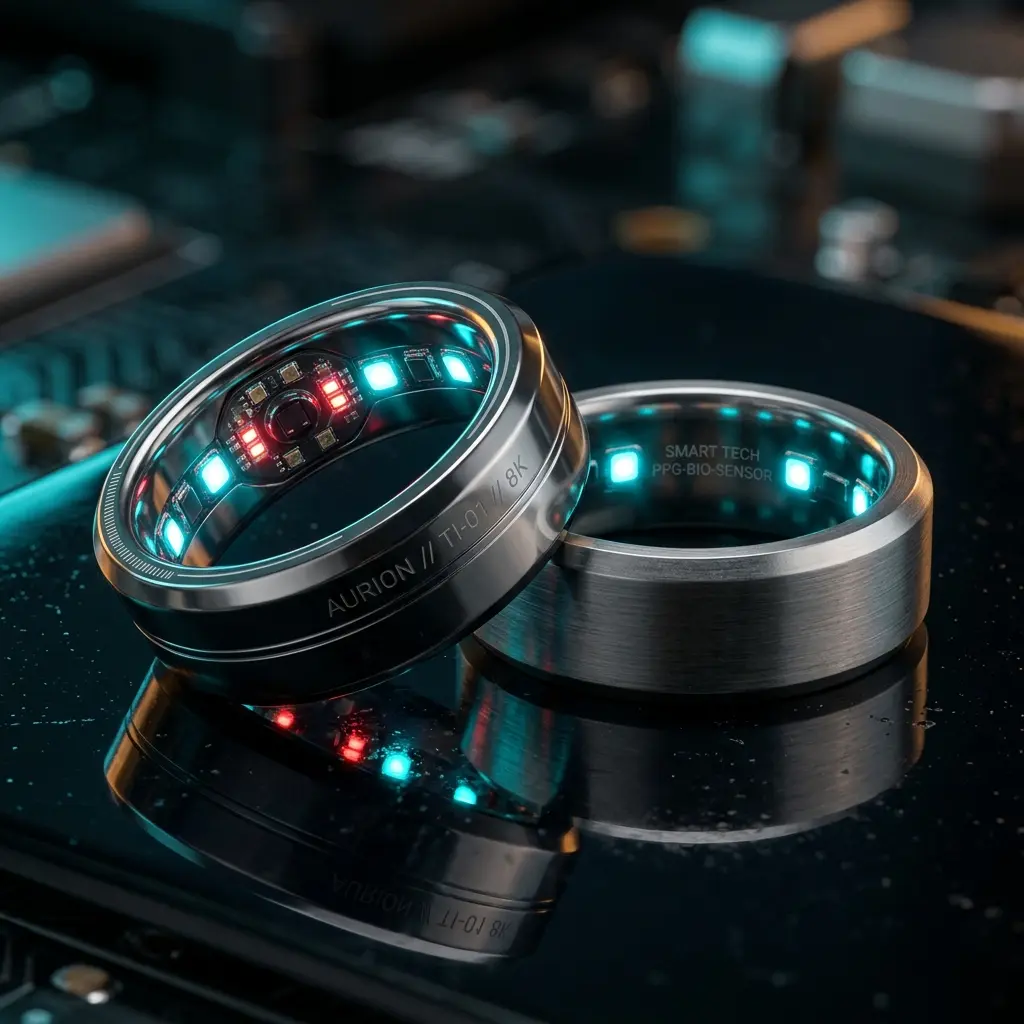
The best smart ring in 2026 is the Oura Ring 5 for overall AI recovery analytics, the RingConn Gen 3 for 14-day battery life with haptic alerts and vascular tracking, and the RingConn Gen 2 Air for an ultra-thin 2.0mm zero-subscription sleep tracker.
The wearable technology landscape of 2026 has witnessed a definitive paradigm shift. The human wrist is no longer the undisputed epicenter of continuous biometric data collection. Consumers and hardware engineering firms alike are increasingly migrating toward the smart ring—a specialized form factor offering a screen-free, unobtrusive, and highly precise physiological monitoring platform. By positioning sensors on the palmar surface of the finger, smart rings capitalize on dense arterial capillary beds, yielding vastly superior photoplethysmography (PPG) signal-to-noise ratios for tracking heart rate variability (HRV), nocturnal respiratory rates, and blood oxygen saturation.
Furthermore, the absence of a glowing screen significantly enhances sleep hygiene and nighttime comfort, making smart rings the premier choice for precise sleep architecture analysis. As hardware engineering has matured, early smart ring bottlenecks—bulky profiles, fragile PVD coatings, and constrained 2-day battery chemistry—have been thoroughly eliminated. The class of 2026 introduces extreme miniaturization, micro-haptic motors, electrodermal activity (EDA) stress sensors, and non-invasive vascular trend monitoring.
Quick Verdict: Hardware specs across smart rings have largely converged on physical perfection, but software business models diverge sharply. If you want unmatched AI health insights and don't mind a $5.99/mo subscription, get the Oura Ring 5. If you refuse recurring paywalls, get the RingConn Gen 3 (for haptics & 14-day battery) or RingConn Gen 2 Air (for ultra-thin comfort at $199).
- Best Overall AI Health: Oura Ring 5 ($399–$499 + $5.99/mo) — 12 pathways, BP Signals [Read Review] Check Deal ↗
- Best Battery & Haptics: RingConn Gen 3 ($349) — 14-day battery, zero subscription [Read Review] Check Deal ↗
- Best Ultra-Thin & Value: RingConn Gen 2 Air ($199) — 2.0mm, 10-day, zero sub [Read Review] Check Deal ↗
- Best for Samsung/Android: Galaxy Ring ($399.99) — Energy Score, zero sub [Read Review] Check Deal ↗
- Best Budget ($149.99): Amazfit Helio Ring — EDA stress, 10 ATM, Zepp fusion [Read Review] Check Deal ↗
- 1. 2026 Smart Ring Comparison Matrix
- 2. Oura Ring 5 Review & Deep Dive
- 3. RingConn Gen 2 Air Review & Deep Dive
- 4. RingConn Gen 3 Review & Deep Dive
- 5. Samsung Galaxy Ring Review & Deep Dive
- 6. Amazfit Helio Ring Review & Deep Dive
- 7. Critical Smart Ring Buying Considerations (Sizing, Subscriptions & Lock-in)
- 8. Interactive AI Wearable Finder Tool
- 9. Frequently Asked Questions
1. 2026 Smart Ring Hardware Comparison Matrix
To evaluate total cost of ownership (TCO) and hardware capabilities across the top smart rings of 2026, the following standardized matrix benchmarks physical dimensions, sensor arrays, battery life, and software paywalls.
| Smart Ring | Price (MSRP) | Battery Life | Monthly Sub | Thickness / Weight | Key Sensors & Highlights | Buy |
|---|---|---|---|---|---|---|
| Oura Ring 5 | $399 – $499 | 6 – 9 Days | $5.99/mo ($69.99/yr) | 2.28mm / 2.0g | 12 pathways, Blood Pressure Signals, Telehealth integration | Amazon → |
| RingConn Gen 2 Air | $199.00 | Up to 10 Days | $0.00 (Free) | 2.00mm / 2.5g | Ultra-thin titanium steel, PPG, skin temp, AI cycle tracking | Amazon → |
| RingConn Gen 3 | $349 – $369 | 10 – 14 Days | $0.00 (Free) | 2.30mm / 2.5g | Micro-vibration motor, vascular trend tracking, sleep apnea alert | Amazon → |
| Samsung Galaxy Ring | $399.99 | 6 – 7 Days | $0.00 (Free) | 2.60mm / 2.3g | Concave scratch-proof titanium, Galaxy AI Energy Score, double-pinch gesture | Amazon → |
| Amazfit Helio Ring | $149.99 | Up to 4 Days | $0.00 (Free core) | 2.60mm / 3.65g | Electrodermal Activity (EDA) stress sensor, 10 ATM water resistance, Zepp smartwatch fusion | Amazon → |
Data verified as of August 2026. Battery life estimates reflect typical continuous 24/7 monitoring workloads.
2. Oura Ring 5 — Best Overall for Premium AI Health Tracking

Oura Ring 5 — The Gold Standard in Biometric AI
$399.00 (Silver/Black) / $499.00 (Gold/Stealth/Deep Rose)
12 signal pathways · 6-9 day battery · Blood Pressure Signals · Telehealth integration
Check Price →The Oura Ring 5 represents the culmination of a decade of iterative biometric engineering and software refinement. The most immediate physical alteration from its predecessor is a remarkable 40% reduction in overall volume, measuring a mere 6.09mm in width and 2.28mm in thickness. Despite this drastic miniaturization, chemical and mechanical redesigns of the internal lithium-polymer battery system allow the device to maintain a robust 6 to 9-day battery life between 80-minute fast charges. The exterior utilizes a super-hard physical vapor deposition (PVD) coating over a high-performance titanium frame, mitigating the cosmetic scratching issues that traditionally plague smart jewelry. Furthermore, the device is water-resistant up to 100 meters with an IP68 rating.
Internally, the Oura Ring 5 introduces a completely redesigned sensing architecture. By utilizing low-profile recessed sensor domes (measuring just 0.7mm in height), upgraded tri-LEDs, and 12 enhanced signal pathways, the ring achieves superior measurement consistency across diverse skin tones and finger anatomies. This hardware foundation powers Oura's expansive software suite, most notably the "Health Radar" system. This proactive platform continuously analyzes biometric trends to detect subtle cardiovascular strain. Within this radar suite, Oura introduces Blood Pressure Signals, an innovative metric designed to track nighttime blood pressure variations and flag cardiovascular anomalies.
The software ecosystem extends beyond passive data recording. The integration of Counsel Health transforms the Oura application into a virtual telehealth platform, allowing users in supported regions to consult licensed medical professionals directly through the app based on biometric alerts. For fitness tracking, Live Activity Tracking bridges the gap between smart ring and smartwatch, streaming real-time pace, distance, and heart rate zones to a smartphone companion screen. Oura has also expanded its global footprint, launching Ring 5 localized sleep research in India, Brazil, and the UAE alongside specialized GLP-1 tracking integration.
3. RingConn Gen 2 Air — Best Ultra-Thin Design & Zero-Subscription Sleep Tracker

RingConn Gen 2 Air — Ultra-Light Featherweight
$199.00 MSRP (Zero Subscription)
2.0mm ultra-thin · 2.5g weight · 10-day battery life · Free AI cycle & sleep tracking
Check Price →The RingConn Gen 2 Air occupies a highly specific and heavily demanded niche in the 2026 wearable market: the ultra-thin, zero-subscription fitness tracker. Engineered to be exceptionally unobtrusive, the Gen 2 Air measures exactly 2.0mm in thickness and weighs as little as 2.5 grams, making it one of the lightest smart rings ever commercialized. The device is constructed using titanium steel treated with a resilient PVD coating and utilizes medical-grade epoxy resin for the internal electronics housing, ensuring a hypoallergenic and comfortable fit for continuous 24/7 wear.
RingConn’s strategy with the Gen 2 Air centers on delivering core high-fidelity health metrics without recurring financial commitments. The device delivers comprehensive evaluations of sleep architecture, including distinct sleep stages, continuous heart rate monitoring, heart rate variability (HRV), and nocturnal blood oxygen saturation (SpO2). Additionally, the ring utilizes precise skin temperature fluctuations to offer sophisticated menstrual cycle predictions and proactive wellness guidance driven by an integrated AI companion.
Despite its minuscule footprint, the Gen 2 Air houses a highly efficient Bluetooth 5.0 module and low-power processing architecture that allows for up to 10 days of continuous operation between charges. When depleted, the ring achieves a full charge in approximately 90 minutes via a standard magnetic charging dock. To achieve its aggressive $199 price point and ultra-thin form factor, certain engineering trade-offs were made; notably, the Gen 2 Air omits the certified sleep apnea monitoring algorithms and haptic feedback motors found in RingConn's flagship Gen 3 model.
4. RingConn Gen 3 — Best for Vascular Trend Tracking & Haptic Alerts

RingConn Gen 3 — Premium Flagship Biohacker Ring
$349.00 (Standard) / $369.00 (Brushed Finishes)
14-day battery life · Micro-vibration alerts · Calibrated vascular blood pressure trends · Portable charging case
Check Price →The RingConn Gen 3 serves as the brand's flagship offering, explicitly engineered to push the boundaries of what is mechanically possible on the human finger. The most profound engineering achievement of the Gen 3 is the integration of a micro-vibration feedback motor within a chassis that measures only 2.3mm thick. This haptic motor transforms the smart ring from a passive data collector into an active health companion. The device delivers discreet physical alerts for prolonged sedentary periods, abnormal heart rate spikes, and low battery status without requiring a phone screen.
The second major pillar of the Gen 3 is its advanced vascular health monitoring suite. Utilizing high-frequency optical photoplethysmography (PPG) sensors combined with localized skin temperature data, the ring tracks longitudinal blood pressure trends. While explicitly not a diagnostic replacement for medical devices, it bridges a critical gap in consumer cardiovascular monitoring. The feature requires a simple 28-day calibration using a traditional arm-cuff blood pressure monitor. Following calibration, the ring continuously evaluates daily cardiovascular load, flagging nocturnal anomalies and vascular stress trends.
Remarkably, these power-intensive features do not cripple the device's stamina. The Gen 3 operates for 10 to 12 days with haptic feedback enabled, and up to 14 days with the motor deactivated, standing as the industry leader in battery endurance. Furthermore, it ships with a universal wireless charging case containing a 500mAh internal battery, providing weeks of off-grid endurance. Hardware is available in expanded sizes (6 through 15) and premium Brushed Silver and Brushed Rose Gold finishes, all backed by RingConn's strict zero-subscription commitment.
5. Samsung Galaxy Ring — Best for Samsung/Android Ecosystem Loyalists

Samsung Galaxy Ring — Seamless Ecosystem Node
$399.99 MSRP (Zero Subscription)
Concave titanium exterior · Double-pinch gesture controls · Galaxy AI Energy Score · Clamshell charging case
Check Price →Samsung’s entry into the smart ring category leverages the massive computational weight of the Galaxy ecosystem. Physically, the Galaxy Ring distinguishes itself via a unique concave titanium exterior. This inward-curving design is highly functional, serving to recess the outer surface of the ring and dramatically reduce accidental abrasions and cosmetic scratches during daily wear. Depending on the selected size (ranging from 5 to 13), the ring houses a battery capacity between 17mAh and 22.5mAh, translating to 6 to 7 days of continuous tracking.
The Galaxy Ring is inherently designed to operate as a node within the broader Samsung Health network. By processing optical bio-signal data (heart rate, SpO2) and skin temperature metrics through Galaxy AI algorithms, the ring generates a daily "Energy Score." This score evaluates sleep architecture, previous day activity, and resting heart rate to dictate physical readiness. While the ring acts as a standalone tracker, its true potential is unlocked when worn synchronously with a Galaxy Watch. In this dual-wearable setup, Samsung Health dynamically selects the most accurate sensor data while optimizing battery consumption on both devices.
Additionally, the Galaxy Ring introduces ecosystem-specific utility beyond health tracking. Users can execute a "double-pinch" gesture with their ring-bearing hand to trigger actions on a connected Galaxy smartphone, such as dismissing alarms or operating the camera shutter. The device also integrates natively with Samsung Find to locate misplaced rings. The hardware includes a transparent clamshell charging case containing a 361mAh battery (providing 1.5 extra full charges on the go) at $399.99 with no subscription fees.
6. Amazfit Helio Ring — Best Budget Entry & Athletic Stress Recovery

Amazfit Helio Ring — Dedicated EDA Stress Tracker
$149.99 MSRP (Lowest Entry Price)
Electrodermal Activity (EDA) sensor · 10 ATM water resistance · Zepp smartwatch data fusion · Fast 1.4-hr charging
Check Price →The Amazfit Helio Ring approaches the wearable market with a distinct philosophy: it is engineered to serve as an ultra-affordable budget entry point ($149.99) that does not compromise on athletic recovery analysis. Physical construction features a titanium alloy outer shell fused to a skin-friendly resin interior. Impressively for its price bracket, it boasts a 10 ATM water-resistance rating that surpasses the standard IP68/100m metrics of many competitors, making it uniquely suited for high-pressure aquatic environments and extreme water sports.
The defining technological feature of the Helio Ring is the inclusion of an Electrodermal Activity (EDA) sensor. While most smart rings estimate physiological stress indirectly through Heart Rate Variability (HRV), the Helio Ring’s EDA sensor physically measures subtle changes in skin electrical conductance driven by sympathetic nervous system sweat gland activity. By combining direct electrodermal conductance with cardiovascular PPG metrics, the Helio Ring provides exceptionally precise mapping of both physical strain and mental stress.
This continuous, high-fidelity data extraction comes at a mechanical cost: battery life is capped at 4 days, the shortest endurance in this comparison. However, for endurance athletes integrated into the Zepp ecosystem, this trade-off is often acceptable. The Zepp companion app fuses the ring's 24/7 recovery metrics with the high-intensity kinematic telemetry of Amazfit sports watches, generating unified Training Readiness scores and race predictions from 3km to full marathons without mandatory subscriptions.
7. Critical Smart Ring Buying Considerations (Sizing, Subscriptions & Lock-in)
When migrating from a traditional wrist-based smartwatch to a smart ring, buyers must re-evaluate several technological, physical, and economic factors. The mechanics of finger-based biometric collection require strict hardware protocols to maintain data fidelity.
A. Sizing and Fitting: The Non-Negotiable First Step
Unlike smartwatches, which utilize elastic or pin-buckle bands to accommodate physical movement, a smart ring is a static titanium cylinder. Sizing precision is the single most critical factor determining biometric accuracy. PPG optical sensors rely on LED light penetration into finger capillaries; if the ring is loose, ambient light leakage corrupts the signal. If the ring is tight, it restricts capillary microcirculation, generating false low SpO2 and irregular heart rate readings.
Therefore, buyers must strictly utilize brand-specific plastic sizing kits before purchasing final hardware. Standard jewelry ring sizes do not correlate with smart rings due to internal sensor dome protrusions. Furthermore, human fingers experience significant volumetric fluctuations throughout a 24-hour cycle. Diurnal fluid shifts, sodium intake, ambient temperature, and exercise-induced vasodilation cause finger expansion of up to one full ring size. Manufacturers recommend wearing the plastic dummy ring for 24 to 48 hours to confirm fit during early morning edema (swelling).
B. Subscription vs. Subscription-Free TCO Analysis
The business models governing health data access in 2026 are heavily bifurcated. Calculating total cost of ownership (TCO) over a standard 3-year battery lifespan reveals major financial differences:
- Oura Ring 5 ($399 Hardware + $5.99/mo Sub): 3-Year TCO = ~$615 total. Justified by continuous AI algorithm updates, medical telehealth partnerships (Counsel Health), and server-side data processing.
- RingConn Gen 3 ($349 Hardware + $0 Sub): 3-Year TCO = $349 total. Delivers haptics, sleep apnea monitoring, and vascular tracking with zero recurring fees.
- RingConn Gen 2 Air ($199 Hardware + $0 Sub): 3-Year TCO = $199 total. Unmatched value for essential 24/7 sleep and recovery tracking.
- Samsung Galaxy Ring ($399 Hardware + $0 Sub): 3-Year TCO = $399 total. Anchors users into the broader Samsung Android ecosystem.
C. Ecosystem Lock-In & Mobile Compatibility
Before purchasing, audit your current smartphone hardware. The Samsung Galaxy Ring is strictly locked to Android (optimized for Galaxy phones). In contrast, Oura, RingConn, and Amazfit offer full cross-platform parity across both iOS and Android with native export support for Apple Health and Google Health Connect.
8. Need Help Deciding? Use Our Interactive AI Wearable Finder
If you want to filter smart rings live by budget, size availability, subscription preference, and smartphone compatibility, try our dedicated interactive finder tool:
9. Frequently Asked Questions
Sources: Official vendor specs (Oura Health, RingConn, Samsung Electronics, Amazfit), Journal of Medical Internet Research (PPG Capillary Signal Fidelity 2026), IEEE Wearable Sensors & Systems. — Himansh, TheAITechPulse
