
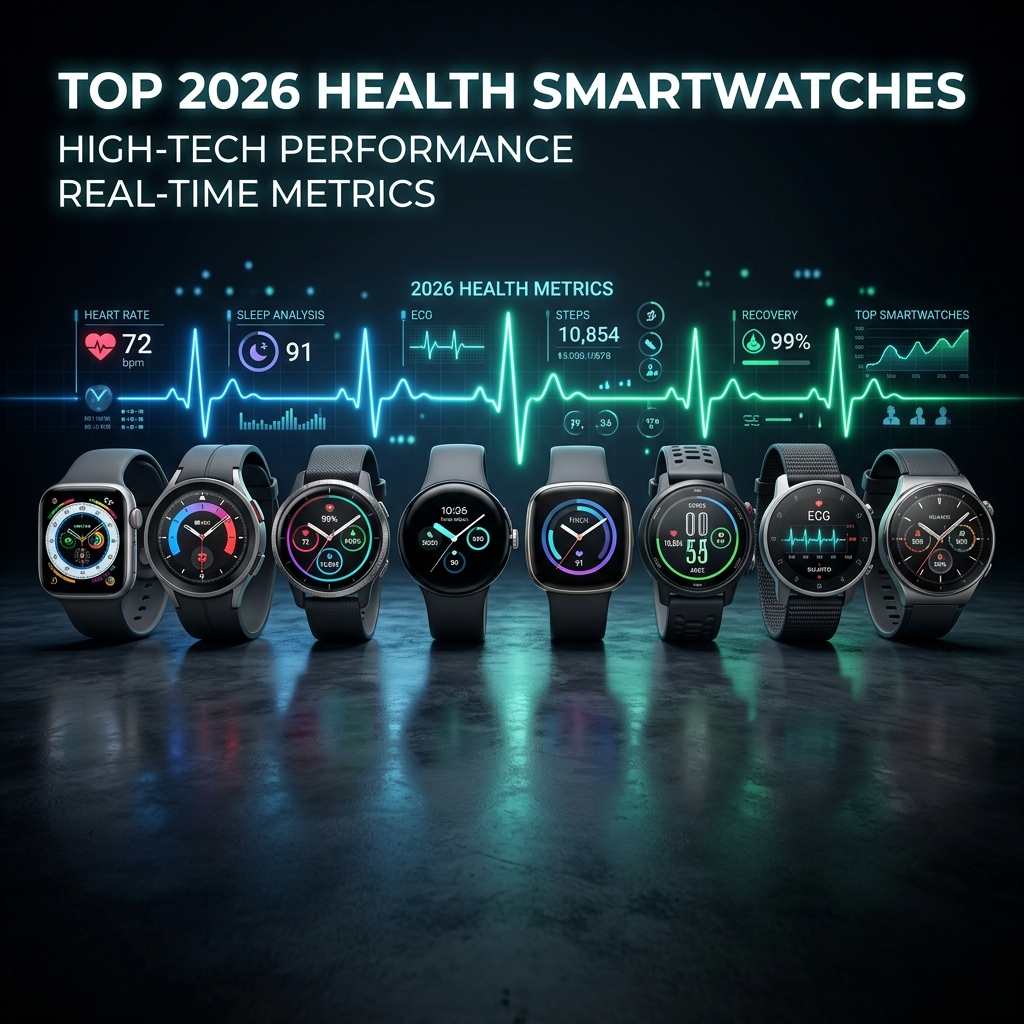
The trajectory of wearable technology has undergone a profound metamorphosis over the past decade. Once relegated to the status of glorified pedometers and rudimentary calorie counters, the modern smartwatch has evolved into a sophisticated, proactive, clinical-grade diagnostic instrument. This transition represents a paradigm shift in personal health management, moving the locus of biometric monitoring from the traditional physician's clinic directly to the consumer's wrist. Contemporary devices are no longer passive data loggers; they are active health guardians equipped with multipath optical sensors, electrocardiogram (ECG) hardware, and advanced machine learning algorithms capable of detecting irregular cardiac rhythms, sleep apnea, hypertension, and acute stress responses.
This evolution is primarily driven by the rapid convergence of miniaturized sensor technology and cloud-based, on-device artificial intelligence. Historically, raw photoplethysmography (PPG) and electrodermal activity (EDA) data suffered from severe motion artifacts and noise. However, on-device neural processing units (NPUs) and computational ecosystems—such as Google's Gemini and Samsung's Galaxy AI—now filter biological noise in real time, translating electrical and optical signals into actionable, high-precision health telemetry without requiring active user intervention.
Furthermore, consumer wearables have reached a critical inflection point characterized by stringent regulatory validation. Features that once existed as general "wellness tracking" are increasingly securing clearances from global health authorities, transforming them into certified medical aids. The ability to monitor hypertension, assess overnight vascular load, or automatically trigger emergency satellite responses upon detecting a complete loss of pulse represents a monumental leap from preventative tracking to acute crisis intervention.
Quick Verdict: For iOS users, the Apple Watch Series 11 remains the gold standard with FDA-cleared hypertension and sleep apnea detection. Android loyalists seeking cutting-edge bio-metrics should choose the Samsung Galaxy Watch 8 for its Antioxidant Index and Vascular Load tracking, while the Google Pixel Watch 4 offers unrivaled safety with Satellite Loss of Pulse Detection. For battery-anxious athletes who demand sub-300-dollar 11-day endurance, the Garmin vívoactive 5 is the ultimate choice.
- Best Overall for iPhone Users: Apple Watch Series 11 ($299 / Rs 26,910) — Medical-grade ECG, FDA-cleared hypertension alerts, sleep apnea detection, 2,000-nit LTPO3 display.
- Best AI Analytics for Android / Samsung: Samsung Galaxy Watch 8 ($237 / Rs 21,330) — Antioxidant Index, Vascular Load tracking, Galaxy AI Energy Score, 3,000-nit screen.
- Best Proactive Safety & Wear OS: Google Pixel Watch 4 ($399 / Rs 35,910) — Loss of Pulse detection with Satellite Emergency SOS, Gemini AI integration, Actua 360 glass.
- Best Long Battery Life (11 Days): Garmin vívoactive 5 ($234.99 / Rs 21,149) — 11-day battery physics, Body Battery energy score, sub-$300 zero-subscription platform.
- Best Mental Stress & Recovery: Fitbit Sense 2 ($199.95 / Rs 17,995) — Continuous electrodermal activity (cEDA) stress sensor, ECG, SpO2, multi-day battery.
- 1. Apple Watch Series 11 — Best Overall for iPhone Users
- 2. Samsung Galaxy Watch 8 — Best AI Biometrics for Android
- 3. Google Pixel Watch 4 — Best Wear OS Safety & Gemini AI
- 4. Garmin vívoactive 5 — Best Long Battery Life (11 Days)
- 5. Fitbit Sense 2 — Best Continuous Stress & Mental Wellness
- 6. 2026 Health Smartwatch Specification Matrix
- 7. Critical Buying Considerations (Ecosystem, Battery & Regulations)
- 8. Final Verdict & Scenario Recommendations
- 9. Frequently Asked Questions
1. Apple Watch Series 11 — Best Overall for iPhone Users

Apple Watch Series 11 — Certified Medical-Grade Guardian
$299.00 / Rs. 26,910 (Zero Subscription)
FDA-cleared hypertension alerts · Sleep apnea detection · 2,000-nit LTPO3 wide-angle OLED · S10 dual-core NPU · Fast 30-min charging
Check Price →The Apple Watch Series 11 represents the refinement of a decade-long dominance in the wearable sector. Rather than reinventing the fundamental form factor, the engineering focus has been placed heavily on expanding the clinical utility of its sensor array while refining the physical chassis to maximize daily wearability and computational speed.
Available in 42mm and 46mm case sizes, the Series 11 utilizes a wide-angle LTPO3 OLED display capable of reaching 2,000 nits peak brightness for outdoor legibility and dimming to 1 nit for power-saving sleep tracking. The materials include an aluminum chassis with Ion-X glass (2x scratch resistance over Series 10) and an aerospace-grade titanium tier protected by sapphire crystal. It features WR50 water resistance (swim-proof up to 6m with depth gauge) and IP6X dust sealing.
The health suite is defined by clinical precision. Powered by a 3rd-generation optical heart sensor, electrical heart sensor (ECG), blood oxygen monitor, and dual wrist-temperature sensors, the Series 11 introduces FDA-cleared hypertension notifications and sleep apnea detection. Overlapping wrist temperature and respiratory rates feed into the Vitals app to quantify daily baseline deviations, while watchOS 11 generates a numerical Sleep Score assessing REM, core, deep, and wake cycles.
Driven by the S10 chip with a 64-bit dual-core CPU and 4-core Neural Engine, on-device Siri processes Apple Health queries locally without cloud latency. Battery endurance reaches up to 24 hours in normal use (38 hours in Low Power Mode), while fast charging restores 0-80% in 30 minutes. Pricing starts at $299 (Rs. 26,910) with zero mandatory subscriptions.
2. Samsung Galaxy Watch 8 — Best AI Biometrics for Android

Samsung Galaxy Watch 8 — Advanced Galaxy AI Health Hub
$237.00 / Rs. 21,330 (Zero Subscription)
Antioxidant Index (carotenoids) · Overnight Vascular Load · 3nm 5-core Exynos W1000 · 3,000-nit Sapphire Crystal · Cushion squircle design
Check Price →The Samsung Galaxy Watch 8 operates as a masterclass in Android wearable engineering, challenging competitors by leveraging deep Galaxy AI integration and introducing novel biometric measurements that push the traditional boundaries of consumer health technology.
Samsung introduced an architectural shift with its "cushion design," mounting a circular Super AMOLED display on a slightly squared aluminum chassis to create a sleek 8.6mm profile. This profile brings sensors closer to skin capillary beds for higher PPG data fidelity. Available in 40mm and 44mm base sizes (alongside a 46mm Classic), the display achieves a staggering 3,000 nits of peak brightness under sapphire crystal glass, backed by 5ATM, IP68, and MIL-STD-810H military durability.
The BioActive sensor array combines Optical Heart Rate, Electrical Heart Signal (ECG), and Bioelectrical Impedance Analysis (BIA) sensors. Beyond standard tracking, the Watch 8 debuts the Antioxidant Index—using optical sensors to measure skin carotenoid levels as a biomarker of cellular oxidative stress and dietary health. It also tracks Vascular Load during sleep, assessing physiological stress on the arterial system alongside BIA body composition analysis.
Running Wear OS 6 with One UI 8 Watch, computational tasks are handled by a 3nm Exynos W1000 5-core processor. Integrated Google Gemini allows voice assistant task execution, while Galaxy AI synthesizes sleep architecture, resting heart rate, and previous workouts into a daily Energy Score. The 40mm model (325mAh) and 44mm model (435mAh) deliver 30 hours with Always-On Display (40 hours AOD-off), charging to 50% in 29 minutes. Priced at $237 (Rs. 21,330) with zero subscription fees.
3. Google Pixel Watch 4 — Best Wear OS Safety & Gemini AI
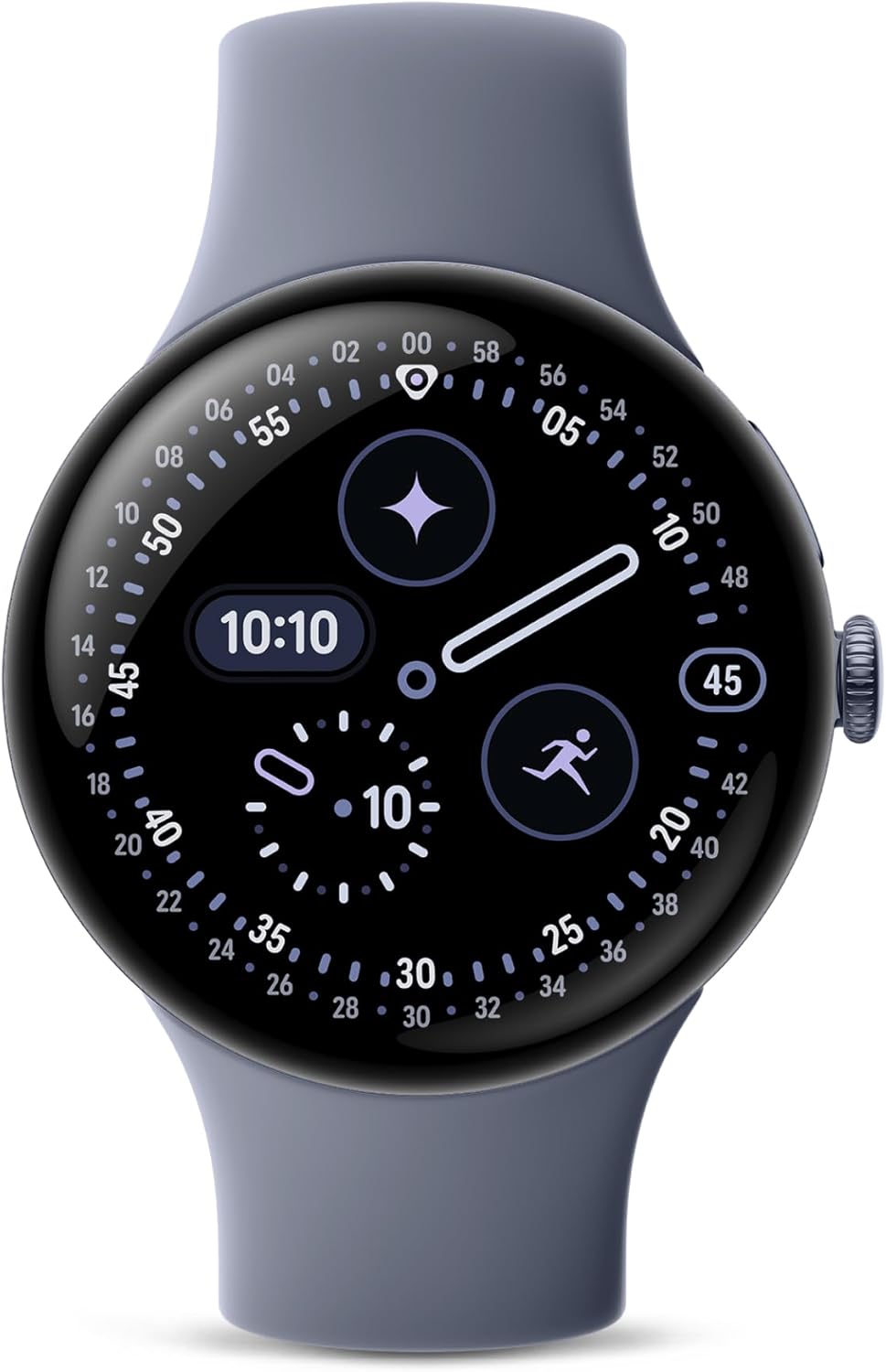
Google Pixel Watch 4 — Life-Saving Safety & AI Intelligence
$399.00 / Rs. 35,910 (Fitbit Premium Optional)
Loss of Pulse Detection + Satellite SOS · Actua 360 domed 3,000-nit screen · Dual-frequency GPS · Native Google Gemini · 15-min quick charge
Check Price →The Google Pixel Watch 4 is the culmination of Google's acquisition of the Fitbit platform and massive investments in artificial intelligence, resulting in a wearable that heavily prioritizes acute personal safety and generative AI-driven fitness coaching.
Maintaining its pebble-like aesthetic, the Pixel Watch 4 introduces an Actua 360 domed glass display with 16% smaller bezels and a 10% larger active touch area. Housed in 100% recycled aerospace-grade aluminum across 41mm and 45mm sizes, the screen hits 3,000 nits peak brightness. The watch is IP68 dust-sealed and 5ATM water-resistant.
The headline innovation is Loss of Pulse Detection. Utilizing multipath optical HR sensors, the watch identifies sustained cardiovascular pulse loss and automatically triggers emergency dispatch via LTE or Satellite Emergency SOS—transitioning the device from passive wellness logging to acute emergency intervention. Fitness telemetry is powered by Fitbit, incorporating dual-frequency GPS for urban and trail navigation, continuous skin temperature tracking, and cardio load targets.
Running Wear OS 6 with native Google Gemini integration, users raise their wrist to prompt generative AI summaries, navigation, and text responses. The 41mm model offers 30 hours of battery life, while the 45mm model reaches 40 hours (60 hours in Battery Saver mode). The new Quick Charge Dock delivers 0-50% charge in 15 minutes. Starting at $399 (Rs. 35,910), deep personalized AI routines require an optional Fitbit Premium subscription.
4. Garmin vívoactive 5 — Best Long Battery Life (11 Days)

Garmin vívoactive 5 — Uninterrupted 11-Day Health Companion
$234.99 / Rs. 21,149 (Zero Subscription)
11-day battery physics · Body Battery energy score · 1.2-inch AMOLED touchscreen · Wheelchair mode · 100% free Garmin Connect
Check Price →For users who suffer from severe "battery anxiety" and view daily charging as a dealbreaker, the Garmin vívoactive 5 positions itself as an uninterrupted wellness companion, trading heavy app ecosystems for 11 days of continuous health logging.
Moving away from transflective MIP displays, the vívoactive 5 features a crisp 1.2-inch AMOLED touchscreen (390x390 resolution) protected by Gorilla Glass 3. Offered in a 42mm fiber-reinforced polymer chassis with an anodized aluminum bezel, it weighs just 36 grams for night wearability and carries a 5ATM swim-proof rating.
Powered by Garmin's Elevate v4 optical sensor, it delivers rich physiological data. The standout metric is Body Battery, synthesizing heart rate variability (HRV), chronic stress, sleep quality, and workouts into a real-time 0-100 energy score. Additional tracking includes HRV status, sleep coaching, nap detection, SpO2, and a dedicated Wheelchair mode tracking pushes instead of steps.
Operating on Garmin's OS, it syncs with Garmin Connect across both iOS and Android. While it omits voice assistants and microphone/speakers, its battery endurance is unmatched: up to 11 days in smartwatch mode (4-5 days with AOD) and 18 hours of continuous GPS tracking. At $234.99 (Rs. 21,149), Garmin provides full analytical depth with zero subscription fees.
5. Fitbit Sense 2 — Best Continuous Stress & Mental Wellness
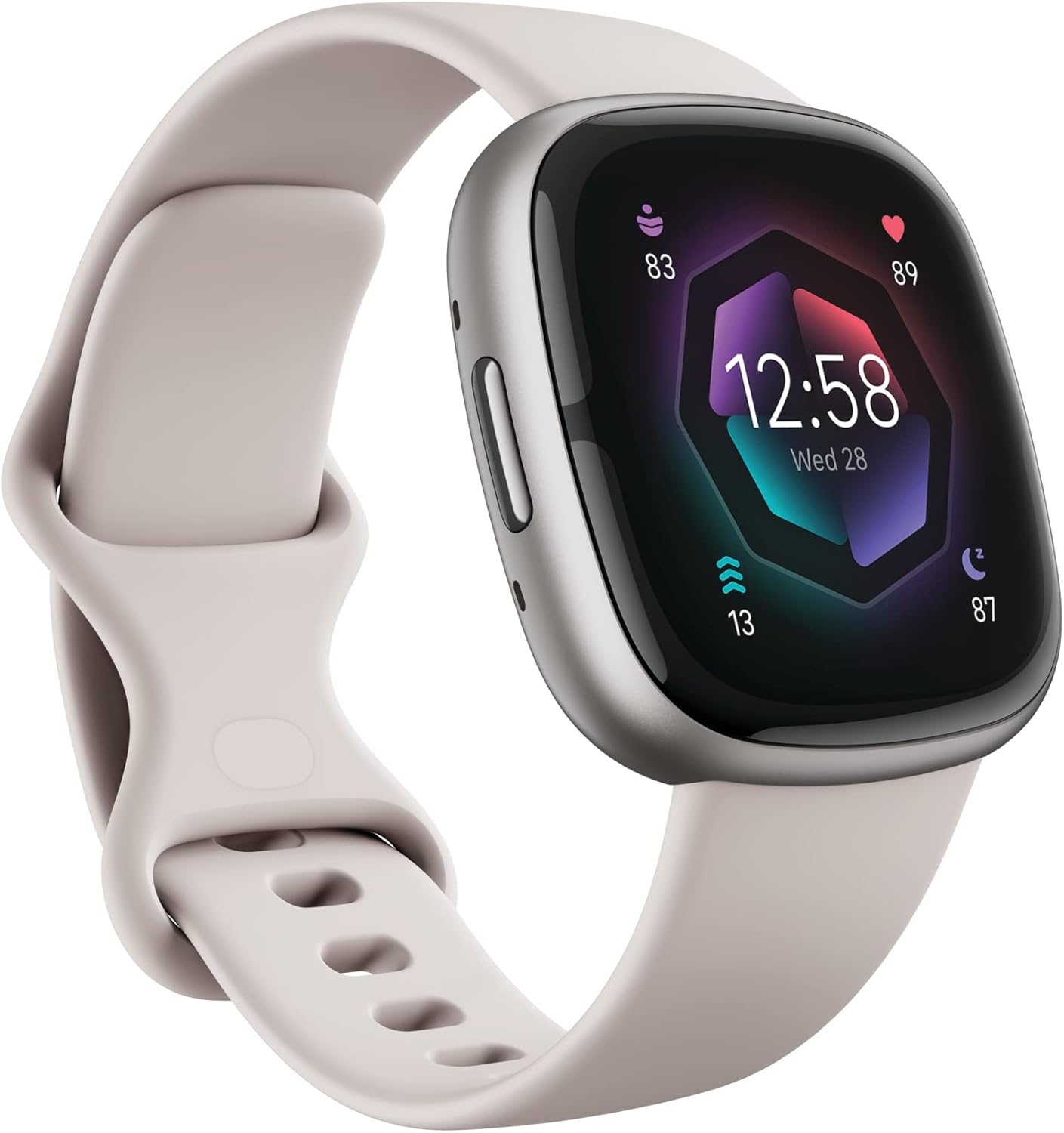
Fitbit Sense 2 — Continuous Autonomic Stress Tracker
$199.95 / Rs. 17,995 (Fitbit Premium Optional)
Continuous cEDA sweat sensor · ECG atrial fibrillation alerts · Sleep Profile animals · 6+ day battery · Lightweight aluminum body
Check Price →The Fitbit Sense 2 is a specialized health wearable designed explicitly for users prioritizing stress management, anxiety mitigation, and holistic sleep tracking over wrist-based computing.
Featuring a square 1.58-inch AMOLED display in a lightweight aluminum casing, the Sense 2 introduces a physical side button for reliable navigation during sweat-heavy workouts. It carries a 5ATM water resistance rating for swimming.
The core technological feature is the continuous electrodermal activity (cEDA) sensor. Unlike standard optical heart rate monitors, the cEDA sensor continuously measures microscopic sweat gland activity driven by sympathetic nervous system arousal. Paired with heart rate and skin temperature, it logs stress responses in real time and prompts guided breathing sessions. It also includes an ECG sensor for AFib detection, SpO2 blood oxygen monitoring, and Fitbit's Sleep Profile system classifying sleep styles into animal archetypes.
Compatible with both iOS and Android via the Fitbit app, it includes built-in Amazon Alexa and Google Maps turn-by-turn prompts. Battery life lasts up to 6+ days on a single charge with fast charging (1 day of battery in 12 minutes). At $199.95 (Rs. 17,995), it is the most affordable clinical stress tracker on the market.
6. 2026 Health Smartwatch Specification Matrix
Compare the raw specifications, display luminosity, sensor configurations, and battery endurance across all top 5 health smartwatches:
| Device | Display & Nits | Key Health Sensors | Battery Life | OS / Phone Parity | MSRP / Price |
|---|---|---|---|---|---|
| Apple Watch Series 11 | LTPO3 OLED (2,000 Nits) | ECG, FDA Hypertension, Sleep Apnea, Temp | 24h (38h Low Power) | watchOS 11 (iOS Only) | $299 / Rs. 26,910 |
| Samsung Galaxy Watch 8 | Super AMOLED (3,000 Nits) | BioActive BIA, Antioxidant Index, Vascular Load | 30h AOD (40h Normal) | Wear OS 6 (Android Only) | $237 / Rs. 21,330 |
| Google Pixel Watch 4 | Actua 360 (3,000 Nits) | Loss of Pulse + Satellite SOS, Temp, SpO2 | 30h (41mm) / 40h (45mm) | Wear OS 6 (Android Only) | $399 / Rs. 35,910 |
| Garmin vívoactive 5 | 1.2" AMOLED (390x390) | Elevate v4 HR, Body Battery, HRV, SpO2 | 11 Days (4-5d AOD) | Garmin OS (iOS & Android) | $234.99 / Rs. 21,149 |
| Fitbit Sense 2 | 1.58" AMOLED | cEDA Stress Sensor, ECG, SpO2, Temp | 6+ Days | Fitbit OS (iOS & Android) | $199.95 / Rs. 17,995 |
7. Critical Smartwatch Buying Considerations
A. Smartphone Ecosystem Parity & Walled Gardens
Before purchasing, audit your current smartphone ecosystem. The Apple Watch Series 11 is strictly locked to iOS, refusing setup with Android phones. Conversely, the Samsung Galaxy Watch 8 and Google Pixel Watch 4 run Wear OS 6 and require Android (with Samsung reserving specific ECG and sleep features for Galaxy phones). If cross-platform flexibility is mandatory, brand-agnostic devices like the Garmin vívoactive 5 and Fitbit Sense 2 sync seamlessly across both iOS and Android.
B. Battery Physics vs. Computational Feature Depth
There is an inverse relationship between smartwatch feature depth and battery life. Full smartwatches running watchOS or Wear OS with 3,000-nit displays and generative AI assistants draw significant power, requiring daily charging (24 to 40 hours). In contrast, the Garmin vívoactive 5 foregoes complex third-party app stores and cellular modems to deliver 11 days of continuous tracking, eliminating daily charging anxiety for 24/7 baseline logging.
C. Clinical-Grade Medical Features vs. General Wellness Tracking
Wellness tracking estimates steps and calories for general fitness. Clinical-grade features undergo regulatory testing (such as FDA clearances) to detect physiological anomalies with high precision. The Apple Watch Series 11 leads with FDA-cleared hypertension and sleep apnea detection, the Pixel Watch 4 features life-saving Loss of Pulse satellite alerts, and the Galaxy Watch 8 tracks skin carotenoids and vascular load.
8. Final Verdict & Scenario Recommendations
The 2026 health smartwatch market offers tailored options for specific user priorities:
- Buy the Apple Watch Series 11 if: You use an iPhone and want certified, medical-grade diagnostic safety with FDA-cleared hypertension and sleep apnea detection.
- Buy the Samsung Galaxy Watch 8 if: You are a Samsung Galaxy or Android user seeking cutting-edge biometrics like the Antioxidant Index, Vascular Load tracking, and Galaxy AI Energy Scores.
- Buy the Google Pixel Watch 4 if: You prioritize acute safety (Loss of Pulse + Satellite SOS) and want native Google Gemini AI assistance on Wear OS.
- Buy the Garmin vívoactive 5 if: You hate daily charging and want an 11-day battery life with Body Battery energy monitoring and zero subscription fees.
- Buy the Fitbit Sense 2 if: Your focus is mental stress management and continuous electrodermal (cEDA) autonomic monitoring at an affordable price.
9. Frequently Asked Questions
Sources: Official vendor specifications (Apple Inc., Samsung Electronics, Google LLC, Garmin Ltd., Fitbit Inc.), FDA Medical Device Clearances 2026, Journal of Medical Internet Research. — Himansh, TheAITechPulse
