
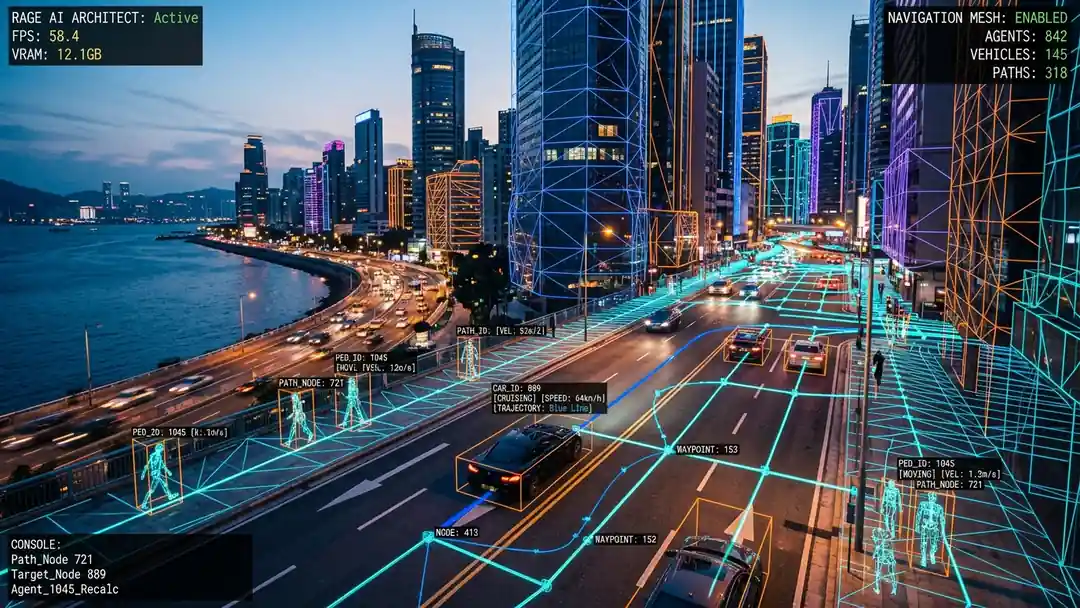
Grand Theft Auto VI uses a deterministic, data-driven artificial intelligence framework built into the proprietary RAGE 9 engine. Operating without runtime generative model hallucinations, the system links two-tier coarse navigation graphs, blackboard modular locomotion, utility witness evaluation trees, and modular law enforcement profiling tokens to simulate thousands of autonomous entities at fixed console frame rates.
While experimental sectors of interactive entertainment attempt to inject generative neural networks into live rendering loops, Take-Two Interactive and Rockstar Games have established a strict architectural division. Machine learning models run exclusively within offline development tooling. At runtime, the simulation relies on verified collision geometry, structured state graphs, and tightly coupled physical rulesets.
Quick Answer: How Does GTA 6 AI Work in the RAGE 9 Engine?
GTA 6 runs on a patented, deterministic AI architecture designed to eliminate runtime hallucination and frame pacing latency:
- Two-Tier Virtual Navigation (US Patents 11,071,916 & 11,684,855): Macro coarse graphs handle world routing while micro-node telemetry drives lane changes and vehicle speed.
- Blackboard Locomotion Synthesis (US Patent 11,620,781): Evaluates terrain slope, injury, and weapon mass to assemble atomic motion blocks dynamically.
- Sensory Witness & Police AI: NPCs report crimes through sensory raycasts and telephone queues, triggering multi-factor suspect token tracking.
- Target Console Hardware Baseline: Deterministic compute budgets on the PlayStation 5 and Xbox Series X Zen 2 CPUs stream simulation data without frame drops.
Key technical take: Rockstar Games rejected runtime generative AI in GTA 6 to eliminate non-deterministic frame times, memory stalls, and hallucinated geometry, choosing instead a deterministic blackboard architecture backed by registered Take-Two engineering patents.
- Pathfinding (US Patents 11,071,916 & 11,684,855): Two-tier hierarchical coarse-macro graphs decouple regional routing from high-density micro-node lane metadata.
- Locomotion (US Patent 11,620,781): Blackboard state evaluation stitches atomic kinematic blocks at runtime instead of blending monolithic animation clips.
- Witness & Law Enforcement: Utility AI decision trees process line-of-sight, acoustic dampening, and five suspect tokens before initiating multi-tier investigations.
- Target Console Baseline: Ninth-generation hardware like the PlayStation 5 (~$599) and Xbox Series X (~$800) provides fixed compute and high-speed NVMe streaming for seamless simulation.
- Network & Memory (US Patent 11,794,114): Dynamic session partitioning divides map regions into fluid sub-servers with runtime variable obfuscation.
- Handcrafted determinism versus generative synthesis
- Macro-navigation and predictive traffic networks
- Modular locomotion and blackboard pose synthesis
- Sensory perception and utility witness logic
- Suspect profiling and law enforcement token mechanics
- RAGE 9 runtime scaling and session infrastructure
- Frequently asked questions
Handcrafted determinism versus generative synthesis
The modern discussion surrounding game intelligence centers on the trade-off between generative synthesis and deterministic runtime simulation. Take-Two Interactive uses machine learning across roughly two hundred offline studio pipelines, including automated quality assurance, regression test automation, motion-capture hand-pose estimation, and texture cleanup. However, corporate engineering leadership has prohibited runtime generative AI from writing geometry, level geometry, or narrative dialogue.
Statistical generative tools introduce non-deterministic frame budgets, spatial hallucinations, and heavy VRAM overhead. Text-to-world diffusion models and generative neural network filters cannot guarantee collision stability or deterministic multi-agent synchronization across network clients. In contrast, Rockstar’s RAGE 9 pipeline relies on fully authored level structures, strict state machines, and verified physics engines.
| Architectural Domain | Generative AI Frameworks (Experimental) | Data-Driven RAGE 9 Runtime Engine |
|---|---|---|
| World Geometry & Topology | Prompt-driven spatial diffusion and procedural runtime reconstruction. | Authored structural layouts, manual street topologies, and verified collision meshes. |
| Animation Systems | Unconstrained neural kinematic approximations. | Data-driven atomic motion blocks assembled dynamically via blackboard criteria. |
| Spatial Navigation | Stochastic local pathing and generative agent traversal. | Hierarchical coarse-macro graphs coupled with high-density low-level node networks. |
| Dialogue & Interactions | Dynamic large language model text synthesis and unconstrained voice generation. | Context-sensitive branching dialogue trees and parametric situational triggers. |
| Compute Footprint | Variable cloud inference latency and high token processing costs. | Fixed, deterministic local compute allocations optimized for target console architectures. |
By eliminating generative instability during execution, the engine architecture guarantees that every CPU cycle assigned to artificial intelligence serves the simulation of systemic gameplay mechanics rather than unstructured asset generation.

PlayStation 5 Digital Edition (825GB) — Target Launch Architecture
~$599.00 MSRP
Deterministic console compute baseline · AMD Zen 2 8-core CPU · 10.28 TFLOPs RDNA 2 GPU · Ultra-fast custom NVMe SSD
Check Price →
Xbox Series X (1TB SSD) — Target Launch Architecture
~$800.00 MSRP
Deterministic console compute baseline · AMD Zen 2 8-core CPU · 12 TFLOPs RDNA 2 GPU · 1TB Velocity NVMe storage
Check Price →Macro-navigation and predictive traffic networks
Open-world vehicular navigation historically relied on localized node grids where non-player character (NPC) drivers made pathing decisions based strictly on immediate, single-frame queries. This older approach caused frequent traffic jams, erratic turns at highway splits, and unresolvable bottlenecks behind stationary obstacles.
Take-Two resolved these limitations through US Patents 11,071,916 and 11,684,855, titled System and Method for Virtual Navigation in a Gaming Environment, invented by Simon Parr and David Hynd. The architecture deploys a two-tier navigation hierarchy that separates high-level journey routing from low-level road telemetry.
Calculates cross-territory journeys across major highway corridors, inter-island bridges, and arterial transit links, avoiding microscopic geometry lookups across distant sectors.
Encodes localized lane boundaries, junction exit vectors, elevation deltas, turning profiles, and surface friction coefficients for immediate path segments.
Evaluates multi-frame entity vectors for advance lane changes, weather adaptations, pursuit roadblock cordons, and collision avoidance.
At the macro level, the virtual state of Leonida is abstracted into a coarse graph of transit nodes representing major geographic sectors, bridges, and highway corridors. When an autonomous vehicle plans a route across the island, it queries this abstracted network first. This optimization eliminates the performance cost of polling millions of microscopic geometry nodes across distant map sectors.
At the micro level, individual road segments carry detailed metadata: lane dimensions, elevation gradients, turning speeds, and surface friction coefficients. The vehicle controller uses multi-frame predictive trajectory modeling. Instead of reacting only to the immediate single frame, the system evaluates proximate entity movement vectors across several preceding frames. This calculation allows autonomous drivers to plan highway lane changes well in advance of exits, brake smoothly on wet asphalt, and steer around collisions without coming to an abrupt halt.
Individual non-player drivers also inherit distinct behavioral profiles. Parameters governing driver aggression, spatial caution, and vehicle handling dictate how nodes are traversed. An autonomous driver in a high-performance sports car calculates overtaking gaps aggressively, while commercial transport drivers enforce wider turning radiuses and longer braking distances. During pursuits, police cruisers use this metadata to calculate predictive interception angles, establishing roadblock perimeters ahead of the target rather than trailing directly behind.
Modular locomotion and blackboard pose synthesis
Character animation in earlier sandbox titles relied heavily on state machines with pre-baked blend trees. Blending between thousands of rigid, pre-recorded animations required massive memory allocations, created visual snapping when animations were interrupted, and struggled to align feet cleanly to uneven world geometry.
Take-Two addressed this challenge in US Patent 11,620,781, titled System and Method for Virtual Character Locomotion, authored by former Rockstar Lead AI/Gameplay Programmer Tobias Kleanthous. The patent describes a data-driven locomotion engine that decouples motion data from core logic, assembling atomic animation building blocks at runtime based on environmental and physiological state vectors.
| Locomotion Layer | Structural Mechanism | Role in Character Synthesis |
|---|---|---|
| Blackboard State Matrix | Shared runtime data structure evaluated every frame. | Ingests agent stamina, injury trauma, emotional panic, weapon weight, rain density, and terrain slope. |
| Archetype Blocks | Base skeletal and physiological constraint templates. | Defines mass distribution, joint limitations, and baseline movement capabilities (civilian pedestrian vs tactical operative). |
| Motion Type Blocks | Categorical movement profiles. | Enforces active movement styles: tactical crouching, injured limping, sprint sliding, or fatigued walking. |
| Motion Animation Blocks | Atomic kinematic units with metadata tags. | Executes granular components: individual foot plants, joint rotations, torso lean angles, and head-shielding postures. |
Ingests agent stamina, locational trauma vectors, weapon posture, panic state, rain density, and terrain slope angles per frame.
Applies skeletal mass distribution profiles and enforces contextual movement modes (such as tactical crouch, injured limp, or sprint slide).
Selects, stitches, and parametrically blends low-level atomic animation units (foot plants, torso angles, head defensive shielding).
Outputs dynamic character locomotion conforming to RAGE 9 collision physics and variable environmental cover heights.
When an agent moves across a muddy hill while injured and taking suppressive fire, the RAGE 9 engine queries the Blackboard data structure. It combines the baseline walk cadence with physical injury offsets, foot-planting adjustments for the slope angle, and defensive torso tilts. This modular approach applies to both main protagonists and ambient civilians, allowing characters to adjust their crouch height to match variable cover objects and shield their faces from rain.
Sensory perception and utility witness logic
Earlier open-world titles frequently suffered from instant police alerts. When a player committed a crime in an isolated alley, the global game engine would immediately trigger a wanted level, spawning patrol cars nearby even if no witness was present.
In GTA 6, crimes do not alter global law enforcement state directly. An illicit act must first pass an empirical perception pipeline evaluated through line-of-sight checks, ambient lighting, obstruction masks, and acoustic dissipation.
Crime or firearm discharge occurs within the simulated environment without direct global wanted dispatch.
Physical tripwires, silent bank alarms, and municipal CCTV security camera vision cones.
Line-of-sight raycasts, ambient lighting, obstruction clearance, and suppressor acoustic dissipation.
Witnesses calculate personal survival, civic duty, and proximity to cover: triggering emergency calls, phone recordings, crowd panic cascades, or armed defense.
Witness reports transmit specific profile tokens: facial silhouette, wardrobe colors, CCTV imagery, vehicle plates, and companion status.
Officers initiate a Hollow Star crime scene cordon and bystander questioning or escalate to an active confirmed pursuit if tokens match.
Entities that witness an event evaluate their response using a Utility AI matrix. The algorithm calculates civic duty parameters, survival instincts, personal bravery scores, and proximity to physical cover. This evaluation generates four distinct ambient behaviors:
- Emergency Dispatch Calls: Non-player characters retreat behind cover, take out mobile phones, and place emergency calls, passing specific descriptive data packets to the police network.
- Smartphone Video Recording: Civilians document incidents with their phones. This footage feeds into the city's virtual police identification network.
- Crowd Panic Propagation: Fleeing pedestrians trigger panic checks in nearby crowds through directional panic contagion, causing people around the corner to run without having seen the crime directly.
- Armed Defensive Engagement: Specific demographics, including licensed concealed carriers, armed store clerks, and rival syndicate members, bypass flight routines entirely to engage the shooter.
Suspect profiling and law enforcement token mechanics
When an emergency call reaches dispatch, the police AI generates a modular suspect profile. Law enforcement units do not hunt the player entity ID; they hunt the specific combination of descriptive tokens reported by witnesses.
| Tracking Token | HUD Indicator | Police AI Tracking Logic | Player Countermeasure |
|---|---|---|---|
| Physical Appearance | Silhouette Icon | Officers search for facial geometry, facial hair, and hair color. | Equipping full masks, bandanas, glasses, or modifying hair at a stylist. |
| Wardrobe Profile | Clothes Hanger Icon | Patrol units look for the specific style, color, and pattern of current clothing. | Purchasing new clothes or changing into spare outfits stored in vehicle trunks. |
| Surveillance Imagery | Camera Icon | Automated identification logged by municipal CCTV security cameras. | Shooting camera lenses, severing local power boxes, or avoiding optical cones. |
| Vehicular Signature | Vehicle Tag Index | Officers scan traffic for exact make, model, license plate, and color finish. | Abandoning the vehicle out of sight, stealing an untracked car, or respraying. |
| Partnership Profile | Dual-Agent Tag | Dispatch notes that Jason and Lucia are operating as a pair, tightening perimeters. | Directing the companion protagonist to split up, breaking the dual-profile match. |
The wanted system uses a six-star hierarchy with distinct investigatory stages. When police units arrive at a crime scene triggered by an automated silent alarm or unverified gunshot sound, the system enters a Hollow Star state. During this phase, officers secure perimeters, sweep alleys, and question witnesses. They do not draw weapons or open fire unless the player matches active tokens, carries visible weapons, or acts aggressively.
Wanted states also feature regional persistence across municipal counties. Committing serious felonies creates localized hot zones. While driving across county borders suspends active pursuit, local precinct databases retain active warrants. Returning to that county before the heat decays increases patrol density and raises the likelihood of roadside recognition.
RAGE 9 runtime scaling and session infrastructure
Running these interconnected AI systems across expansive urban and wilderness biomes requires strict compute budgeting within the RAGE 9 engine pipeline. The engine balances CPU loads through dynamic Level of Detail (LOD) simulation.
Entities within the player's immediate view frustum execute full modular locomotion blend graphs, high-frequency raycasted vision checks, and complete utility matrices. As agents move into the mid-field and background distances, their simulation steps down to coarse-graph routing and basic archetype loops, preserving consistent frame pacing in dense urban corridors.
Near-field agents run full modular locomotion blend graphs and raycasted sensory checks; far-field entities step down to coarse-graph pathing to maintain console frame pacing.
Pedestrians dynamically route to shelter under awnings during tropical storms; vehicles scale tire traction for hydroplaning risks.
Apex predators evaluate water displacement, foliage obstruction, and prey distance in wetland biomes.
US Patent 11,794,114 partitions map regions into fluid sub-servers with runtime variable obfuscation preventing latency spikes and tampering.
Crowd density interacts directly with environmental simulation. During tropical storms, pedestrian state machines instruct agents to clear open sidewalks and gather under awnings, while vehicle physics scale friction coefficients to simulate hydroplaning risks. In wetland and wilderness biomes, apex predators such as alligators operate on sensory trees evaluating water displacement, foliage obstruction, and prey distance, interacting naturally with wildlife and stray civilians.
To support high entity counts and world persistence in multiplayer environments, Take-Two deployed its patented session management framework under US Patents 11,794,114 and 11,192,032 (System and Method for Session Management in a Multiplayer Network Gaming Environment), developed by Philip Degarmo and Robert Schmitz. The architecture partitions the map into load-balanced sub-zones, allowing network sessions to split and merge without loading screens. Dedicated sub-servers process local inventory states, transactions, and ambient pathfinding, preventing server-wide latency spikes. Key simulation variables are encrypted and relocated in memory at runtime to prevent injection tampering.
Frequently asked questions
Sources: Take-Two Interactive US Patent Filings (US11071916B2, US11684855B2, US11620781B2, US11794114B2), Rockstar Games Technology Disclosures, RAGE Engine Technical Analysis (2026). — Himansh, TheAITechPulse
