
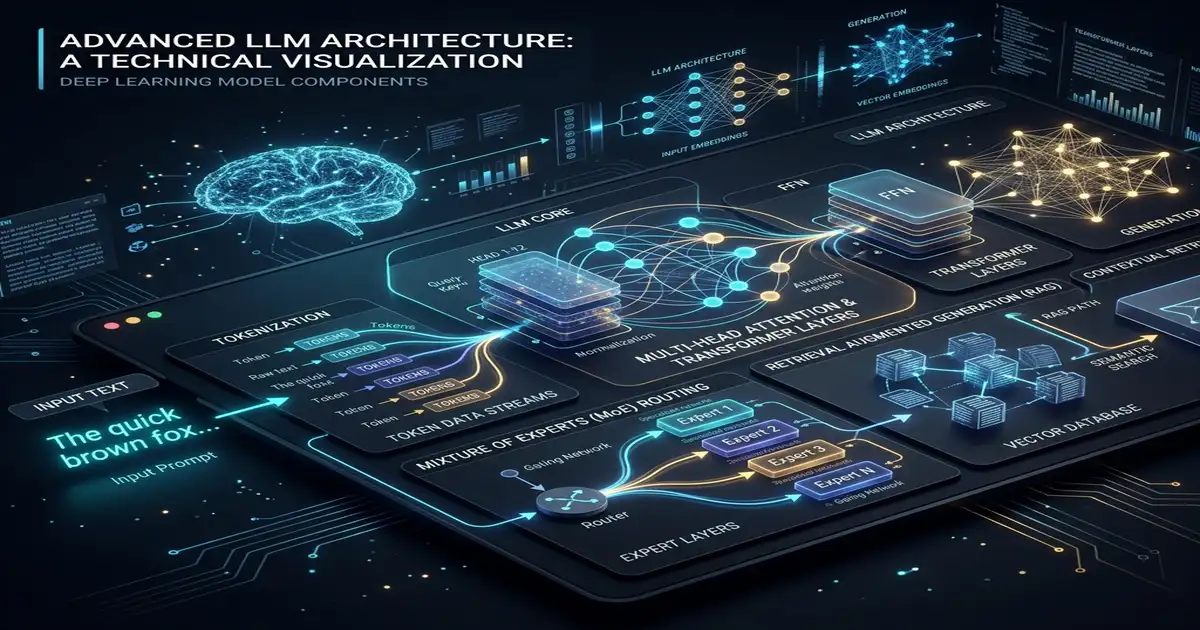
Mastering artificial intelligence in 2026 requires understanding both foundational concepts—such as subword tokenization, context windows, and parameter memory footprints—and advanced architectures like Retrieval-Augmented Generation (RAG), Mixture of Experts (MoE), test-time compute scaling, and INT4 quantization. This primer bridges beginner intuition with production engineering.
As artificial intelligence rapidly transitions from novel chat applications to mission-critical backend software, developers, data scientists, and systems engineers must possess a deep, structural understanding of Large Language Models (LLMs). Building resilient AI applications demands knowing how models process text at the hardware layer, how memory constraints dictate server VRAM overhead, and how architectural innovations reduce latency and hosting costs.
This guide is structured into three progressive parts: Part 1 establishes zero-jargon mental models for core concepts; Part 2 explores practical intermediate workflows like JSON mode and function calling; and Part 3 demystifies frontier techniques including MoE, test-time reasoning compute, RAG, and model quantization.
Core Takeaway: Modern AI engineering is about matching workload complexity to model mechanics. Simple classification tasks belong on small, high-throughput models (e.g. Gemini 2.0 Flash or quantized Llama 8B), while multi-hop logic and repo refactoring demand reasoning compute (o3-mini / DeepSeek R1) or agentic hybrid models (Claude 3.7 Sonnet).
Quick Reference: 3 Pillars of AI Model Efficiency
If you are building or deploying LLMs in 2026, keep these three golden rules in mind:
- Memory Calculation: In FP16 precision, every 1 billion parameters require 2 GB of GPU VRAM for model weights alone.
- Token Economics: English text averages roughly 1.5 tokens per word (or ~750 words per 1,000 tokens).
- 4-Bit Quantization: INT4 quantization reduces GPU memory footprints by 75% while retaining ~98–99% of raw FP16 intelligence.
- Tokens: The fundamental currency of LLMs. Text is chopped into subword token IDs processed as integer matrices.
- Context Window: The model's active short-term working memory. Information outside this window is completely invisible to the AI.
- Parameters: The learned numerical weights (synapses). More parameters mean richer knowledge, but higher VRAM requirements.
- Function Calling: Turns passive LLMs into active agents by outputting structured JSON to trigger external code and APIs.
- RAG (Retrieval-Augmented Generation): An "open-book exam" framework combining vector database retrieval with generative LLMs to eliminate hallucinations.
- MoE (Mixture of Experts): Routes inputs to specialized sub-networks, achieving massive parametric breadth with low active compute costs per token.
Data sources: IBM Research, OpenAI Developer Docs, Anthropic Technical Papers, DeepSeek R1 Architecture Reports, and Stanford HAI AI Index 2026.
- Part 1: The Beginner's Blueprint (Zero-Jargon Fundamentals)
- 1.1 Tokens & Tokenization
- 1.2 The Context Window (Working Memory)
- 1.3 Parameters (Learned Knowledge & VRAM Overhead)
- 1.4 Prompt Roles: System, User, Assistant
- 1.5 Generation Controls: Temperature & Top-P
- Part 2: Practical Intermediate Concepts (Working with LLMs)
- 2.1 Structured Outputs & JSON Mode
- 2.2 Tool Use & Function Calling (Connecting to APIs)
- 2.3 System Prompts & Safety Guardrails
- Part 3: Introduction to Advanced Concepts (Demystifying the Tech)
- 3.1 Reasoning Models vs. Standard LLMs (Test-Time Compute)
- 3.2 Mixture of Experts (MoE Architecture)
- 3.3 Context Retrieval & RAG (Retrieval-Augmented Generation)
- 3.4 Quantization & Model Size (FP16 → INT8 → INT4)
- 3.5 Model Selection Strategy & Matrix
- 4. Common Deployment Pitfalls & Solutions
- 5. Architectural Summary for Engineering Teams
- Frequently Asked Questions
Part 1: The Beginner's Blueprint (Zero-Jargon Fundamentals)
Understanding modern artificial intelligence starts with discarding abstract sci-fi concepts and focusing on the underlying mechanics of text processing, working memory, parameter weights, and probability sampling.
1.1 Tokens & Tokenization
Imagine reading a book: humans read words and letters, but AI models process language as tokens—chunks of text that might represent whole common words or fragments of rarer words. A token is the smallest computational unit an LLM "sees" when processing natural language.
Common English words (like "the", "cat", or "run") are encoded as a single token ID. Unfamiliar, complex, or long words (such as "unbelievable" or "hyperparameter") are split by tokenization algorithms—primarily Byte Pair Encoding (BPE)—into subword pieces (e.g. "un", "believ", "able").
1.2 The Context Window (Working Memory)
Think of an LLM's context window as its short-term working memory or active scratchpad. This window holds the recent prompt, conversation history, and context documents that the model is processing during a single forward pass.
If a piece of information is not present within the context window, the model cannot reason over it during that request. When a conversation exceeds the maximum context length (e.g., 32,000 or 200,000 tokens), earlier messages must be truncated or summarized. This boundary explains why long conversational sessions can cause an AI assistant to "forget" instructions given at the start of the chat.
1.3 Parameters (Learned Knowledge & VRAM Overhead)
Parameters are the learned numerical weights (the "knobs and dials") within a neural network. You can visualize parameters like brain synapses: each parameter connects artificial neurons, carrying a learned numerical strength of association derived from pre-training on massive datasets.
A model with 7 billion parameters (7B) contains 7 billion individual numerical weights. Larger models (e.g. 70B or 671B parameters) possess richer parametric knowledge and capacity for nuanced reasoning, but require significantly more computing hardware.
Memory Calculation for GPU Hosting
Parameter count directly dictates the GPU High-Bandwidth Memory (HBM/VRAM) required to serve a model:
- FP16 Precision (16-bit float): Uses 2 bytes of VRAM per parameter. A 7B parameter model requires
7B × 2 bytes = 14 GBof VRAM just to load model weights. - INT8 Precision (8-bit integer): Uses 1 byte per parameter (
7B = 7 GB VRAM). - INT4 Precision (4-bit integer): Uses 0.5 bytes per parameter (
7B = 3.5 GB VRAM).
1.4 Prompt Roles: System, User, Assistant
Modern ChatML and API schemas structure input payloads into distinct roles. An intuitive mental model is a movie production:
- System Prompt (The Director): Overarching instructions defining the AI's persona, operational rules, constraints, and output formatting.
- User Prompt (The Scriptwriter): The immediate question, prompt, or task submitted by the end user.
- Assistant Prompt (The Actor): The previous outputs generated by the AI, maintaining state in multi-turn conversations.
1.5 Generation Controls: Temperature & Top-P
Text generation in autoregressive LLMs is probabilistic. Developers control randomness using sampling dials:
- Temperature (Creativity Dial): Controls the entropy of the probability distribution over output logits. At
Temperature = 0.0, the model executes greedy decoding (always selecting the single most probable token)—ideal for deterministic code, math, and SQL output. Higher values (e.g.0.8or1.0) flatten the distribution, encouraging creative word choices. - Top-P (Nucleus Sampling): Sets a cumulative probability cutoff (e.g.,
P = 0.90). The engine sorts tokens by probability and samples strictly from the top subset whose cumulative sum reaches 90%, discarding unpredictable long-tail tokens.
Part 2: Practical Intermediate Concepts (Working with LLMs)
Transitioning from basic prompting to building applications requires integrating LLMs with structured software systems.
2.1 Structured Outputs & JSON Mode
When integrating LLMs into web applications or microservices, raw natural language output is a liability. Developers require predictable data formats (such as rigid JSON payloads) to parse responses programmatically into application code.
Structured Outputs guarantee type safety by applying context-free grammar masks (constrained decoding) at the inference engine level. If a schema specifies {"status": "success", "count": int}, the engine sets the logits of all invalid non-conforming tokens to negative infinity, guaranteeing 100% syntactically valid JSON output and eliminating parsing exceptions.
2.2 Tool Use & Function Calling (Connecting to APIs)
Function calling transforms a static language model into an interactive agent. In this workflow, developers supply the LLM with JSON definitions of external tools (e.g., database lookup APIs, weather services, or python code interpreters).
When presented with a query requiring live data, the model does not attempt to answer directly; instead, it generates a structured function call payload:
{"function": "get_weather", "arguments": {"city": "London"}}
The developer's host backend intercepts this JSON, executes the actual external API call, retrieves live data, and appends the result back into the LLM context. The model then synthesizes the final answer grounded in real-time facts.
2.3 System Prompts & Safety Guardrails
System prompts act as persistent framing instructions across chat sessions. Beyond defining persona, system prompts enforce safety guardrails—explicitly instructing the model to refuse forbidden queries, redact personally identifiable information (PII), or follow strict domain boundaries.
Part 3: Introduction to Advanced Concepts (Demystifying the Tech)
Frontier AI engineering in 2026 centers on test-time compute scaling, structural network routing, external knowledge retrieval, and model quantization.
3.1 Reasoning Models vs. Standard LLMs (Test-Time Compute)
Standard LLMs perform zero-shot autocomplete: they generate responses rapidly in a single continuous forward pass. Reasoning models (such as OpenAI o3-mini and DeepSeek R1) utilize reinforcement learning (RL) to allocate "test-time compute."
Instead of responding immediately, reasoning models generate hidden Chain-of-Thought (CoT) traces in latent space—exploring multiple problem branches, testing mathematical assertions, and self-correcting logic before outputting text.
3.2 Mixture of Experts (MoE Architecture)
Dense neural networks activate 100% of their parameter weights for every token generated. Mixture of Experts (MoE) architectures segment feed-forward layers into multiple specialized sub-networks ("experts").
Hospital Analogy: Imagine a medical center staffed by 64 specialists. When a patient arrives with an orthopedic issue, only the orthopedic team is dispatched, while cardiologists remain idle. Similarly, an MoE model like DeepSeek V3 contains 671 billion total parameters, but a gating router dynamically activates only 37 billion active parameters per token. This decoupling provides immense parametric knowledge while keeping inference FLOPs and server costs low.
3.3 Context Retrieval & RAG (Retrieval-Augmented Generation)
Retrieval-Augmented Generation (RAG) transforms an LLM from a closed-book memorization engine into an open-book exam student.
In a RAG pipeline, a user query first triggers a vector database search over private company documents or live knowledge bases. The most semantically relevant text chunks are extracted and automatically injected into the LLM context window. The model then synthesizes its answer grounded directly in those verified source documents, eliminating hallucinations and ensuring factual provenance.
3.4 Quantization & Model Size (FP16 → INT8 → INT4)
Quantization is the process of compressing neural network parameter weights by reducing their numeric bit precision:
| Precision Format | Bits per Weight | VRAM Footprint (70B Model) | Quality Retention | Primary Use Case |
|---|---|---|---|---|
| FP16 (Half-Float) | 16-bit (2 bytes) | ~140 GB VRAM | 100% (Baseline) | Model training & master weights. |
| INT8 (8-bit Integer) | 8-bit (1 byte) | ~70 GB VRAM | ~99.5% | High-fidelity enterprise cloud hosting. |
| INT4 (4-bit Integer) | 4-bit (0.5 bytes) | ~35 GB VRAM | ~98–99% | Local GPU hosting & edge deployments. |
Modern quantization techniques (such as AWQ and GPTQ with per-group scaling) allow a 70B parameter model compressed to INT4 to fit inside a single 40 GB GPU while maintaining virtually identical reasoning quality to unquantized FP16 weights.
3.5 Model Selection Strategy & Matrix
No single LLM excels across all operational dimensions. Software architects must select models using a multi-factor matrix balancing task complexity, privacy constraints, latency, and cost:
- Frontier Reasoning & Complex Math: OpenAI o3-mini, DeepSeek R1 (High test-time compute).
- Agentic Coding & Repo Refactoring: Claude 3.7 Sonnet (Extended Thinking + CLI tooling).
- High-Throughput Log / Telemetry Ingestion: Gemini 2.0 Flash (1M–2M context, $0.10/1M input).
- On-Premise & Privacy-Strict Hosting: DeepSeek V3 or Llama 3.3 70B (Quantized INT4 via vLLM / TensorRT-LLM).
4. Common Deployment Pitfalls & Solutions
Cause: Asking pure generative LLMs to perform complex arithmetic in natural language text.
Solution: Enable Function Calling / Python Code Interpreter tools so the AI writes and executes pandas/numpy code rather than predicting math tokens.
Cause: Unconstrained KV cache expansion during long context sessions.
Solution: Implement strict context truncation sliding windows, prompt caching, or deploy models utilizing Multi-Head Latent Attention (MLA).
5. Architectural Summary for Engineering Teams
The 2026 AI ecosystem rewards engineering teams that understand the underlying physics of LLMs. By combining clear mental models of tokens, context memory, and parameter VRAM overhead with advanced architectures like MoE, RAG, and INT4 quantization, developers can build fast, cost-efficient, and highly accurate AI infrastructure.
Frequently Asked Questions
Sources & Citations: IBM ThinkPad Research Papers, OpenAI Developer Documentation & Structured Outputs Guide, Anthropic Claude Technical Specifications, DeepSeek R1/V3 Architecture Papers, SitePoint LLM Quantization Benchmarks, Stanford HAI AI Index Report 2026. — Himansh, TheAITechPulse
